

20 reales – Spain
Add to wishlist
Spain
Context
Years: 1856–1864
Issuer: Spain
Ruler: Isabella II
Currency:
(1848—1873)
Demonetized: Yes
Total mintage: 11,423,000
Material
References
KM: #
Numista: #19074
Value
Bullion value: $58.74
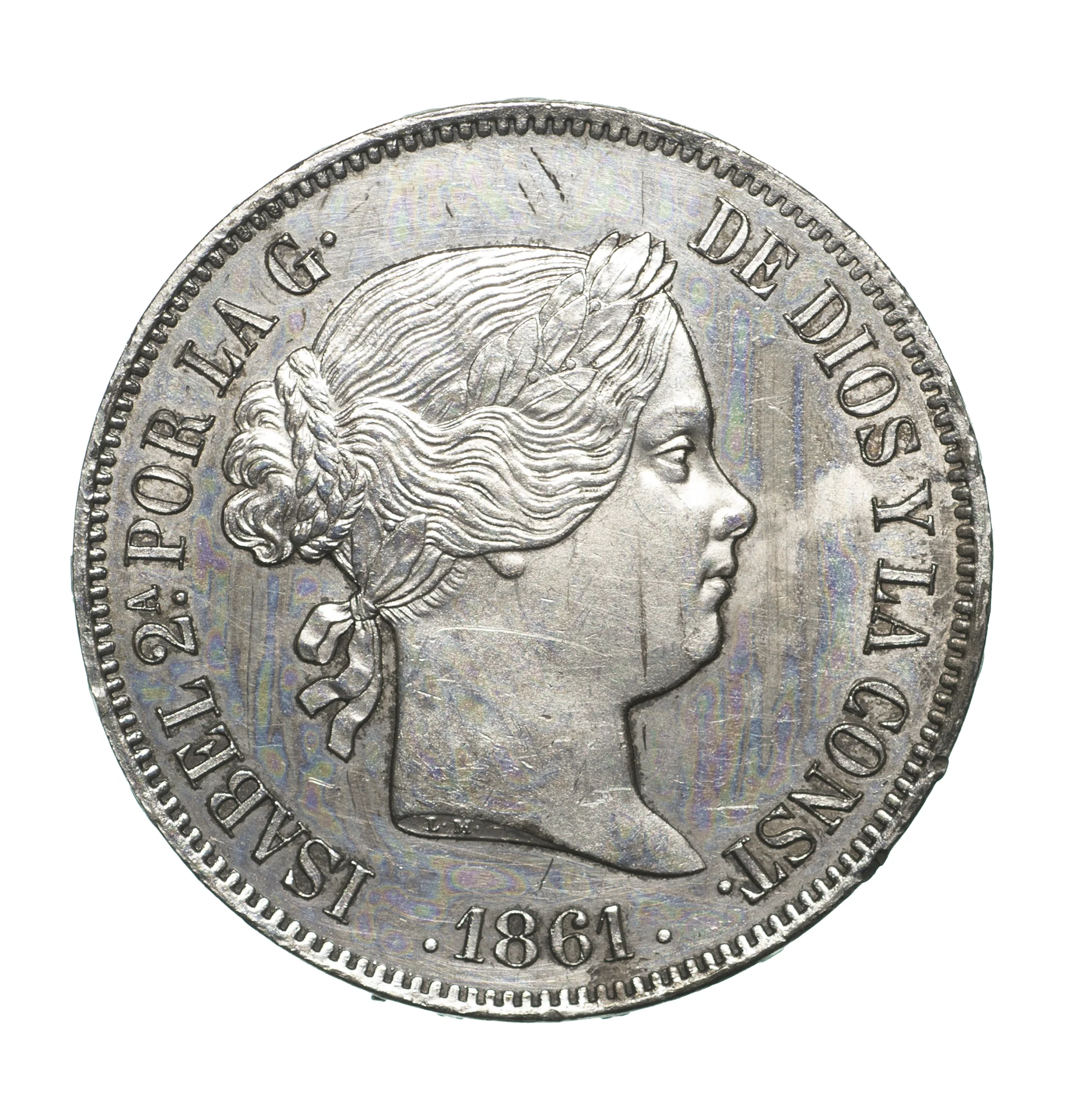
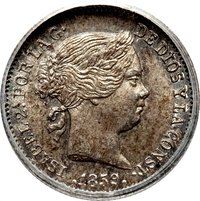
Obverse
Description:
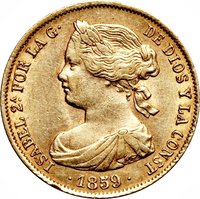
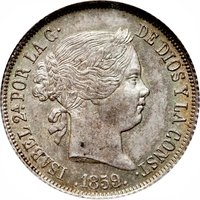
Queen Isabella II facing right.
Inscription:
ISABEL 2A POR LA G· DE DIOS Y LA CONST·
.1856.
.1856.
Translation:
ISABEL 2ND BY THE GRACE OF GOD AND THE CONSTITUTION
.1856.
.1856.
Script: Latin
Language: Spanish
Engraver: Luis Marchionni y Hombrón
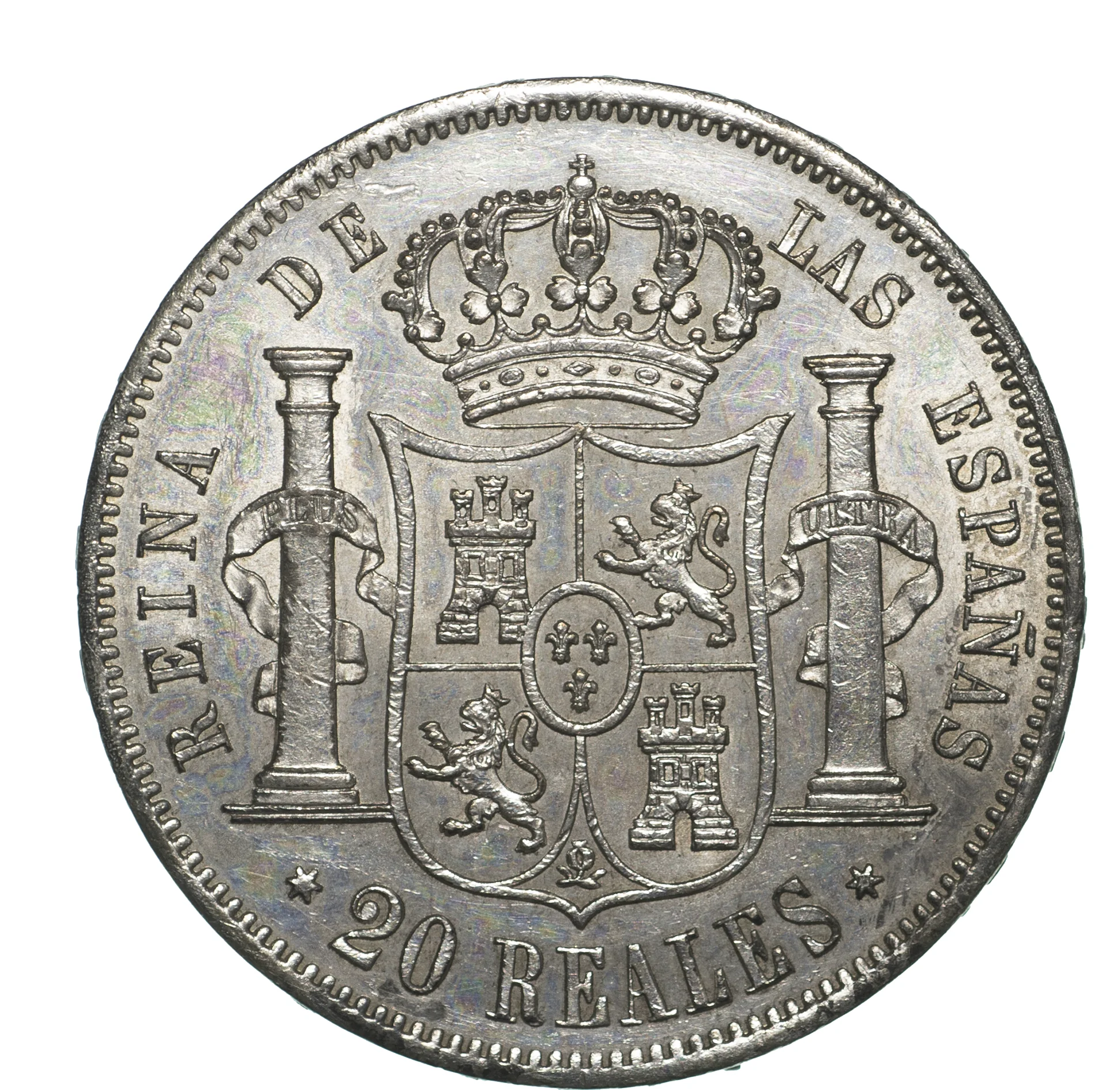
Reverse
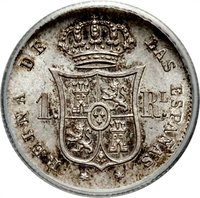
Description:
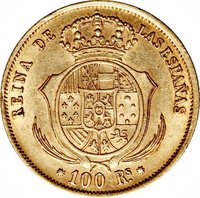
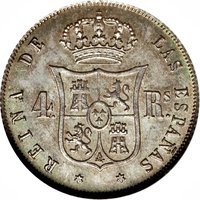
Spanish coat of arms with the Pillars of Hercules.
Inscription:
REINA DE LA ESPAÑAS
PLUS ULTRA
* 20 REALES *
PLUS ULTRA
* 20 REALES *
Translation:
Queen of the Spains
Further Beyond
* 20 Reales *
Further Beyond
* 20 Reales *
Script: Latin
Engraver: Luis Marchionni y Hombrón
Edge
Categories
| Mythology |
| Symbols> Coat of Arms |
Mints
| Name | Mark |
|---|---|
| Barcelona Mint / La Seca | — |
| Royal Mint of Madrid | — |
| Royal Mint of Seville | — |
Mintings
| Year | Mint Mark | Mintage | Quality | Collection |
|---|---|---|---|---|
| 1856 | — | 1,021,000 | ||
| 1857 | — | 713,000 | ||
| 1858 | — | 1,626,000 | ||
| 1859 | — | 880,000 | ||
| 1860 | — | 941,000 | ||
| 1861 | — | 1,352,000 | ||
| 1862 | — | 1,594,000 | ||
| 1863 | — | 520,000 | ||
| 1864 | — | 2,776,000 |
Historical background
In 1856, Spain’s currency system was in a state of profound transition and instability, caught between the old colonial-era bimetallic standard and the pressures of modernizing its financial infrastructure. The legal framework was the 1848 Monetary Law, which established a bimetallic system based on the silver real and the gold escudo, with an official fixed ratio between the two metals. However, like many bimetallic systems of the era, it was vulnerable to the global market value of precious metals; the discovery of gold in California and Australia in the late 1840s had devalued gold relative to silver, leading to the hoarding and export of undervalued silver coinage. This created a chronic shortage of circulating specie, particularly small change, hampering everyday commerce and causing public frustration.
The immediate financial context of 1856 was one of crisis and reform. The year fell within the turbulent Bienio Progresista (1854-1856), a period of liberal government that sought major economic modernization. A key development was the founding of the Bank of Spain (Banco de España) in 1856 through the fusion of the Bank of San Fernando and the Bank of Isabella II, intended to create a stronger, unified bank of issue to stabilize the currency. Furthermore, the government passed the General Credit Companies Law (Ley de Sociedades de Crédito) in 1856, aiming to stimulate investment and create mortgage banks. Despite these legislative efforts, the state's finances were deeply strained by deficit spending and political instability, which undermined confidence in the paper banknotes issued by the new central bank.
Consequently, the everyday monetary experience for Spaniards was one of complexity and uncertainty. The circulation consisted of a confusing mix of full-bodied silver and gold coins, worn and clipped older coins, and private banknotes of questionable credibility outside major cities. The scarcity of fractional coinage was a persistent problem. While the reforms of 1856 laid crucial institutional foundations for a future national currency, the immediate situation was far from resolved. True stability would only begin to materialize with the later adoption of the peseta as the sole monetary unit in 1868, moving Spain definitively toward the gold standard and a more unified national currency system.
The immediate financial context of 1856 was one of crisis and reform. The year fell within the turbulent Bienio Progresista (1854-1856), a period of liberal government that sought major economic modernization. A key development was the founding of the Bank of Spain (Banco de España) in 1856 through the fusion of the Bank of San Fernando and the Bank of Isabella II, intended to create a stronger, unified bank of issue to stabilize the currency. Furthermore, the government passed the General Credit Companies Law (Ley de Sociedades de Crédito) in 1856, aiming to stimulate investment and create mortgage banks. Despite these legislative efforts, the state's finances were deeply strained by deficit spending and political instability, which undermined confidence in the paper banknotes issued by the new central bank.
Consequently, the everyday monetary experience for Spaniards was one of complexity and uncertainty. The circulation consisted of a confusing mix of full-bodied silver and gold coins, worn and clipped older coins, and private banknotes of questionable credibility outside major cities. The scarcity of fractional coinage was a persistent problem. While the reforms of 1856 laid crucial institutional foundations for a future national currency, the immediate situation was far from resolved. True stability would only begin to materialize with the later adoption of the peseta as the sole monetary unit in 1868, moving Spain definitively toward the gold standard and a more unified national currency system.
🌟 Uncommon