

5 Dīnār – Iran
Iran
Context
Material
Diameter: 16 mm
Weight: 1.6 g
Shape: Round
Composition: Aluminium bronze
Magnetic: No
Technique: Milled
Alignment: Coin alignment
flip
References
KM: #Click to copy to clipboard1138
Numista: #19034
Value
Exchange value: 0.05 IRR
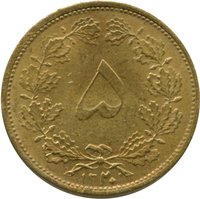
Obverse
Description:
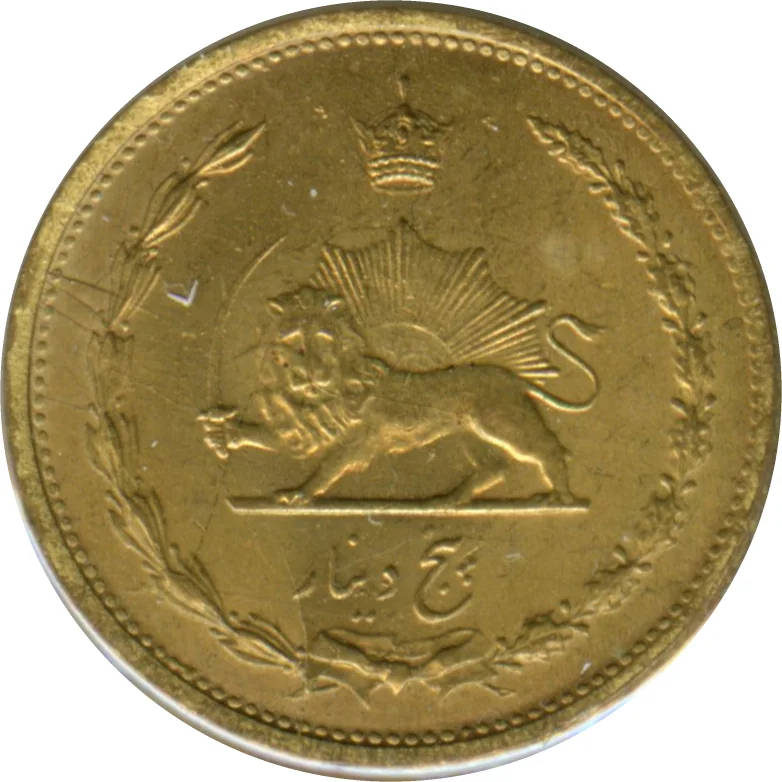
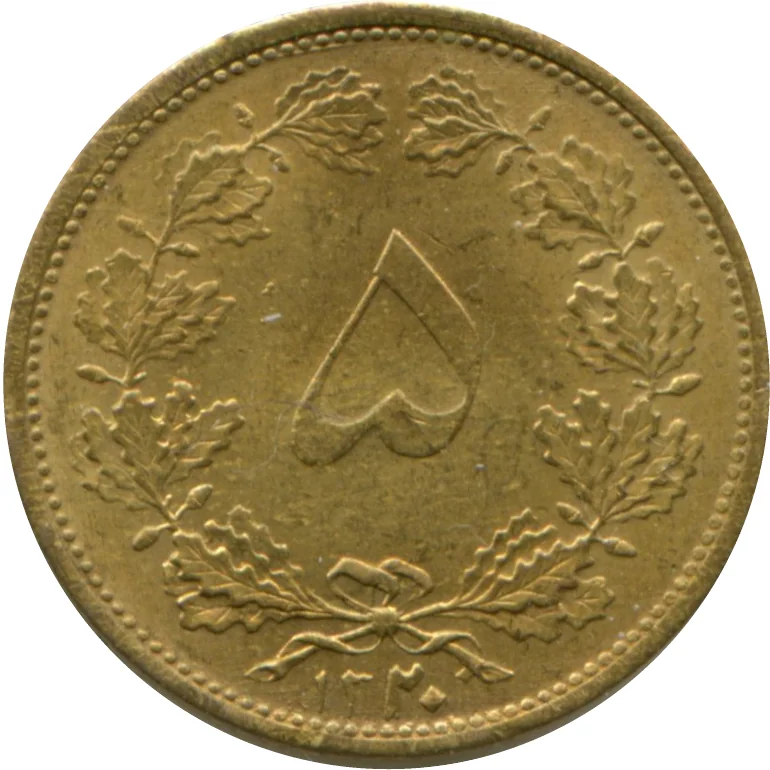
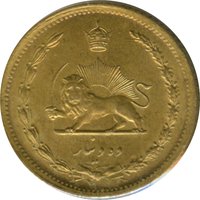
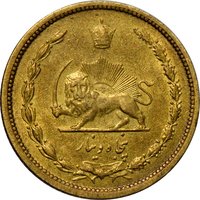
Iran's Coat of Arms: A crowned lion with a sword before a sun, all encircled by a wreath.
Script: Arabic
Reverse
Edge
Milled
Mintings
| Year | Mint Mark | Mintage | Quality | Collection |
|---|---|---|---|---|
| 1936 | — | 5,665,000 | ||
| 1937 | — | — | ||
| 1938 | — | 13,025,000 | ||
| 1939 | — | — | ||
| 1940 | — | — | ||
| 1941 | — | — | ||
| 1942 | — | — |
Historical background
In 1936, Iran’s currency situation was defined by the dominance of the rial, which had officially replaced the qiran as the country's basic monetary unit in 1932. This change was part of a broader, state-driven modernization program under Reza Shah Pahlavi, aimed at centralizing economic authority and reducing foreign influence. The banking system was entirely controlled by the state-owned Bank Melli Iran (founded in 1928), which held the exclusive right to issue banknotes. This ended the previous era of decentralized and often unstable currency issuance by various private banks and even foreign entities, bringing a much-needed uniformity to the nation's money.
Economically, the currency was nominally on a silver standard, though its practical link to bullion was weakening. The government maintained strict exchange controls, and the rial's value was managed rather than being freely convertible. This period saw relative stability in the 1930s, partly due to rising state revenues from oil concessions (with the Anglo-Iranian Oil Company) and a general increase in centralized tax collection. This fiscal strength allowed the government to avoid the hyperinflation seen in some neighboring regions, funding ambitious infrastructure and industrial projects without resorting to excessive money printing.
However, the system was not without underlying pressures. Iran's economy remained largely agrarian and dependent on single-commodity exports (like carpets and agricultural products), making it vulnerable to global price shifts. Furthermore, the currency regime was an instrument of nationalist policy, deliberately insulating Iran from the worst of the Great Depression but also limiting international financial integration. By 1936, the foundations for a modern, centralized monetary system were firmly established, setting a precedent for state management that would characterize Iran's financial landscape for decades to come.
Economically, the currency was nominally on a silver standard, though its practical link to bullion was weakening. The government maintained strict exchange controls, and the rial's value was managed rather than being freely convertible. This period saw relative stability in the 1930s, partly due to rising state revenues from oil concessions (with the Anglo-Iranian Oil Company) and a general increase in centralized tax collection. This fiscal strength allowed the government to avoid the hyperinflation seen in some neighboring regions, funding ambitious infrastructure and industrial projects without resorting to excessive money printing.
However, the system was not without underlying pressures. Iran's economy remained largely agrarian and dependent on single-commodity exports (like carpets and agricultural products), making it vulnerable to global price shifts. Furthermore, the currency regime was an instrument of nationalist policy, deliberately insulating Iran from the worst of the Great Depression but also limiting international financial integration. By 1936, the foundations for a modern, centralized monetary system were firmly established, setting a precedent for state management that would characterize Iran's financial landscape for decades to come.
Series: 1936 Iran circulation coins
🌱 Fairly Common