

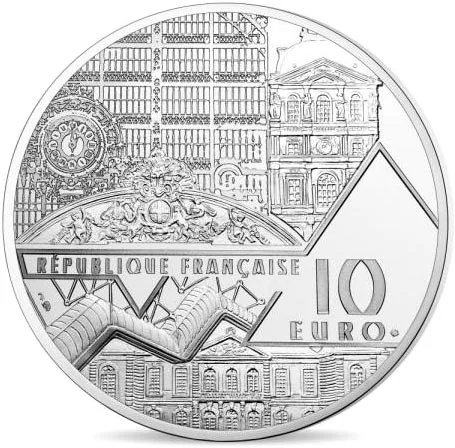



Obverse
Description:
The obverse combines views of major French museums: the Musée d'Orsay's clock, the Louvre's façade, the Picasso Museum (Hôtel Salé), the Musée Rodin (Hôtel Biron), and the Centre Pompidou's staircase. It also includes the face value and "République Française."
Inscription:
RÉPUBLIQUE FRANÇAISE
10
EURO
10
EURO
Translation:
FRENCH REPUBLIC
10
EURO
10
EURO
Language: French
Reverse
Description:
Le Revers presents Renoir's 1876 masterpiece, *Bal du moulin de la Galette*, featuring the artist's friends at a Montmartre dance hall. Housed at the Musée d'Orsay, this edition includes the series stamp with the title and the vintage.
Inscription:
LE BAL DU MOULIN DE LA GALETTE
P. A. RENOIR
2018
CHEFS D'ŒUVRE DES MUSÉES
P. A. RENOIR
2018
CHEFS D'ŒUVRE DES MUSÉES
Translation:
The Ball at the Moulin de la Galette
P. A. Renoir
2018
Masterpieces from the Museums
P. A. Renoir
2018
Masterpieces from the Museums
Language: French
Edge
Plain
Mints
| Name | Mark |
|---|---|
| Monnaie de Paris | — |
Mintings
| Year | Mint Mark | Mintage | Quality | Collection |
|---|---|---|---|---|
| 2018 | — | 3,000 | Proof |
Historical background
In 2018, France remained a core member of the Eurozone, using the euro (€) as its sole legal tender, a status it had held since the currency's physical introduction in 2002. The broader monetary policy, including interest rates and money supply, was set by the European Central Bank (ECB) in Frankfurt, not by the French government. This meant that France's domestic economic challenges, such as persistently high unemployment and sluggish growth, could not be addressed through traditional national tools like devaluation or independent interest rate adjustments, a point of occasional political friction.
Domestically, the year was marked by the "Gilets Jaunes" (Yellow Vests) protest movement, which began in November 2018. While sparked by a proposed fuel tax hike, the protests rapidly expanded into a broader outcry against the rising cost of living and perceived economic injustice. A key grievance was the erosion of purchasing power, with protesters arguing that the euro and EU fiscal constraints were exacerbating financial pressures on low- and middle-income households. The crisis forced the government to abandon the fuel tax increase and announce emergency spending measures, testing the limits of France's budget deficit commitments under EU rules.
Financially, France's relationship with the euro was stable but under scrutiny. The government of President Emmanuel Macron was a staunch advocate for deeper Eurozone integration, proposing reforms like a common budget. However, France's own fiscal position was a concern, as it repeatedly breached the EU's deficit ceiling of 3% of GDP, a rule it was instrumental in creating. The European Commission ultimately recommended closing the excessive deficit procedure against France in 2018, acknowledging its efforts, but the tension between national spending pressures and European fiscal discipline remained a defining feature of the currency and economic landscape.
Domestically, the year was marked by the "Gilets Jaunes" (Yellow Vests) protest movement, which began in November 2018. While sparked by a proposed fuel tax hike, the protests rapidly expanded into a broader outcry against the rising cost of living and perceived economic injustice. A key grievance was the erosion of purchasing power, with protesters arguing that the euro and EU fiscal constraints were exacerbating financial pressures on low- and middle-income households. The crisis forced the government to abandon the fuel tax increase and announce emergency spending measures, testing the limits of France's budget deficit commitments under EU rules.
Financially, France's relationship with the euro was stable but under scrutiny. The government of President Emmanuel Macron was a staunch advocate for deeper Eurozone integration, proposing reforms like a common budget. However, France's own fiscal position was a concern, as it repeatedly breached the EU's deficit ceiling of 3% of GDP, a rule it was instrumental in creating. The European Commission ultimately recommended closing the excessive deficit procedure against France in 2018, acknowledging its efforts, but the tension between national spending pressures and European fiscal discipline remained a defining feature of the currency and economic landscape.
Series: Museum Masterpieces











💎 Extremely Rare