

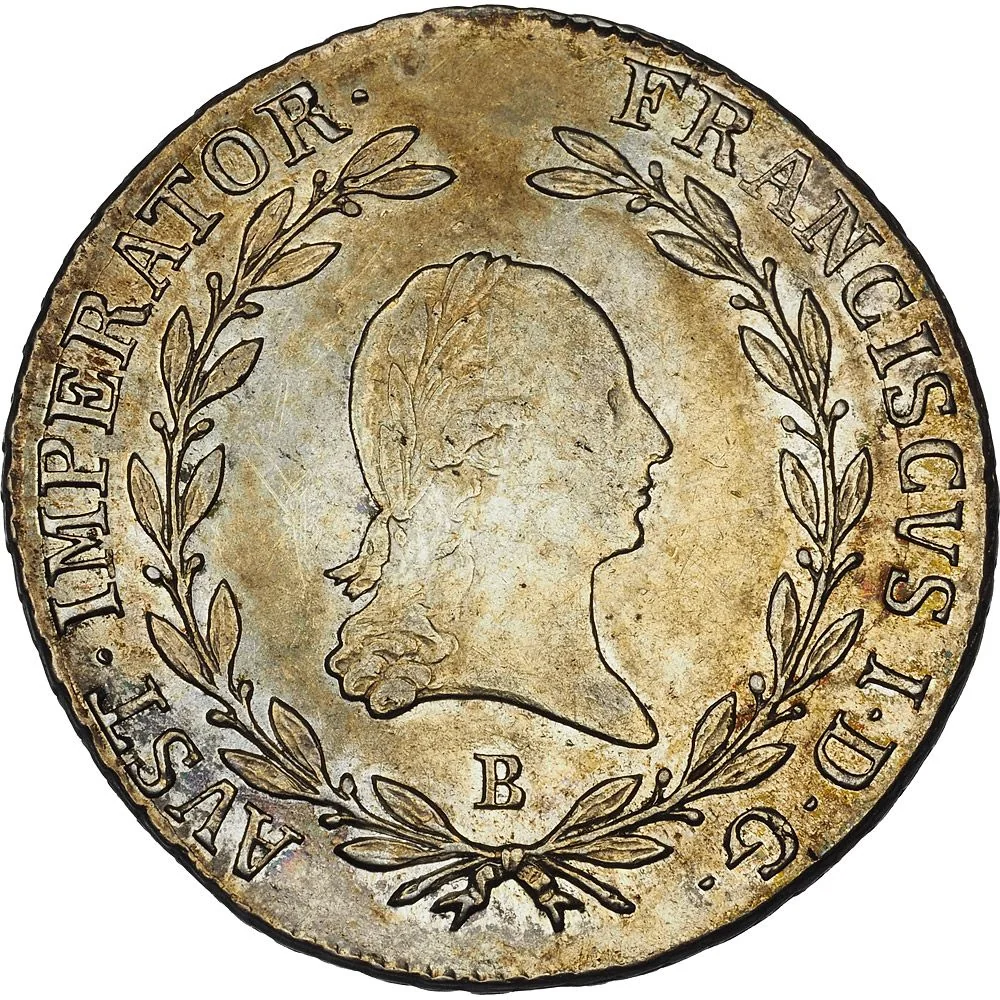
20 kreuzers – Austrian Empire
Add to wishlist
Austria
Context
Years: 1806–1814
Country: Austria
Issuer: Austrian Empire
Ruler: Francis I of Austria
Currency:
(1754—1857)
Demonetized: Yes
Total mintage: 24,048,000
Material
References
KM: #
Numista: #18835
Value
Bullion value: $9.72
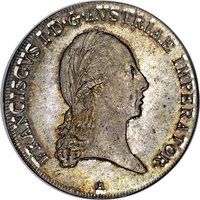
Obverse
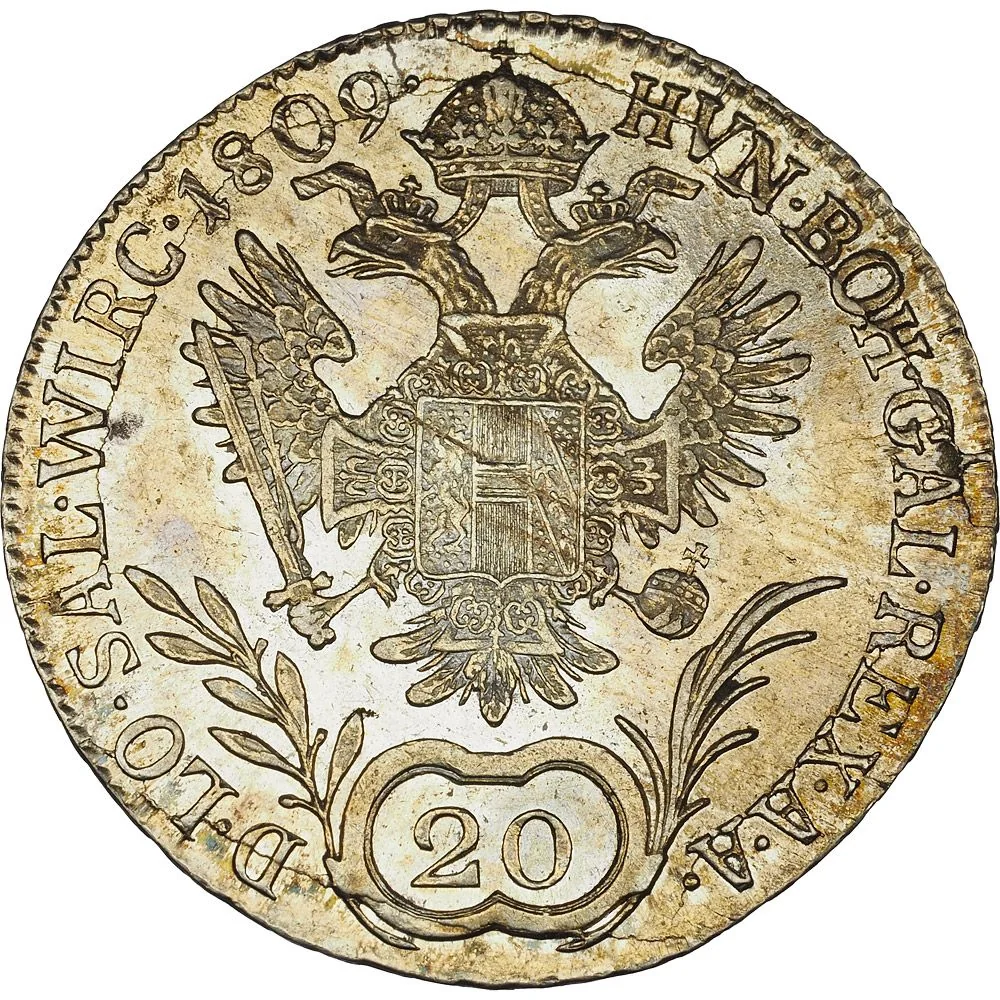
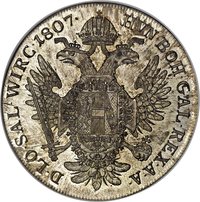
Reverse
Description:
Crowned double-headed eagle, value in framed wreath. Legend around (starts at 1 o'clock).
Inscription:
HVN·BOH·GAL·REX·A·A· D·LO·SAL·WIRC· 1809
20
20
Translation:
By the grace of God, King of Hanover, Duke of Brunswick and Lüneburg, Warden of the Holy Wends, 1809.
Script: Latin
Language: Latin
Edge
Patterned
Mints
| Name | Mark |
|---|---|
| Münze Österreich | A |
| Kremnica | B |
| Prague | C |
| Salzburg | D |
| Alba Iulia | E |
| Baia Mare | G |
Mintings
Historical background
In 1806, the currency situation within the Austrian Empire was complex and strained, a direct consequence of the Napoleonic Wars. The state finances were in dire condition due to the immense costs of continuous warfare. To meet these expenses, the Habsburg monarchy had increasingly resorted to issuing paper money, known as Bancozettel, since the late 18th century. By 1806, these notes were not convertible to silver, and their over-issuance had led to significant depreciation and inflation, creating a deep distrust in the paper currency among the populace and merchants.
The monetary system was officially bimetallic, based on both silver and gold, but in practice, it was fractured. Alongside the devalued paper Bancozettel, there circulated a confusing array of older silver and gold coins from various Habsburg lands, as well as foreign currencies, particularly in border regions. This created a multi-tiered system where transactions often required intricate calculations of exchange rates between metal and paper, hindering trade and economic stability. The state's attempts to mandate the acceptance of Bancozettel at face value were largely unsuccessful, as the market consistently valued metal coinage higher.
This precarious financial backdrop was exacerbated by the geopolitical shocks of 1806, namely the dissolution of the Holy Roman Empire following Francis II's assumption of the title Emperor of Austria in 1804. While this political restructuring did not immediately alter monetary policy, it underscored the empire's weakened position and the urgent need for fiscal reform. The currency chaos would ultimately culminate in the state bankruptcy of 1811, when the government was forced to drastically devalue the Bancozettel, wiping out much of its nominal value in a desperate attempt to reset the financial system.
The monetary system was officially bimetallic, based on both silver and gold, but in practice, it was fractured. Alongside the devalued paper Bancozettel, there circulated a confusing array of older silver and gold coins from various Habsburg lands, as well as foreign currencies, particularly in border regions. This created a multi-tiered system where transactions often required intricate calculations of exchange rates between metal and paper, hindering trade and economic stability. The state's attempts to mandate the acceptance of Bancozettel at face value were largely unsuccessful, as the market consistently valued metal coinage higher.
This precarious financial backdrop was exacerbated by the geopolitical shocks of 1806, namely the dissolution of the Holy Roman Empire following Francis II's assumption of the title Emperor of Austria in 1804. While this political restructuring did not immediately alter monetary policy, it underscored the empire's weakened position and the urgent need for fiscal reform. The currency chaos would ultimately culminate in the state bankruptcy of 1811, when the government was forced to drastically devalue the Bancozettel, wiping out much of its nominal value in a desperate attempt to reset the financial system.

🌱 Fairly Common