Logo Title
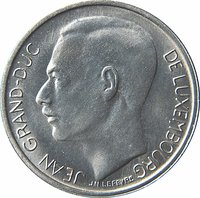
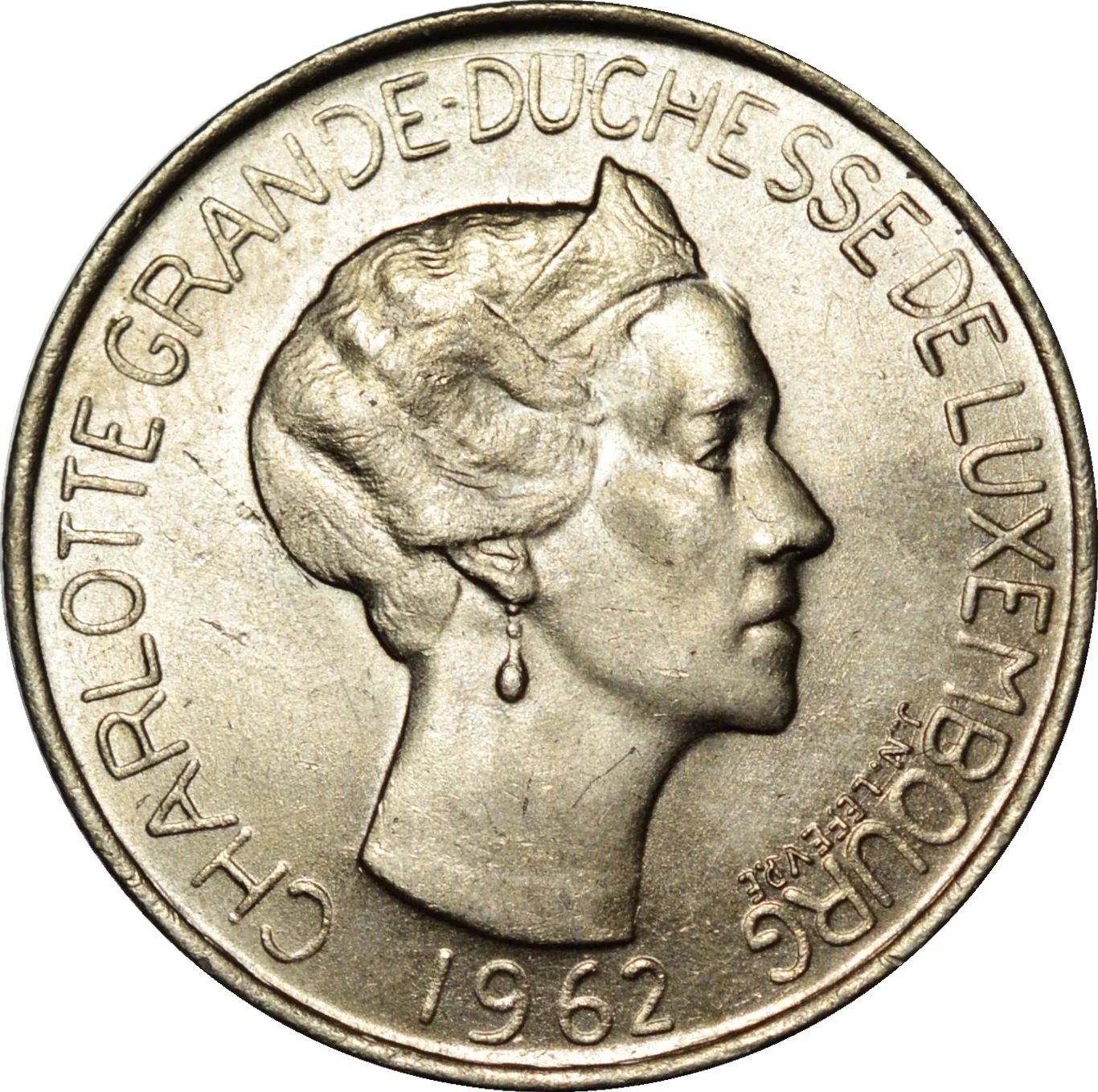
obverse
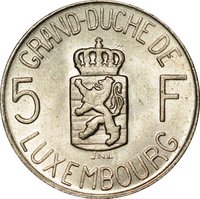
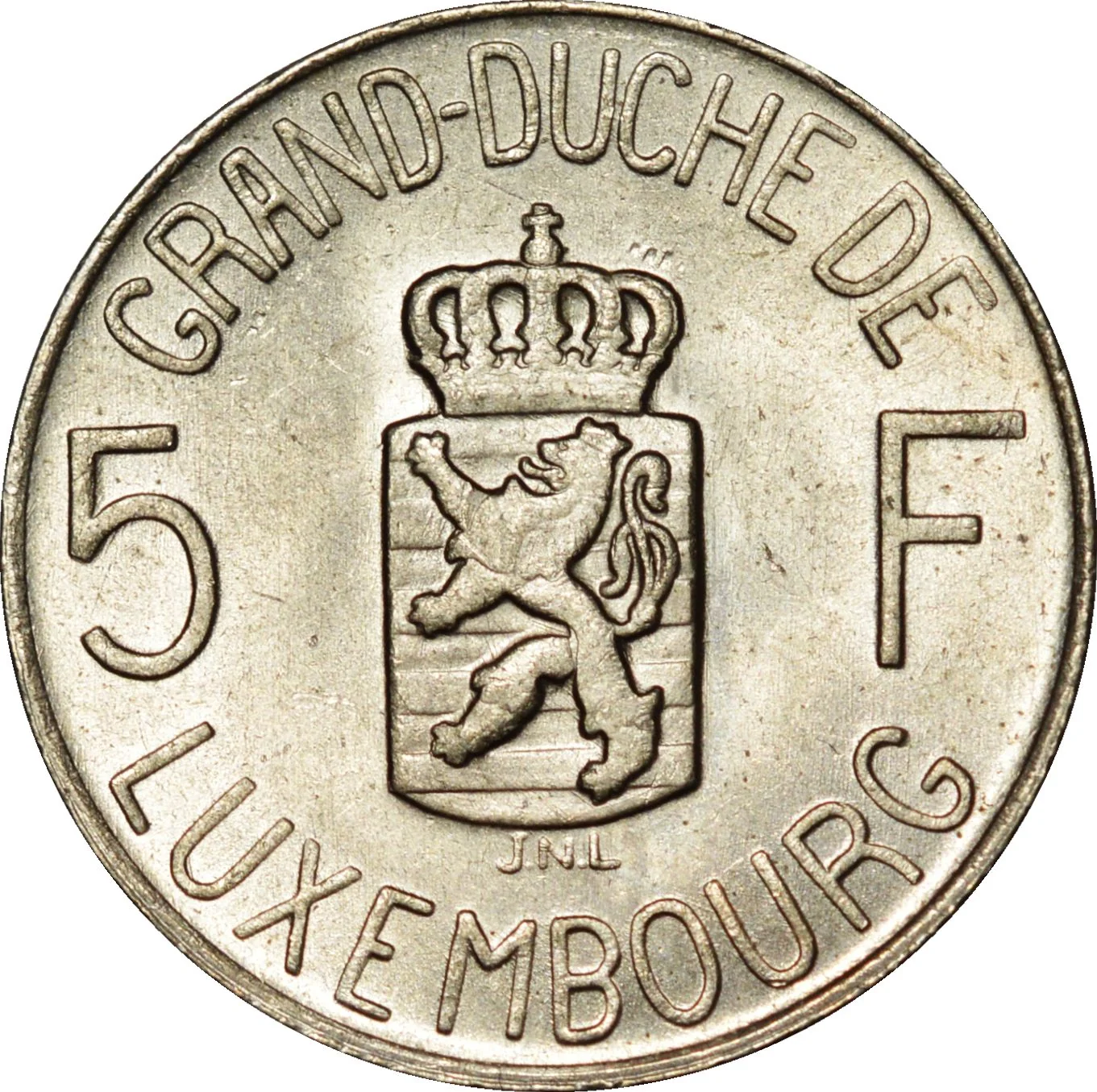
reverse
smy77 CC BY-NC-SA

5 Francs – Grand Duchy of Luxembourg

Luxembourg
Context
Year: 1962
Country: Luxembourg Country flag
Ruler: Charlotte
Currency:
(1854—2001)
Demonetization: 15 January 1987
Total mintage: 2,000,000
Material
Diameter: 24 mm
Weight: 6 g
Thickness: 1.8 mm
Shape: Round
Composition: Copper-nickel
Technique: Milled
Alignment: Coin alignment
Obverse
OBVERSE ↑
flip
Reverse
REVERSE ↓
References
KM: #Click to copy to clipboard51
Numista: #1875
Value
Exchange value: 5 LUF
Inflation-adjusted value: 40.10 LUF

Obverse

Description:
Right-facing portrait of Grand Duchess Charlotte of Luxembourg (1896-1985), encircled by legend and issue date. Engravers' signature below.
Inscription:
CHARLOTTE GRANDE DUCHESSE DE LUXEMBOURG

J.N.LEFEVRE

1962
Translation:
CHARLOTTE GRAND DUCHESS OF LUXEMBOURG
J.N.LEFEVRE
1962
Script: Latin
Language: French

Reverse

Description:
Crowned Luxembourg shield flanked by face value. Engravers' initials above and below the legend.
Inscription:
GRAND DUCHE DE LUXEMBOURG

5 F

JNL
Script: Latin

Edge

Milled

Categories

Symbols> Coat of Arms

Mints

NameMark
Royal Mint of Belgium

Mintings

YearMint MarkMintageQualityCollection
19622,000,000

Historical background

In 1962, the Grand Duchy of Luxembourg operated within the framework of the Belgian-Luxembourg Economic Union (BLEU), established in 1922. This deep monetary and economic integration meant that the Luxembourgish franc was pegged at par to the Belgian franc, and both currencies were legal tender within the two countries. However, Luxembourg did issue its own distinct banknotes and coins, a symbolic assertion of its sovereignty, though the Belgian franc dominated in daily circulation and commercial transactions. The Luxembourgish franc's value and monetary policy were therefore intrinsically tied to decisions made in Brussels, with the Banque Nationale de Belgique acting as the central bank for the union.

The period was one of international monetary stability under the Bretton Woods system, which fixed currencies to the US dollar and indirectly to gold. For Luxembourg, this meant its franc, via its link to the Belgian franc, had a stable exchange rate against other major world currencies. This stability was crucial for Luxembourg's burgeoning economy, which was transitioning from its traditional steel industry base towards developing its financial services sector. The predictable currency environment provided a solid foundation for attracting international banks and investment.

Looking ahead, the currency situation of 1962 was on the cusp of significant change. Within a few years, the BLEU agreement would be renewed with modifications, and more profoundly, Luxembourg would become a founding and committed advocate for European economic integration. This path would ultimately lead it to the European Monetary System and, decades later, to adopting the euro, replacing the Luxembourgish franc entirely. Thus, 1962 represents a point of stable, yet externally dependent, monetary order before the grand duchy's deeper embedding into the European project.
🌱 Very Common