

10 Francs – Saar
Germany
Context
Material
References
KM: #Click to copy to clipboard1
Numista: #1863
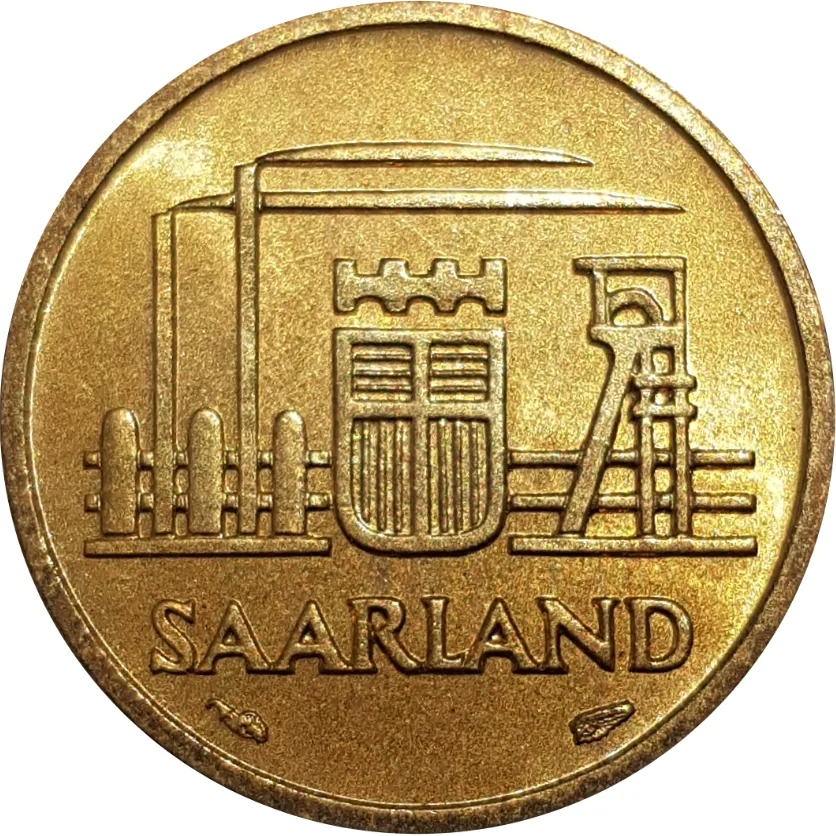
Obverse
Description:
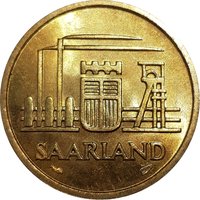
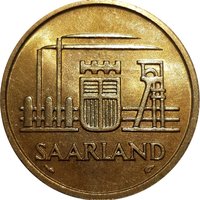
Industrial setting, central focus on machinery.
Inscription:
SAARLAND
Translation:
Saarland
Script: Latin
Language: German
Engraver: Theo Siegle
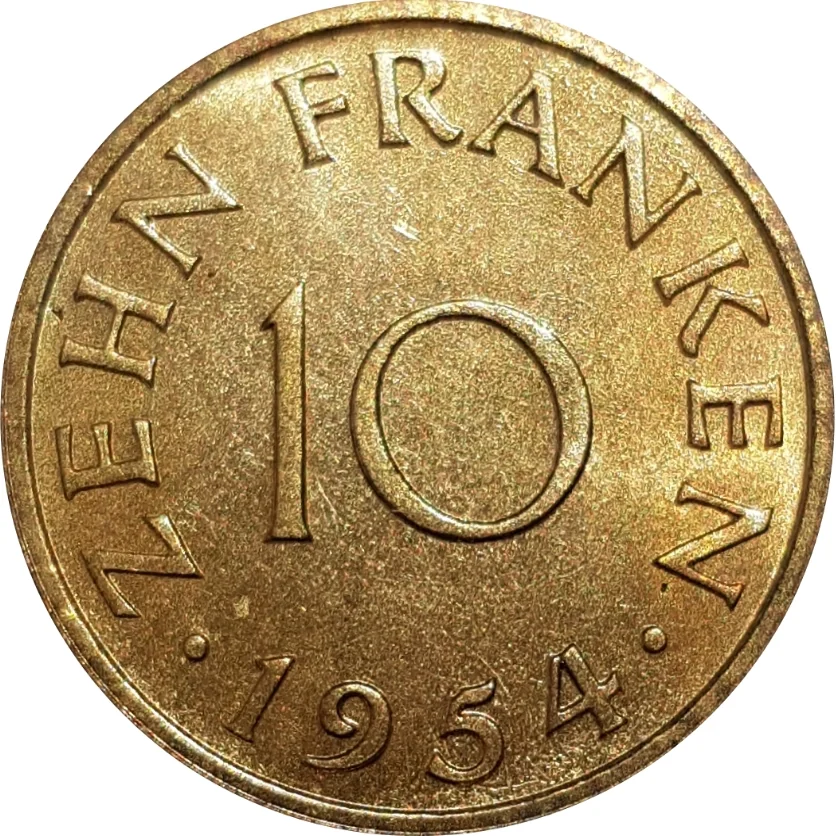
Reverse
Description:
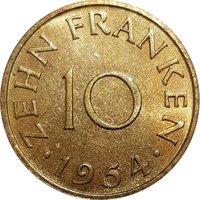
Value over date
Inscription:
ZEHN FRANKEN
10
·1954·
10
·1954·
Translation:
TEN FRANCS
10
·1954·
10
·1954·
Script: Latin
Engraver: Theo Siegle
Edge
Plain
Categories
| Symbols> Coat of Arms |
| Industry |
Mints
| Name | Mark |
|---|---|
| Monnaie de Paris | — |
Mintings
| Year | Mint Mark | Mintage | Quality | Collection |
|---|---|---|---|---|
| 1954 | — | 11,000,000 |
Historical background
In 1954, the Saarland, a small but industrially significant region bordering France and Germany, existed under a unique and complex post-war status. It was politically autonomous and economically integrated with France, having been separated from Germany after World War II. This arrangement was formalized by the 1947 constitution and the 1950 Franco-Saar Conventions, which made the French franc the official legal tender. France controlled the Saar's foreign policy and defense, while its coal mines were directly operated under French administration, cementing its economic dependency.
The currency situation was a direct manifestation and a powerful symbol of this political control. The use of the French franc, rather than the Deutsche Mark used in the nascent Federal Republic of Germany, physically anchored the Saar to the French economic sphere. This monetary separation from West Germany created practical barriers to trade and daily life for a population that remained culturally and linguistically German. The franc was not merely a medium of exchange but a political statement, representing the French government's ambition to permanently detach the Saar from German influence and secure its resources.
However, by 1954, this arrangement was under increasing strain. A growing pro-German movement within the Saar, coupled with West Germany's economic resurgence, fueled public opposition to the franc and the political status quo. The decisive rejection of the European Saar Statute—a French-backed proposal for Europeanization—in a referendum on October 23, 1955, sealed the fate of the franc in the region. This clear vote for a return to Germany set in motion the process that would lead to the Saar Treaty of 1956 and the territory's political reintegration into West Germany on January 1, 1957, followed by the full reintroduction of the Deutsche Mark on July 6, 1959.
The currency situation was a direct manifestation and a powerful symbol of this political control. The use of the French franc, rather than the Deutsche Mark used in the nascent Federal Republic of Germany, physically anchored the Saar to the French economic sphere. This monetary separation from West Germany created practical barriers to trade and daily life for a population that remained culturally and linguistically German. The franc was not merely a medium of exchange but a political statement, representing the French government's ambition to permanently detach the Saar from German influence and secure its resources.
However, by 1954, this arrangement was under increasing strain. A growing pro-German movement within the Saar, coupled with West Germany's economic resurgence, fueled public opposition to the franc and the political status quo. The decisive rejection of the European Saar Statute—a French-backed proposal for Europeanization—in a referendum on October 23, 1955, sealed the fate of the franc in the region. This clear vote for a return to Germany set in motion the process that would lead to the Saar Treaty of 1956 and the territory's political reintegration into West Germany on January 1, 1957, followed by the full reintroduction of the Deutsche Mark on July 6, 1959.
🌱 Very Common