

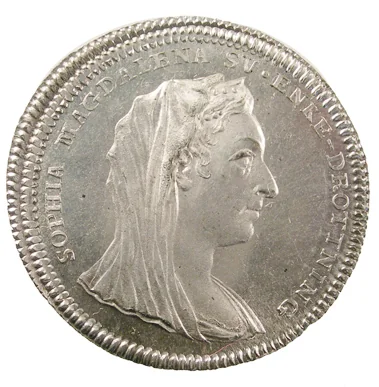
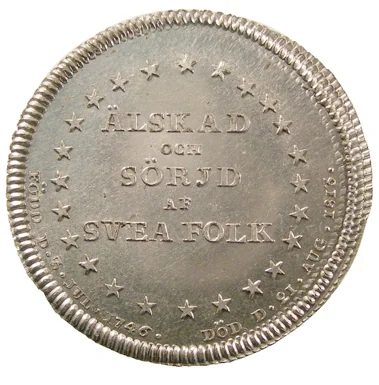
⅓ Riksdaler – Sweden
Circulating commemorative coins
Commemoration: Largesse money for queen Sofia Magdalena's funeral in 1813.
Sweden
Context
Material
References
Numista: #186173
Value
Bullion value: $24.14
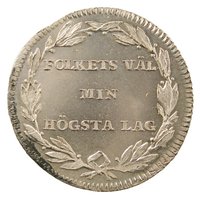
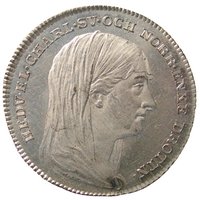
Obverse
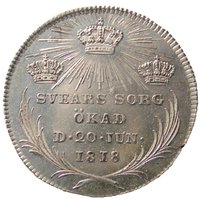
Reverse
Edge
Mints
| Name | Mark |
|---|---|
| Stockholm | — |
Mintings
| Year | Mint Mark | Mintage | Quality | Collection |
|---|---|---|---|---|
| 1813 | — | — |
Historical background
In 1813, Sweden found itself in a severe monetary crisis, a direct consequence of its costly involvement in the Napoleonic Wars. To finance the war, the state had resorted to excessive printing of paper money known as riksdaler riksmynt, which was not backed by silver. This led to rampant inflation, a sharp depreciation of the currency's value, and a crippling loss of public confidence. The economic situation was dire, with the paper riksdaler trading at only about one-third of its nominal value in silver, paralyzing trade and state finances.
In response, the government, under the leadership of Crown Prince Charles John (the former French Marshal Bernadotte), enacted a radical monetary reform through the Riksgäldscontoret (the National Debt Office). The cornerstone of this reform was the introduction of a new currency unit, the riksdaler riksgälds, which was established as a stable, paper-based currency intended to restore trust. Crucially, it was not convertible to silver but was declared legal tender for all transactions, including tax payments to the state, which guaranteed its circulation.
This reform of 1813 was a pragmatic and necessary step to break the cycle of inflation and stabilize the economy, but it created a complex dual-currency system. The old, discredited riksdaler riksmynt and the new riksdaler riksgälds circulated alongside the silver-based riksdaler specie, with official exchange rates set between them. While not an immediate solution to all economic woes, this restructuring provided the foundation for eventual recovery and paved the way for the more lasting monetary unity that would come with the establishment of the Scandinavian Monetary Union decades later.
In response, the government, under the leadership of Crown Prince Charles John (the former French Marshal Bernadotte), enacted a radical monetary reform through the Riksgäldscontoret (the National Debt Office). The cornerstone of this reform was the introduction of a new currency unit, the riksdaler riksgälds, which was established as a stable, paper-based currency intended to restore trust. Crucially, it was not convertible to silver but was declared legal tender for all transactions, including tax payments to the state, which guaranteed its circulation.
This reform of 1813 was a pragmatic and necessary step to break the cycle of inflation and stabilize the economy, but it created a complex dual-currency system. The old, discredited riksdaler riksmynt and the new riksdaler riksgälds circulated alongside the silver-based riksdaler specie, with official exchange rates set between them. While not an immediate solution to all economic woes, this restructuring provided the foundation for eventual recovery and paved the way for the more lasting monetary unity that would come with the establishment of the Scandinavian Monetary Union decades later.
✨ Legendary