

2 Francs – Madagascar
Madagascar
Context
Years: 1965–1989
Issuer: Madagascar 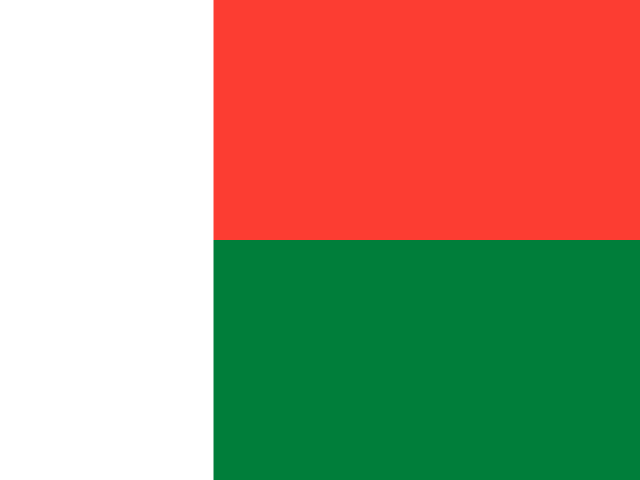
Period:
(1958—1975)
Currency:
(1963—2004)
Subdivision: 2 Francs = 1 Venti 1 Kirobo
Total mintage: 43,950,000
Material
Diameter: 19 mm
Weight: 3.4 g
Thickness: 1.88 mm
Shape: Round
Composition: Stainless steel
Technique: Milled
Alignment: Coin alignment
flip
References
KM: #Click to copy to clipboard9
Numista: #1854
Value
Exchange value: ⅖ MGF
Obverse
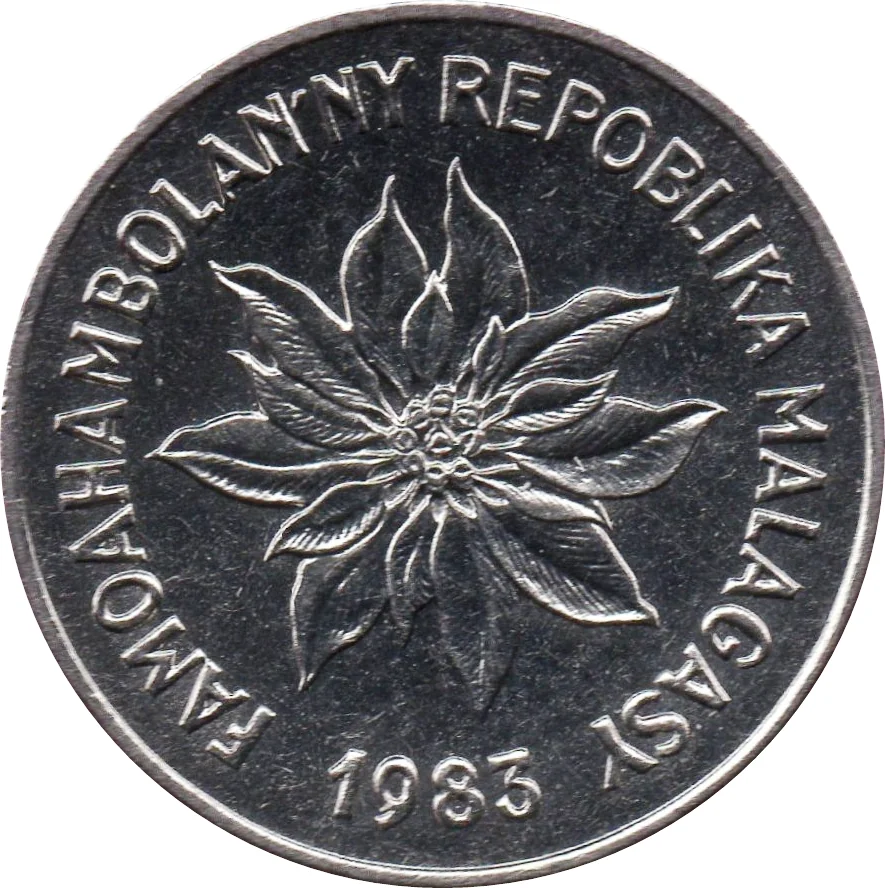
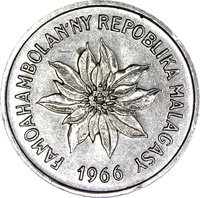
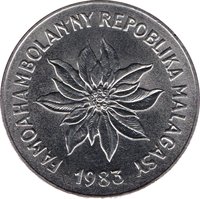
Description:
Poinsettia flower.
Inscription:
FAMOAHAMBOLAN'NY REPOBLIKA MALAGASY
1983
1983
Translation:
THE REPUBLIC OF MADAGASCAR
Script: Latin
Language: Malagasy
Engraver: Raymond Joly
Reverse
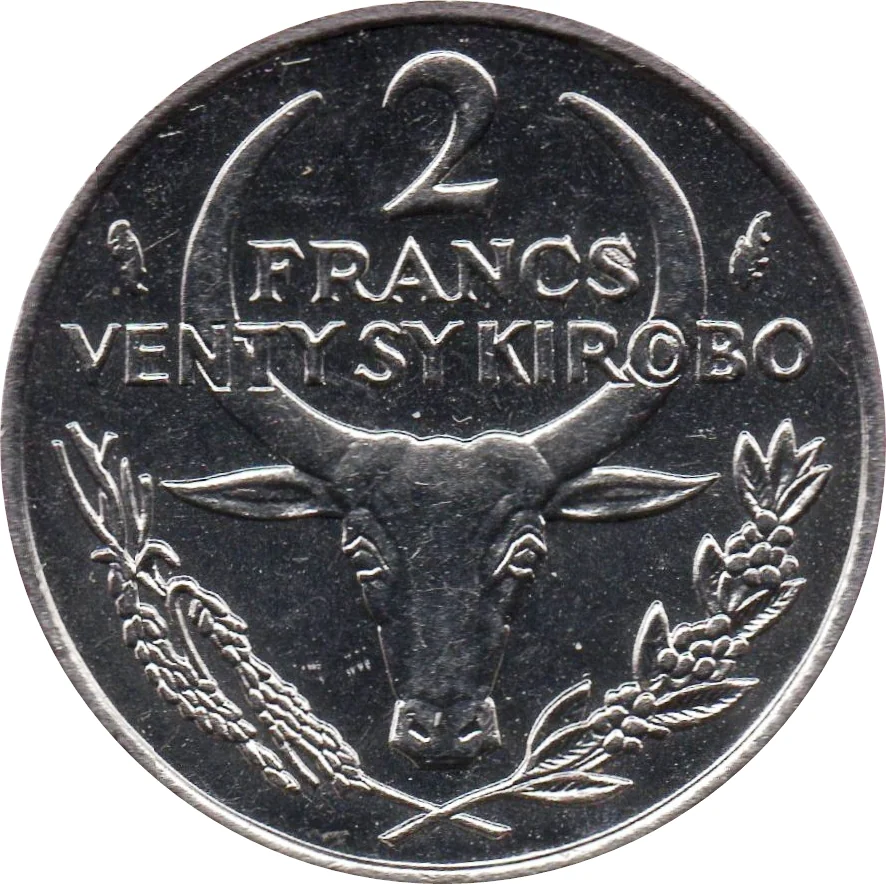
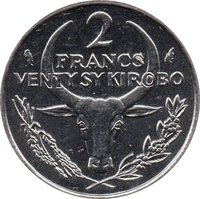
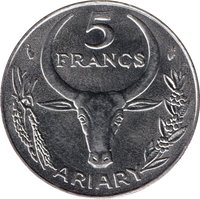
Description:
Ox head with horns above sprigs.
Inscription:
2
FRANCS
VENTY SY KIROBO
FRANCS
VENTY SY KIROBO
Script: Latin
Engraver: Raymond Joly
Edge
Plain
Mints
| Name | Mark |
|---|---|
| Monnaie de Paris | — |
Mintings
| Year | Mint Mark | Mintage | Quality | Collection |
|---|---|---|---|---|
| 1965 | — | 10,000,000 | ||
| 1970 | — | — | ||
| 1974 | — | 1,250,000 | ||
| 1975 | — | 1,200,000 | ||
| 1976 | — | 2,000,000 | ||
| 1977 | — | 5,000,000 | ||
| 1979 | — | 2,500,000 | ||
| 1980 | — | 2,500,000 | ||
| 1981 | — | 3,500,000 | ||
| 1982 | — | 3,000,000 | ||
| 1983 | — | 4,000,000 | ||
| 1984 | — | 2,000,000 | ||
| 1986 | — | 2,000,000 | ||
| 1987 | — | 1,500,000 | ||
| 1988 | — | 1,500,000 | ||
| 1989 | — | 2,000,000 |
Historical background
In 1965, Madagascar's currency situation was characterized by its continued use of the CFA franc, a legacy of its colonial past. As a member of the Franc Zone, the Malagasy Republic (as it was then known) utilized the CFA franc (Franc des Colonies Françaises d'Afrique), which was pegged at a fixed and guaranteed exchange rate to the French franc. This arrangement, managed by the Banque Centrale de Madagascar, provided monetary stability and facilitated trade with France, the nation's dominant economic partner. The peg offered insulation from direct currency fluctuations, but it also meant Madagascar's monetary policy was largely directed from Paris, limiting autonomous economic tools.
Economically, the country faced challenges that strained its currency system. Following independence in 1960, the government of President Philibert Tsiranana pursued a conservative, pro-French policy, but the economy remained heavily dependent on agricultural exports like coffee, vanilla, and cloves. Fluctuations in global commodity prices created trade imbalances and pressure on foreign exchange reserves. While the fixed peg provided stability, it could not shield the economy from structural issues such as a narrow export base and a reliance on imported manufactured goods, which affected the overall balance of payments.
Looking forward, the inherent constraints of the CFA system within a sovereign nation would eventually lead to change. The stability of 1965 was thus a prelude to reform; within a decade, Madagascar would seek greater monetary independence. In 1973, it left the Franc Zone and introduced its own national currency, the Malagasy franc (franc malgache), marking a significant step in asserting its post-colonial economic sovereignty, though this move would later introduce new challenges of inflation and devaluation.
Economically, the country faced challenges that strained its currency system. Following independence in 1960, the government of President Philibert Tsiranana pursued a conservative, pro-French policy, but the economy remained heavily dependent on agricultural exports like coffee, vanilla, and cloves. Fluctuations in global commodity prices created trade imbalances and pressure on foreign exchange reserves. While the fixed peg provided stability, it could not shield the economy from structural issues such as a narrow export base and a reliance on imported manufactured goods, which affected the overall balance of payments.
Looking forward, the inherent constraints of the CFA system within a sovereign nation would eventually lead to change. The stability of 1965 was thus a prelude to reform; within a decade, Madagascar would seek greater monetary independence. In 1973, it left the Franc Zone and introduced its own national currency, the Malagasy franc (franc malgache), marking a significant step in asserting its post-colonial economic sovereignty, though this move would later introduce new challenges of inflation and devaluation.
🌱 Very Common