

5 francs – Madagascar
Add to wishlist
Madagascar
Context
Years: 1966–1989
Issuer: Madagascar
Period:
(1958—1975)
Currency:
(1963—2004)
Subdivision: 5 francs = 1 Ariary
Total mintage: 88,800,000
Material
Diameter: 22 mm
Weight: 5 g
Thickness: 1.94 mm
Shape: Round
Composition: Stainless steel
Technique: Milled
Alignment: Coin alignment
flip
References
KM: #
Numista: #1849
Value
Exchange value: 1 MGF
Obverse
Description:
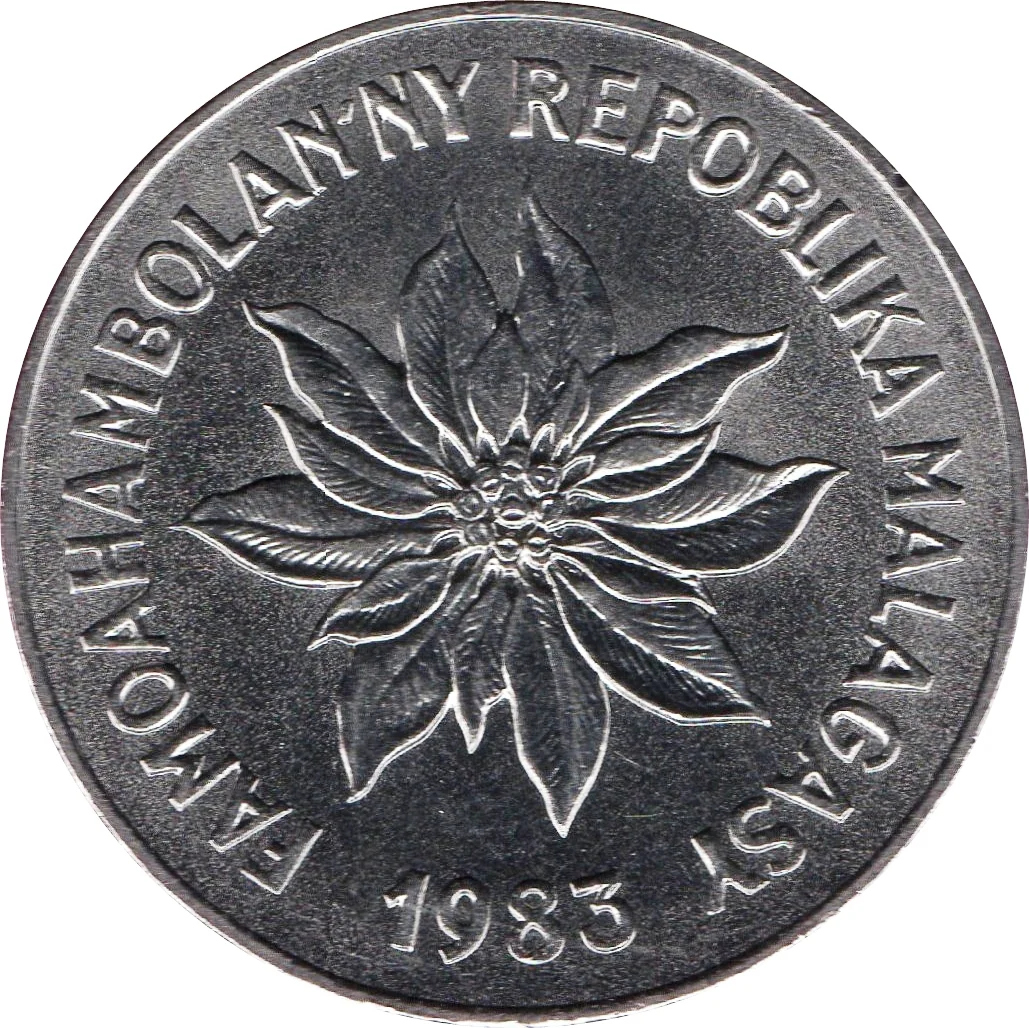
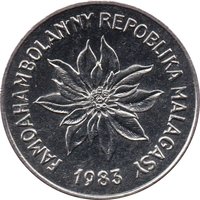
Poinsettia over date.
Inscription:
FAMOAHAMBOLAN'NY REPOBLIKA MALAGASY
1983
1983
Translation:
THE REPUBLIC OF MADAGASCAR
Script: Latin
Language: Malagasy
Engraver: Raymond Joly
Reverse
Description:
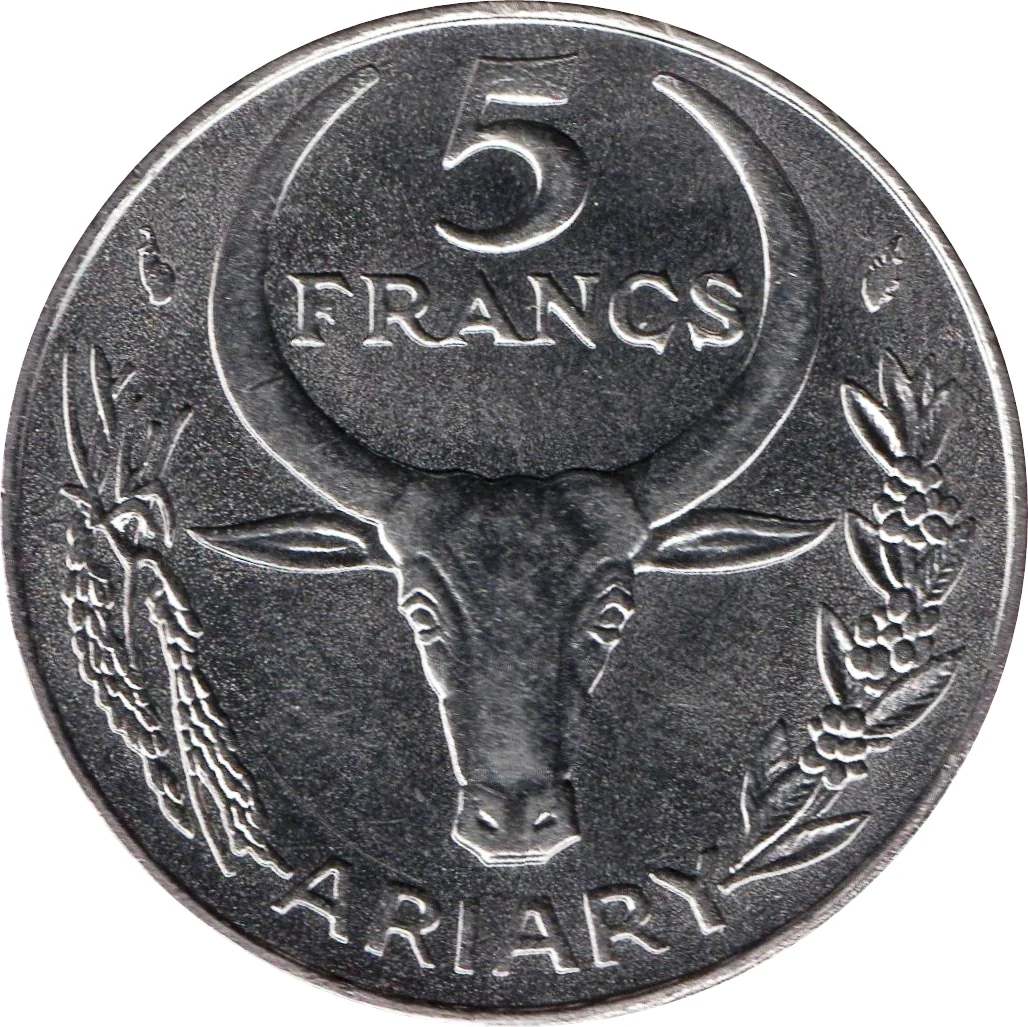
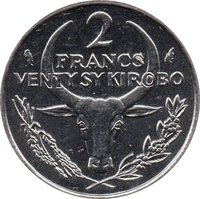
Ox head horns above sprigs.
Inscription:
5
FRANCS
ARIARY
FRANCS
ARIARY
Script: Latin
Engraver: Raymond Joly
Edge
Plain
Mints
| Name | Mark |
|---|---|
| Monnaie de Paris | — |
Mintings
| Year | Mint Mark | Mintage | Quality | Collection |
|---|---|---|---|---|
| 1966 | — | 5,000,000 | ||
| 1967 | — | 7,500,000 | ||
| 1968 | — | 7,500,000 | ||
| 1970 | — | — | ||
| 1972 | — | 10,000,000 | ||
| 1976 | — | 5,000,000 | ||
| 1977 | — | 4,200,000 | ||
| 1979 | — | 4,300,000 | ||
| 1980 | — | 4,300,000 | ||
| 1981 | — | 5,200,000 | ||
| 1982 | — | 3,300,000 | ||
| 1983 | — | — | ||
| 1984 | — | 2,500,000 | ||
| 1986 | — | 5,000,000 | ||
| 1987 | — | 2,500,000 | ||
| 1988 | — | 2,500,000 | ||
| 1989 | — | 20,000,000 |
Historical background
In 1966, Madagascar's currency situation was characterized by its recent transition to an independent monetary system following the end of the Malagasy Franc's peg to the French Franc. Upon gaining independence in 1960, the nation initially remained within the CFA franc zone, using a currency guaranteed by the French Treasury. However, in 1963, Madagascar exited this arrangement and introduced its own distinct Malagasy Franc (FMG), managed by the newly established Banque Centrale de la République Malgache. This move was a key symbol of economic sovereignty, allowing the government greater control over its monetary policy to support national development goals.
The economy in the mid-1960s was predominantly agricultural, relying on exports like coffee, vanilla, and cloves. The value and stability of the new FMG were therefore heavily dependent on the volatile prices of these primary commodities on the world market. While the central bank aimed to maintain a stable exchange rate, the economy faced underlying pressures, including a growing trade deficit and the challenges of building domestic financial institutions from the ground up. The currency's credibility was still in a formative stage, both domestically and internationally.
Overall, the currency situation in 1966 reflected a young nation cautiously navigating its post-colonial economic path. The Malagasy Franc operated without the backing of the French guarantee, placing the full responsibility for its stability on Madagascar's own central bank and the performance of its export-driven economy. This period was one of foundational management, setting the stage for the monetary challenges and inflationary pressures that would become more pronounced in the following decades.
The economy in the mid-1960s was predominantly agricultural, relying on exports like coffee, vanilla, and cloves. The value and stability of the new FMG were therefore heavily dependent on the volatile prices of these primary commodities on the world market. While the central bank aimed to maintain a stable exchange rate, the economy faced underlying pressures, including a growing trade deficit and the challenges of building domestic financial institutions from the ground up. The currency's credibility was still in a formative stage, both domestically and internationally.
Overall, the currency situation in 1966 reflected a young nation cautiously navigating its post-colonial economic path. The Malagasy Franc operated without the backing of the French guarantee, placing the full responsibility for its stability on Madagascar's own central bank and the performance of its export-driven economy. This period was one of foundational management, setting the stage for the monetary challenges and inflationary pressures that would become more pronounced in the following decades.

🌱 Very Common