

1 peseta – Spain
Add to wishlist
Spain
Context
Years: 1889–1891
Issuer: Spain
Ruler: Alfonso XIII
Currency:
(1868—2001)
Demonetization: 20 February 1939
Total mintage: 4,948,225
Material
References
KM: #
Numista: #18488
Value
Exchange value: 1 ESP
Bullion value: $10.64
Obverse
Description:
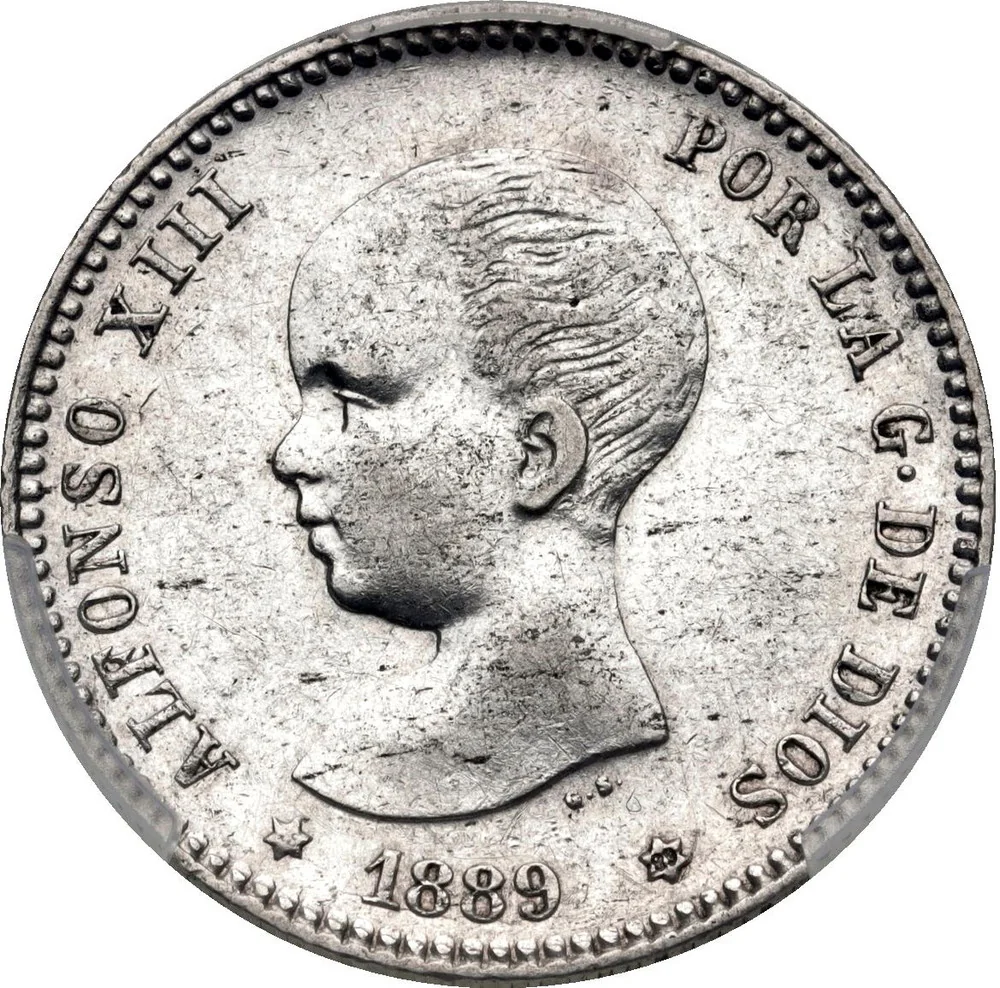
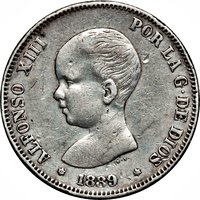
Toddler King Alfonso XIII facing left.
Inscription:
ALFONSO XIII POR LA G· DE DIOS
G· S·
🟌 1889 🟌
G· S·
🟌 1889 🟌
Translation:
ALFONSO XIII BY THE GRACE OF GOD
KING OF SPAIN
🟌 1889 🟌
KING OF SPAIN
🟌 1889 🟌
Script: Latin
Language: Spanish
Engraver: Gregorio Sellán y González
Reverse
Description:
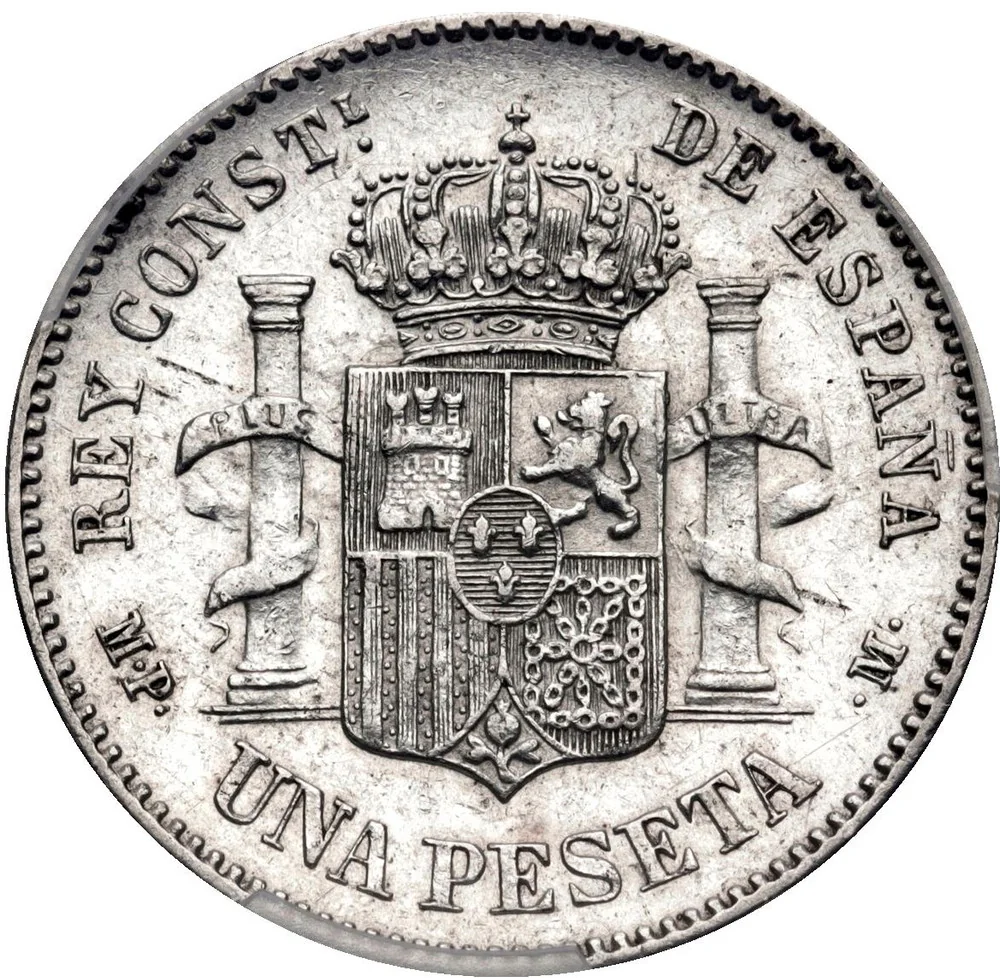
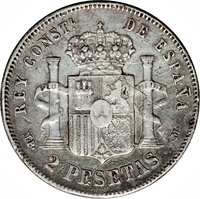
Spanish coat of arms with the Pillars of Hercules.
Inscription:
REY CONSTL. DE ESPAÑA
PLUS ULTRA
M·P· UNA PESETA ·M·
PLUS ULTRA
M·P· UNA PESETA ·M·
Translation:
KING CONSTITUTIONAL OF SPAIN
MORE BEYOND
M·P· ONE PESETA ·M·
MORE BEYOND
M·P· ONE PESETA ·M·
Script: Latin
Engraver: Gregorio Sellán y González
Edge
Reeded
Categories
| Person> Monarch |
| Symbols> Coat of Arms |
Mints
| Name | Mark |
|---|---|
| Royal Mint of Madrid | (🟌) |
Mintings
| Year | Mint Mark | Mintage | Quality | Collection |
|---|---|---|---|---|
| 1889 | 🟌 | — | ||
| 1891 | 🟌 | 4,948,225 |
Historical background
In 1889, Spain's currency situation was defined by the Peseta, which had been established as the nation's sole legal tender in 1868 following the Glorious Revolution. The country was operating on a de facto silver standard, though this was under immense strain. The international phenomenon known as the "crisis of silver" was pivotal, as the metal's value plummeted globally due to massive new discoveries and its demonetization by major powers like Germany and the Latin Monetary Union. This caused a significant disparity between the falling market value of silver and the fixed legal value of silver coins, leading to the widespread hoarding and export of full-bodied Spanish silver coins for their bullion worth, which in turn caused a shortage of circulating currency.
The government of Prime Minister Práxedes Mateo Sagasta attempted to address this crisis with the Currency Law of 1878, which was still governing policy in 1889. This law aimed to stabilize the system by introducing a limping standard, where gold coins were also minted but with no fixed legal ratio to silver, and by reducing the silver content in new subsidiary coinage. However, these measures were only partially successful. By 1889, the currency in daily circulation was a chaotic mix of underweight silver coins, worn older coins, and a flood of token coins made from copper and bronze, eroding public trust. The scarcity of sound money hindered commerce and revealed the system's fundamental instability.
Consequently, 1889 found Spain in a protracted period of monetary disorder, caught between a discredited silver standard and the emerging global gold standard. The persistent outflow of silver bullion strained the Bank of Spain's reserves and pressured public finances. This environment fueled intense debate among economists, politicians, and business leaders, setting the stage for the eventual, and difficult, transition to the gold standard, which would be formally adopted with the Currency Law of 1891, just two years later. The situation of 1889 was thus a critical juncture of economic vulnerability and a prelude to significant monetary reform.
The government of Prime Minister Práxedes Mateo Sagasta attempted to address this crisis with the Currency Law of 1878, which was still governing policy in 1889. This law aimed to stabilize the system by introducing a limping standard, where gold coins were also minted but with no fixed legal ratio to silver, and by reducing the silver content in new subsidiary coinage. However, these measures were only partially successful. By 1889, the currency in daily circulation was a chaotic mix of underweight silver coins, worn older coins, and a flood of token coins made from copper and bronze, eroding public trust. The scarcity of sound money hindered commerce and revealed the system's fundamental instability.
Consequently, 1889 found Spain in a protracted period of monetary disorder, caught between a discredited silver standard and the emerging global gold standard. The persistent outflow of silver bullion strained the Bank of Spain's reserves and pressured public finances. This environment fueled intense debate among economists, politicians, and business leaders, setting the stage for the eventual, and difficult, transition to the gold standard, which would be formally adopted with the Currency Law of 1891, just two years later. The situation of 1889 was thus a critical juncture of economic vulnerability and a prelude to significant monetary reform.
🌱 Common