

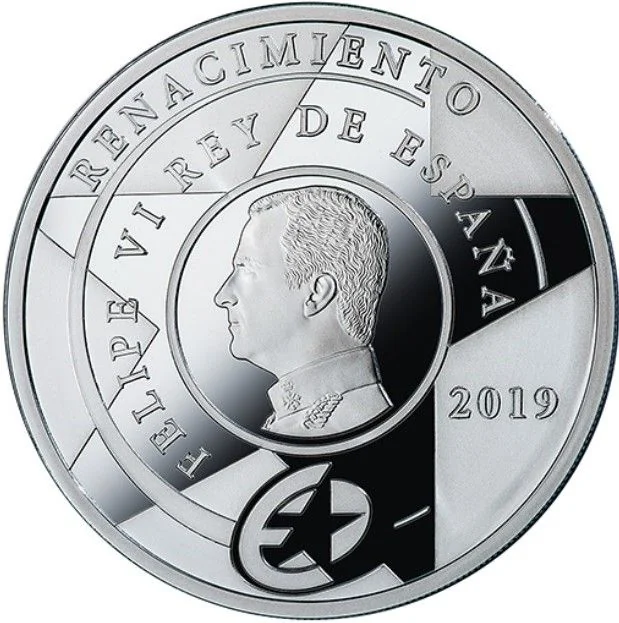

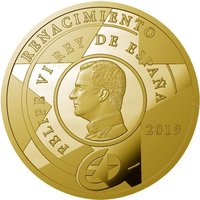
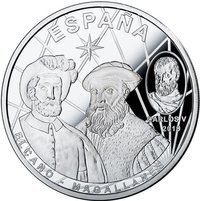
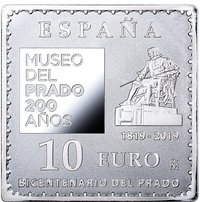
Obverse
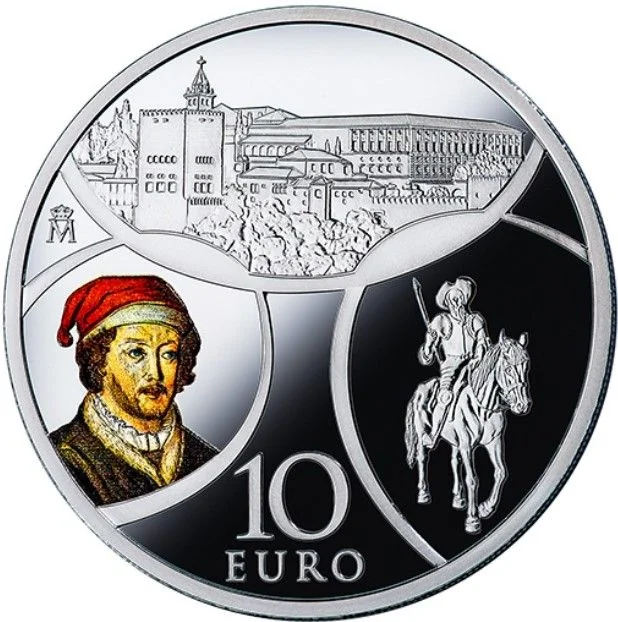
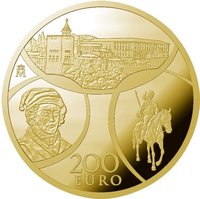
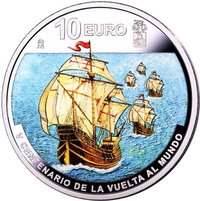
Reverse
Description:
Three ovals: the Alhambra with the Palace of Charles V; Don Quixote on Rocinante; a detail from Juan de la Cosa's portrait at the Naval Museum of Madrid.
Inscription:
10 EURO
M
M
Script: Latin
Edge
Reeded
Mints
| Name | Mark |
|---|---|
| Royal Mint of Madrid | (M) |
Mintings
| Year | Mint Mark | Mintage | Quality | Collection |
|---|---|---|---|---|
| 2019 | M | 5,000 | Proof |
Historical background
In 2019, Spain was a fully integrated member of the Eurozone, using the euro (€) as its sole official currency for nearly two decades since its introduction in 2002. The country had no independent monetary policy, as this was set by the European Central Bank (ECB) in Frankfurt, which aimed to maintain price stability across the entire Eurozone. This framework provided Spain with significant benefits, including exchange rate stability within the bloc, lower transaction costs, and enhanced credibility in international markets, which were crucial for its heavily tourism-dependent economy.
However, the legacy of the 2008 financial crisis and the subsequent Eurozone debt crisis still cast a long shadow. While the Spanish economy had experienced a strong recovery since 2014, concerns persisted about structural vulnerabilities. These included a high public debt-to-GDP ratio (hovering around 98%), which limited fiscal flexibility, and an unemployment rate that, despite falling, remained the second highest in the EU at around 14%. The single currency meant Spain could not devalue its money to boost competitiveness, placing the entire adjustment burden on internal reforms and fiscal austerity measures implemented in prior years.
Politically, the euro enjoyed broad support among the mainstream political parties and the public, as it was seen as a cornerstone of Spain's modern European identity. There was no significant political movement advocating for a return to the peseta, unlike the rising euroscepticism seen in some other member states. The primary economic debates in 2019, therefore, focused not on the currency itself, but on how to operate within its constraints—specifically, discussions centered on achieving greater fiscal space within EU rules to address social inequality and regional disparities, while maintaining financial stability under the ECB's umbrella.
However, the legacy of the 2008 financial crisis and the subsequent Eurozone debt crisis still cast a long shadow. While the Spanish economy had experienced a strong recovery since 2014, concerns persisted about structural vulnerabilities. These included a high public debt-to-GDP ratio (hovering around 98%), which limited fiscal flexibility, and an unemployment rate that, despite falling, remained the second highest in the EU at around 14%. The single currency meant Spain could not devalue its money to boost competitiveness, placing the entire adjustment burden on internal reforms and fiscal austerity measures implemented in prior years.
Politically, the euro enjoyed broad support among the mainstream political parties and the public, as it was seen as a cornerstone of Spain's modern European identity. There was no significant political movement advocating for a return to the peseta, unlike the rising euroscepticism seen in some other member states. The primary economic debates in 2019, therefore, focused not on the currency itself, but on how to operate within its constraints—specifically, discussions centered on achieving greater fiscal space within EU rules to address social inequality and regional disparities, while maintaining financial stability under the ECB's umbrella.
Series: Europa Star






✨ Legendary