

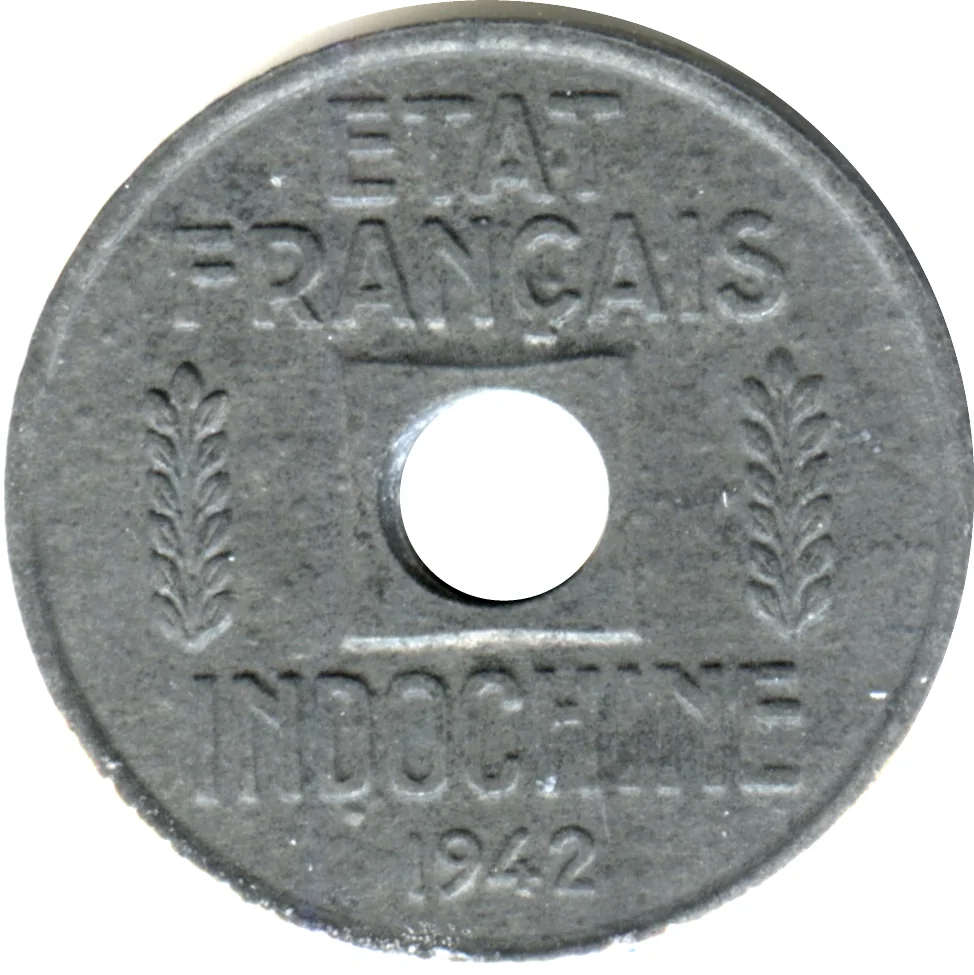
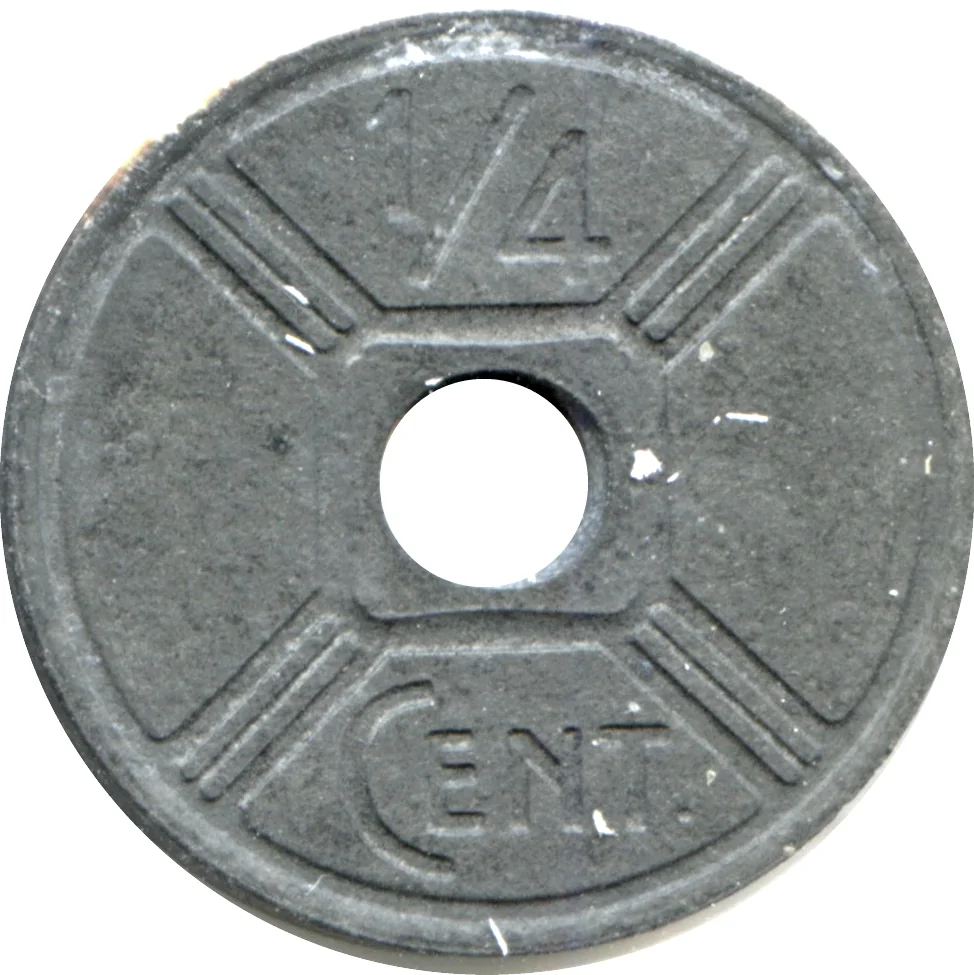
¼ cent – French Indochina
Add to wishlist
Context
Years: 1941–1944
Issuer: French Indochina
Period:
(1940—1944)
Currency:
(1880—1952)
Demonetized: Yes
Total mintage: 547,372,000
Material
Diameter: 20 mm
Weight: 2.4 g
Thickness: 1.6 mm
Shape: Round with a round hole
Composition: Zinc
Magnetic: No
Technique: Milled
Alignment: Coin alignment
flip
References
KM: #
Numista: #10055
Value
Exchange value: 0.0025 ICFP
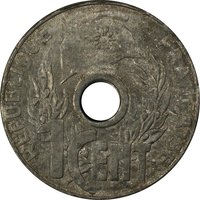
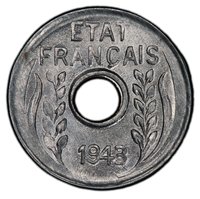
Obverse
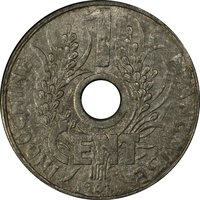
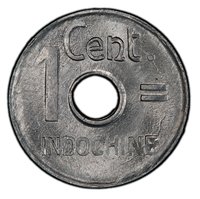
Reverse
Edge
Plain
Mints
| Name | Mark |
|---|---|
| Japan Mint | — |
Mintings
| Year | Mint Mark | Mintage | Quality | Collection |
|---|---|---|---|---|
| 1941 | — | — | ||
| 1942 | — | 221,800,000 | ||
| 1943 | — | 279,450,000 | ||
| 1944 | — | 46,122,000 |
Historical background
In 1941, the currency situation in French Indochina was defined by its precarious position under the dual authority of Vichy France and occupying Japanese forces. The official currency remained the French Indochinese piastre, issued by the Bank of Indochina. This currency was historically strong, pegged to the French franc at a fixed rate but effectively backed by gold and silver reserves, which made it a stable and coveted currency across Southeast Asia. However, this very strength became a point of contention, as the Japanese military sought to seize the colony's substantial bullion reserves to fund their wider war effort.
The Japanese, having forced the Vichy authorities into a nominal alliance in 1940, exerted increasing pressure to integrate the economy into their "Greater East Asia Co-Prosperity Sphere." While they allowed the piastre to remain in circulation, they introduced their own military scrip, the Japanese Invasion Money, to pay for their occupation costs and procure local resources. This led to a dual-currency system where the Japanese military yen circulated alongside, and increasingly in competition with, the piastre. The Japanese heavily requisitioned goods and services, paying with this scrip, which flooded the market and lacked public trust.
Consequently, the region began to suffer from severe inflation and economic distortion. The French administration, trying to maintain a degree of autonomy, resisted Japanese demands to hand over the piastre's gold reserves and to fix the yen-to-piastre exchange rate at an unfavorable level. This economic tug-of-war, combined with rampant Japanese printing of scrip to fund purchases, devalued local currency, sparked hoarding of the metallic piastre, and created a burgeoning black market. By 1941, the foundations were laid for the hyperinflation and monetary chaos that would fully engulf Indochina in the final years of World War II.
The Japanese, having forced the Vichy authorities into a nominal alliance in 1940, exerted increasing pressure to integrate the economy into their "Greater East Asia Co-Prosperity Sphere." While they allowed the piastre to remain in circulation, they introduced their own military scrip, the Japanese Invasion Money, to pay for their occupation costs and procure local resources. This led to a dual-currency system where the Japanese military yen circulated alongside, and increasingly in competition with, the piastre. The Japanese heavily requisitioned goods and services, paying with this scrip, which flooded the market and lacked public trust.
Consequently, the region began to suffer from severe inflation and economic distortion. The French administration, trying to maintain a degree of autonomy, resisted Japanese demands to hand over the piastre's gold reserves and to fix the yen-to-piastre exchange rate at an unfavorable level. This economic tug-of-war, combined with rampant Japanese printing of scrip to fund purchases, devalued local currency, sparked hoarding of the metallic piastre, and created a burgeoning black market. By 1941, the foundations were laid for the hyperinflation and monetary chaos that would fully engulf Indochina in the final years of World War II.
🌱 Common