

10 escudo cents – Spain
Add to wishlist
Spain
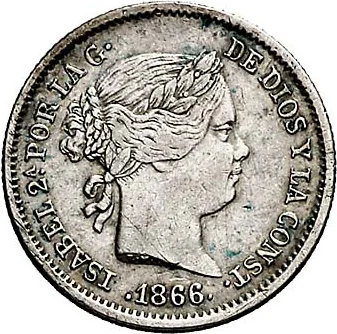
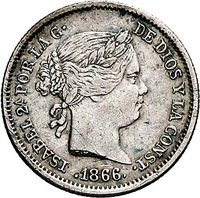
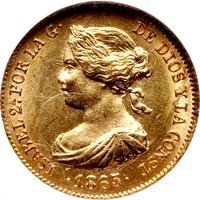
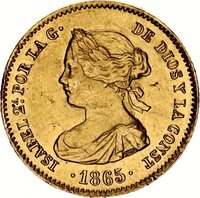
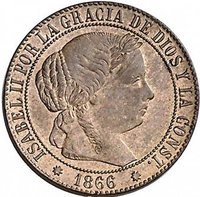
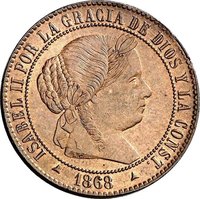
Obverse
Description:
Queen Isabella II facing right.
Inscription:
ISABEL 2A. POR LA G· DE DIOS Y LA CONST ·
. 1866 .
. 1866 .
Translation:
Isabel 2nd. By the Grace of God and the Constitution. 1866.
Script: Latin
Language: Spanish
Engraver: Luis Marchionni y Hombrón
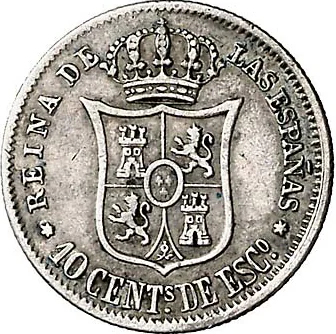
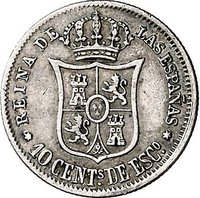
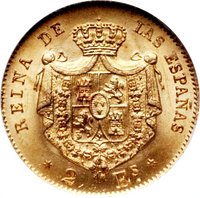
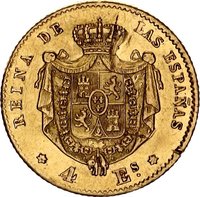
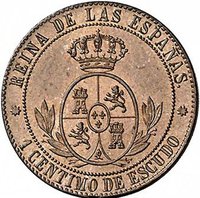
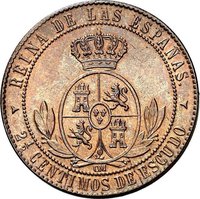
Reverse
Description:
Royal arms of Spain.
Inscription:
REINA DE LAS ESPAÑAS
* 10 CENTs. DE ESCº. *
* 10 CENTs. DE ESCº. *
Translation:
Queen of the Spains
* 10 Cents. of Escº. *
* 10 Cents. of Escº. *
Script: Latin
Language: Spanish
Engraver: Luis Marchionni y Hombrón
Edge
Reeded
Categories
| Symbols> Coat of Arms |
Mints
| Name | Mark |
|---|---|
| Royal Mint of Madrid | — |
| Royal Mint of Seville | — |
Mintings
| Year | Mint Mark | Mintage | Quality | Collection |
|---|---|---|---|---|
| 1865 | — | — | ||
| 1866 | — | — | ||
| 1867 | — | — | ||
| 1868 | — | — |
Historical background
In 1865, Spain's currency system was in a state of transition and strain, caught between the old peseta and the traditional real. The revolutionary government of 1868 would soon formally introduce the peseta as the sole national currency in 1869, but in 1865, both units were circulating in a complex relationship. The basic unit of account was the real, with the silver peseta officially valued at 4 reales. However, the system was fragmented, with different regions using their own subsidiary coinage, and the government struggled with chronic budget deficits that undermined monetary stability.
The broader context was one of financial pressure. The mid-1860s were a period of economic difficulty for Spain, following the loss of colonial revenues and costly foreign interventions. The state treasury was depleted, leading to repeated devaluations and the issuance of low-quality fractional coinage. Internationally, Spain was on a bimetallic (gold and silver) standard, but like many nations, it faced the disruptive effects of fluctuating global precious metal values. This environment created uncertainty for both domestic commerce and foreign trade.
Consequently, by 1865, there was a growing consensus among economic reformers and political liberals that the existing monetary order was untenable. The call for a unified, decimal, and modern currency system was gaining momentum as a necessary step for national economic integration and progress. Thus, the currency situation of 1865 represents the final years of an antiquated system, with the country on the cusp of the monetary reform that would permanently establish the peseta as the symbol of Spain's modern financial identity.
The broader context was one of financial pressure. The mid-1860s were a period of economic difficulty for Spain, following the loss of colonial revenues and costly foreign interventions. The state treasury was depleted, leading to repeated devaluations and the issuance of low-quality fractional coinage. Internationally, Spain was on a bimetallic (gold and silver) standard, but like many nations, it faced the disruptive effects of fluctuating global precious metal values. This environment created uncertainty for both domestic commerce and foreign trade.
Consequently, by 1865, there was a growing consensus among economic reformers and political liberals that the existing monetary order was untenable. The call for a unified, decimal, and modern currency system was gaining momentum as a necessary step for national economic integration and progress. Thus, the currency situation of 1865 represents the final years of an antiquated system, with the country on the cusp of the monetary reform that would permanently establish the peseta as the symbol of Spain's modern financial identity.
Series: 1865 Spain circulation coins
⭐ Rare