

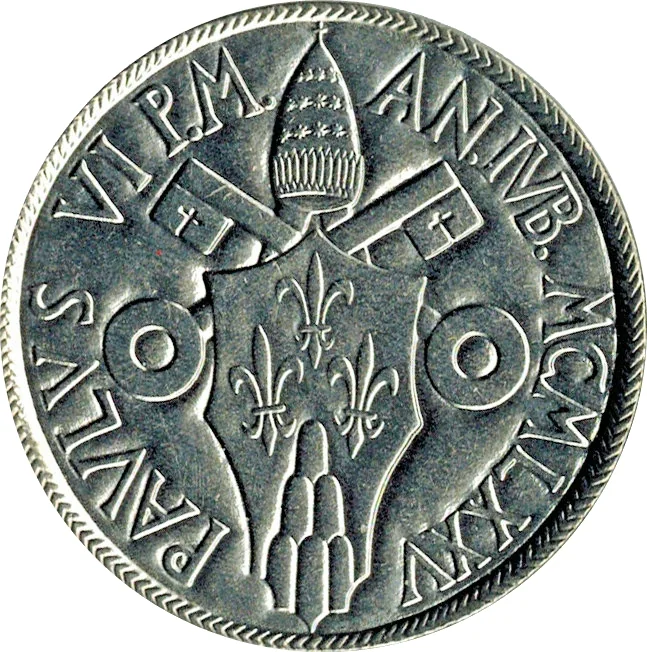
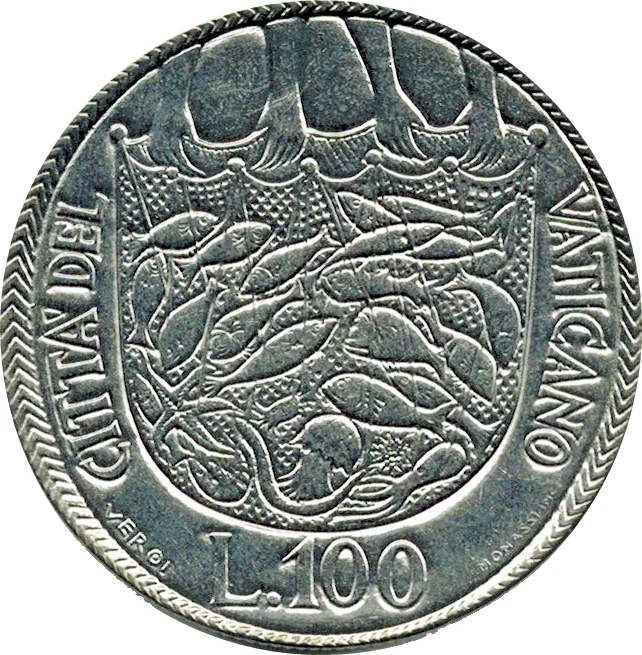
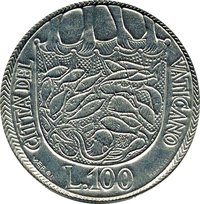
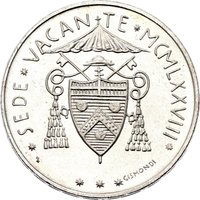
100 Lire – Vatican City
Circulating commemorative coins
Commemoration: Holy Year
Vatican City
Context
Year: 1975
Issuer: Vatican City 
Ruler: Paul VI
Currency:
(1929—2001)
Demonetization: 1 March 2002
Total mintage: 605,000
Material
Diameter: 27.75 mm
Weight: 8 g
Thickness: 2 mm
Shape: Round
Composition: Stainless steel
Technique: Milled
Alignment: Coin alignment
flip
References
KM: #Click to copy to clipboard130
Numista: #10048
Value
Exchange value: 100 VAL
Obverse
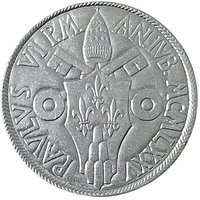
Reverse
Edge
Reeded
Mintings
| Year | Mint Mark | Mintage | Quality | Collection |
|---|---|---|---|---|
| 1975 | — | 605,000 |
Historical background
In 1975, Vatican City's currency situation was defined by its unique status as a sovereign city-state without an independent monetary policy. It did not issue its own banknotes for general circulation. Instead, its official legal tender was the Italian lira, as established by the 1929 Lateran Treaty that created the modern Vatican state. This practical arrangement reflected Vatican City's geographical and economic integration with Italy, facilitating all daily transactions and financial operations within its walls.
However, the Vatican did possess the right to mint its own coins, a key symbol of its sovereignty. These Vatican lire coins, issued in denominations matching those of Italy (from 1 to 500 lire), were legal tender within Vatican City and, by agreement, throughout Italy and San Marino. Struck at the Italian Mint (Istituto Poligrafico e Zecca dello Stato), these coins bore distinctive designs featuring the effigy of Pope Paul VI and symbols of the papacy or the state. Their issuance was strictly limited by treaty to amounts deemed necessary for the city-state's internal needs, preventing them from disrupting the Italian monetary supply.
The year 1975 fell within a period of significant economic turmoil for Italy, marked by high inflation and lira instability following the collapse of the Bretton Woods system. While the Vatican's currency was pegged to the struggling lira, its small, closed economy and unique revenue sources (including donations and museum admissions) somewhat insulated it from the worst effects. The primary monetary concern for the Holy See was less about day-to-day currency and more about managing its substantial international assets and investments in a volatile global economic climate, a task overseen by the Administration of the Patrimony of the Apostolic See.
However, the Vatican did possess the right to mint its own coins, a key symbol of its sovereignty. These Vatican lire coins, issued in denominations matching those of Italy (from 1 to 500 lire), were legal tender within Vatican City and, by agreement, throughout Italy and San Marino. Struck at the Italian Mint (Istituto Poligrafico e Zecca dello Stato), these coins bore distinctive designs featuring the effigy of Pope Paul VI and symbols of the papacy or the state. Their issuance was strictly limited by treaty to amounts deemed necessary for the city-state's internal needs, preventing them from disrupting the Italian monetary supply.
The year 1975 fell within a period of significant economic turmoil for Italy, marked by high inflation and lira instability following the collapse of the Bretton Woods system. While the Vatican's currency was pegged to the struggling lira, its small, closed economy and unique revenue sources (including donations and museum admissions) somewhat insulated it from the worst effects. The primary monetary concern for the Holy See was less about day-to-day currency and more about managing its substantial international assets and investments in a volatile global economic climate, a task overseen by the Administration of the Patrimony of the Apostolic See.
🌱 Common