

1 Rupee – Nepal
Nepal
Context
Years: 1949–1953
Issuer: Nepal 
Ruler: Tribhuvan Bir Bikram Shah
Currency:
(since 1932)
Demonetized: Yes
Material
References
KM: #Click to copy to clipboard726
Numista: #18324
Value
Exchange value: 1 NPR
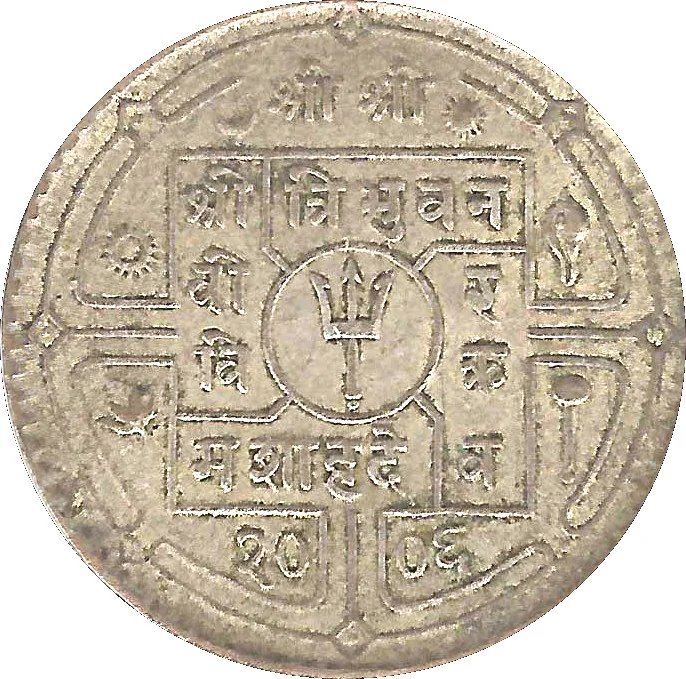
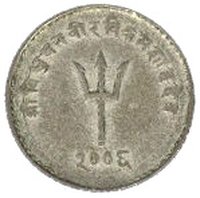
Obverse
Description:
Trident in center circle. Date below.
Inscription:
२००६ (Date 2006=1949)
Translation:
Two thousand six (Date 2006=1949)
Language: Nepali
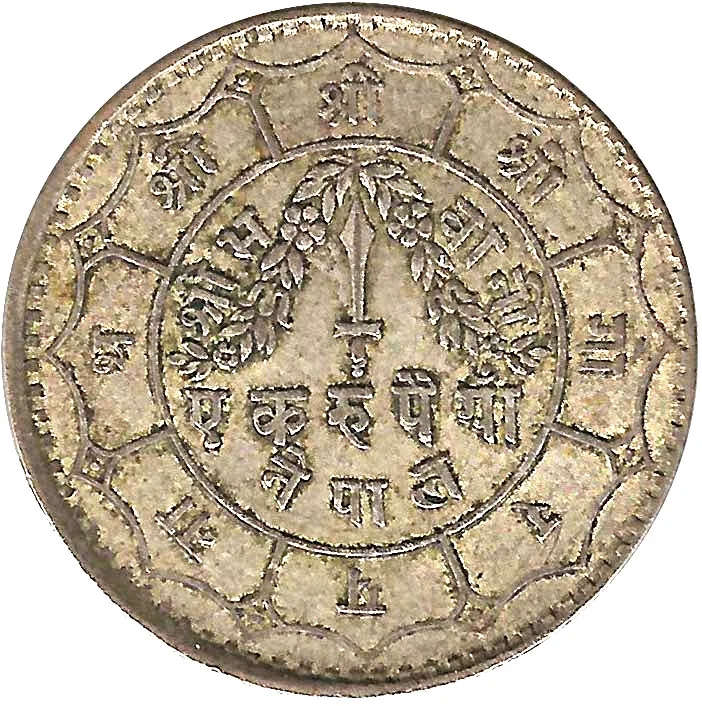
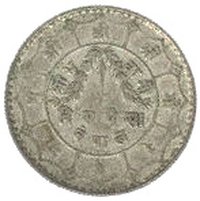
Reverse
Description:
Dagger between hanging garlands.
Edge
© Michass (CC BY-SA)
Mintings
| Year | Mint Mark | Mintage | Quality | Collection |
|---|---|---|---|---|
| 1949 | — | — | ||
| 1950 | — | — | ||
| 1951 | — | — | ||
| 1952 | — | — | ||
| 1953 | — | — |
Historical background
In 1949, Nepal's currency situation was characterized by a complex and transitional monetary system, heavily influenced by its economic and political ties with British India. The primary circulating medium was the Indian Rupee, which held de facto legal tender status and dominated trade and government accounts. Alongside this, the Nepalese government minted its own silver Mohar and copper coins, but these were limited in circulation and often valued in relation to the Indian Rupee. This dependency created a vulnerable, externally anchored monetary system where Nepal's domestic economy was directly susceptible to monetary policies and economic shifts in India.
The year 1949 was particularly significant as it followed the political upheaval of the 1947 Indian independence and preceded Nepal's own major reforms. The collapse of the Rana regime's century-old autocracy in 1950 was imminent, and economic discontent was rising. A critical issue was the severe shortage of Indian Rupee coins in Nepal, which crippled everyday small transactions in markets. This coin famine caused significant public inconvenience and economic disruption, highlighting the impracticalities and constraints of relying entirely on a foreign currency for a nation's daily monetary needs.
This crisis directly catalyzed a decisive monetary shift. In response to the chronic shortage and the need for sovereign economic control, the Rana government, under Prime Minister Mohan Shumsher, established the Nepal Rastra Bank in April 1949 through the Nepal Rastra Bank Act. While the bank would not be fully operational until 1956, its founding in 1949 marked the definitive plan to introduce a distinct national currency. Thus, the currency situation of 1949 is best understood as the final chapter of monetary dependency, setting the immediate legal and institutional groundwork for the introduction of the Nepalese Rupee in the subsequent decade.
The year 1949 was particularly significant as it followed the political upheaval of the 1947 Indian independence and preceded Nepal's own major reforms. The collapse of the Rana regime's century-old autocracy in 1950 was imminent, and economic discontent was rising. A critical issue was the severe shortage of Indian Rupee coins in Nepal, which crippled everyday small transactions in markets. This coin famine caused significant public inconvenience and economic disruption, highlighting the impracticalities and constraints of relying entirely on a foreign currency for a nation's daily monetary needs.
This crisis directly catalyzed a decisive monetary shift. In response to the chronic shortage and the need for sovereign economic control, the Rana government, under Prime Minister Mohan Shumsher, established the Nepal Rastra Bank in April 1949 through the Nepal Rastra Bank Act. While the bank would not be fully operational until 1956, its founding in 1949 marked the definitive plan to introduce a distinct national currency. Thus, the currency situation of 1949 is best understood as the final chapter of monetary dependency, setting the immediate legal and institutional groundwork for the introduction of the Nepalese Rupee in the subsequent decade.

🌟 Limited