

1 lira – San Marino
Add to wishlist
Non-circulating coins
Series: Fortifications
San Marino
Context
Year: 1988
Issuer: San Marino
Period:
(since 301)
Currency:
(1864—2001)
Demonetization: 1 March 2002
Total mintage: 38,000
Material
References
KM: #
Numista: #18263
Value
Exchange value: 1 SML
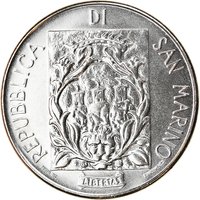
Obverse
Description:
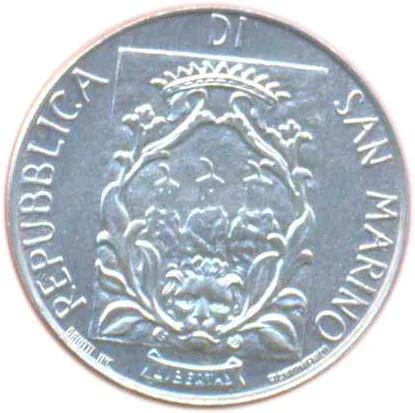
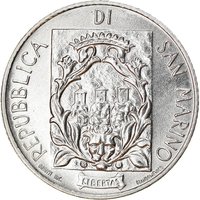
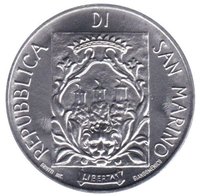
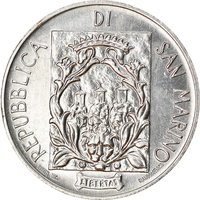
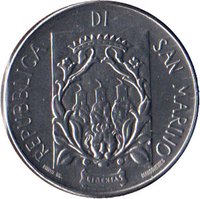
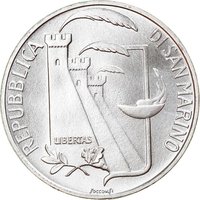
Rectangular plaque featuring San Marino's crowned arms, encircled by a wreath with a lion's head beneath.
Inscription:
REPUBBLICA DI SAN MARINO
LIBERTAS
LIBERTAS
Translation:
Liberty Republic of San Marino
Script: Latin
Engravers: Sergio Giandomenico, Eugenio Driutti
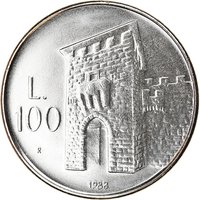
Reverse
Description:
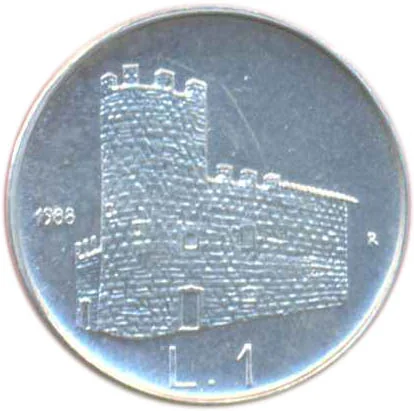
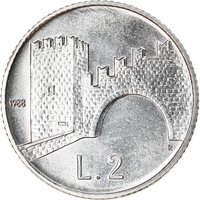
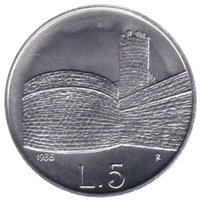
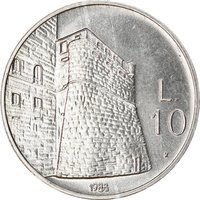
Fortified tower with battlements.
Inscription:
1988 R
L. 1
L. 1
Script: Latin
Engravers: Sergio Giandomenico, Eugenio Driutti
Edge
Plain
Categories
| Building> Castle or fortification |
| Building> Tower |
Mints
| Name | Mark |
|---|---|
| Rome | R |
Mintings
| Year | Mint Mark | Mintage | Quality | Collection |
|---|---|---|---|---|
| 1988 | R | 38,000 | In sets |
Historical background
In 1988, San Marino's currency situation was fundamentally defined by its close economic and monetary integration with Italy, governed by a series of bilateral treaties. The Republic used the Italian Lira (ITL) as its sole legal tender for all everyday transactions, having formally adopted it under a 1939 convention that replaced the Sammarinese lira. This arrangement meant San Marino had no independent monetary policy; its money supply, interest rates, and inflation were directly determined by the decisions of the Banca d'Italia, effectively ceding monetary sovereignty to its much larger neighbor.
However, San Marino maintained the right to issue limited quantities of its own commemorative and collectible coinage, denominated in "Lire Sammarinesi." These special coins, minted for numismatists, had the same face value as their Italian counterparts and were technically legal tender within the republic's borders, but they rarely circulated in practice. Their issuance was strictly controlled by treaty to prevent any disruption to the Italian monetary system and served primarily as a source of state revenue and a symbol of national identity.
The year 1988 fell within a period of relative stability under this long-standing system, but it was also the final decade of the Lira's exclusive dominion. Looking ahead, discussions at the European Community level—which Italy was a part of—were already underway regarding Economic and Monetary Union (EMU). These distant talks would eventually lead to the introduction of the Euro, a change that San Marino, through new negotiations, would also adopt in 2002 while retaining the right to issue its own limited euro coinage, thus preserving a key element of its 1988 monetary model.
However, San Marino maintained the right to issue limited quantities of its own commemorative and collectible coinage, denominated in "Lire Sammarinesi." These special coins, minted for numismatists, had the same face value as their Italian counterparts and were technically legal tender within the republic's borders, but they rarely circulated in practice. Their issuance was strictly controlled by treaty to prevent any disruption to the Italian monetary system and served primarily as a source of state revenue and a symbol of national identity.
The year 1988 fell within a period of relative stability under this long-standing system, but it was also the final decade of the Lira's exclusive dominion. Looking ahead, discussions at the European Community level—which Italy was a part of—were already underway regarding Economic and Monetary Union (EMU). These distant talks would eventually lead to the introduction of the Euro, a change that San Marino, through new negotiations, would also adopt in 2002 while retaining the right to issue its own limited euro coinage, thus preserving a key element of its 1988 monetary model.
Series: Fortifications
🌟 Uncommon