

2 fillér – Hungary
Add to wishlist
Hungary
Obverse
Description:
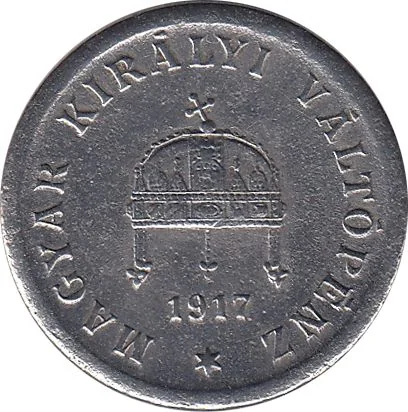
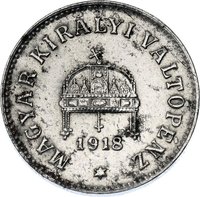
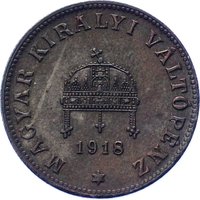
Holy Crown of Hungary, with legend and date.
Inscription:
MAGYAR KIRÁLYI VÁLTÓPÉNZ *
1918
1918
Translation:
ROYAL HUNGARIAN CHANGE COIN *
1918
1918
Script: Latin
Language: Hungarian
Engraver: Richard Adolf Zutt
Reverse
Description:
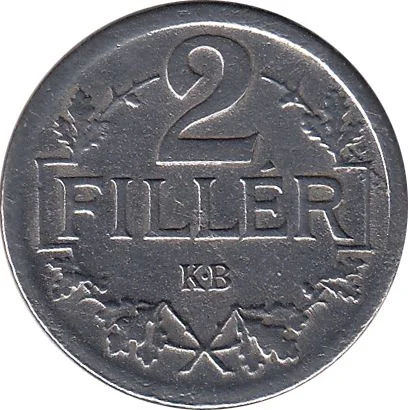
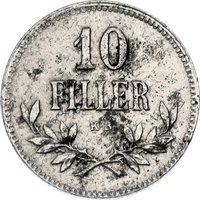
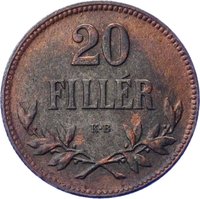
Spray denomination.
Inscription:
2 FILLÉR
K.B
K.B
Translation:
Two Fillér
Script: Latin
Language: Hungarian
Engraver: Richard Adolf Zutt
Edge
Plain
Mints
| Name | Mark |
|---|---|
| Kremnica | KB |
Historical background
By 1916, Hungary's currency situation was defined by the severe strains of the First World War, fought as part of the Austro-Hungarian Dual Monarchy. The Hungarian korona, legally equal to the Austrian krone and part of a unified currency area, was financed primarily through war loans and the continuous printing of money by the Austro-Hungarian Bank. This direct monetization of the state's deficit led to rampant inflation, as the money supply expanded dramatically without corresponding economic growth. Price controls and rationing were implemented on essential goods, but these measures created widespread shortages and a burgeoning black market where real prices soared.
The underlying economic structure exacerbated the crisis. Hungary's role as the agricultural heartland of the Empire was undermined by the mobilization of manpower and horses for the front, leading to falling production just as demand from the military and civilian populations peaked. Furthermore, the Allied blockade severed access to international markets and key imports, crippling industry and creating critical raw material shortages. The government's financial policy was effectively subordinated to the Monarchy's joint war effort, leaving Budapest with little independent monetary authority to address the spiraling domestic economic collapse.
Consequently, the currency's purchasing power eroded significantly. Public confidence in the korona dwindled, and people increasingly hoarded goods, precious metals, or stable foreign currencies. The inflationary financing marked the beginning of a complete unraveling of the monetary system, setting the stage for the hyperinflation and currency fragmentation that would follow the Empire's dissolution in 1918. The 1916 situation was therefore a pivotal point on a path toward total financial disintegration.
The underlying economic structure exacerbated the crisis. Hungary's role as the agricultural heartland of the Empire was undermined by the mobilization of manpower and horses for the front, leading to falling production just as demand from the military and civilian populations peaked. Furthermore, the Allied blockade severed access to international markets and key imports, crippling industry and creating critical raw material shortages. The government's financial policy was effectively subordinated to the Monarchy's joint war effort, leaving Budapest with little independent monetary authority to address the spiraling domestic economic collapse.
Consequently, the currency's purchasing power eroded significantly. Public confidence in the korona dwindled, and people increasingly hoarded goods, precious metals, or stable foreign currencies. The inflationary financing marked the beginning of a complete unraveling of the monetary system, setting the stage for the hyperinflation and currency fragmentation that would follow the Empire's dissolution in 1918. The 1916 situation was therefore a pivotal point on a path toward total financial disintegration.
🌱 Common