

8 euro – Portugal
Add to wishlist
Portugal
Context
Material
Diameter: 36 mm
Weight: 31.1 g
Silver Weight:: 28.77 g
Shape: Round
Composition: 92.5% Silver
Standard: Silver ounce
Magnetic: No
Technique: Milled
Alignment: Medal alignment
flip
References
KM: #
Numista: #18238
Value
Exchange value: 8 EUR
Bullion value: $73.51
Inflation-adjusted value: 10.86 EUR
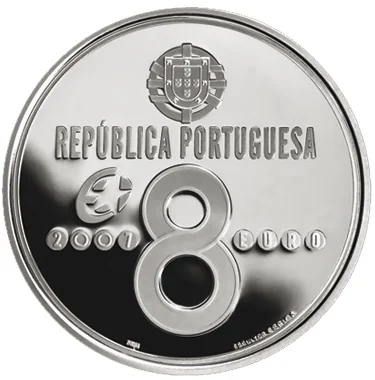
Obverse
Description:
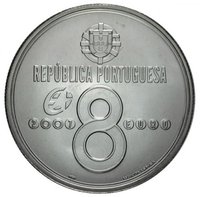
Portuguese coat of arms.
Inscription:
REPÚBLICA PORTUGUESA
2007 8 EURO
INCM ESCULTOR ESPIGA
2007 8 EURO
INCM ESCULTOR ESPIGA
Translation:
PORTUGUESE REPUBLIC
2007 8 EURO
INCM SCULPTOR ESPIGA
2007 8 EURO
INCM SCULPTOR ESPIGA
Script: Latin
Language: Portuguese
Engraver: J. M. Espiga Pinto
Reverse
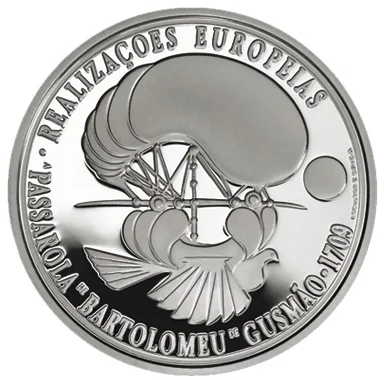
Description:
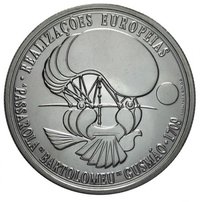
Bartolomeu Lourenço de Gusmão (1685–1724), a Brazilian-born inventor and religious, created the first aerostation invention. It was pejoratively called "the Glider" due to fanciful European drawings depicting it as a bird-shaped boat, leading to its name, the Passarola ("Big Bird").
Inscription:
REALIZAÇOES EUROPEIAS
·A PASSAROLA DE BARTOLOMEU DE GUSMÃO·1709
·A PASSAROLA DE BARTOLOMEU DE GUSMÃO·1709
Translation:
European Achievements
·Bartolomeu de Gusmão's Passarola·1709
·Bartolomeu de Gusmão's Passarola·1709
Script: Latin
Language: Portuguese
Engraver: J. M. Espiga Pinto
Edge
Fine grooves.
Categories
| Symbols> Coat of Arms |
Mints
| Name | Mark |
|---|---|
| Imprensa Nacional - Casa da Moeda | INCM |
Mintings
| Year | Mint Mark | Mintage | Quality | Collection |
|---|---|---|---|---|
| 2007 | INCM | 14,856 | Proof |
Historical background
In 2007, Portugal was a member of the Eurozone, having adopted the euro as its official currency in 1999 (with notes and coins introduced in 2002). This meant it had fully ceded control of its monetary policy to the European Central Bank (ECB), which set interest rates for the entire currency bloc. While the euro brought macroeconomic stability, lower transaction costs, and easier access to capital markets, it also removed key adjustment tools like currency devaluation, which Portugal had historically used to regain competitiveness against its European partners.
The country entered 2007 in a state of economic fragility, marked by a decade of low growth and rising public and private debt. A key issue was a pronounced loss of competitiveness within the Eurozone, as unit labor costs had risen faster than in Germany and other core economies. This resulted in persistent current account deficits, as Portugal imported more than it exported. The economy was propped up by relatively low ECB interest rates, which fueled a credit boom and a housing market bubble, masking underlying structural problems in productivity and the export sector.
By the end of 2007, the global financial crisis was beginning to unfold, but its full impact on Portugal was not yet fully felt. The underlying weaknesses—stagnant growth, high debt levels, and a lack of competitiveness—had made the Portuguese economy particularly vulnerable. The fixed exchange rate of the euro meant Portugal could not devalue its currency to stimulate exports, trapping it in what some economists termed a "straitjacket." This precarious situation set the stage for the severe sovereign debt crisis that would fully erupt in 2010-2011, ultimately leading Portugal to request an international financial bailout in April 2011.
The country entered 2007 in a state of economic fragility, marked by a decade of low growth and rising public and private debt. A key issue was a pronounced loss of competitiveness within the Eurozone, as unit labor costs had risen faster than in Germany and other core economies. This resulted in persistent current account deficits, as Portugal imported more than it exported. The economy was propped up by relatively low ECB interest rates, which fueled a credit boom and a housing market bubble, masking underlying structural problems in productivity and the export sector.
By the end of 2007, the global financial crisis was beginning to unfold, but its full impact on Portugal was not yet fully felt. The underlying weaknesses—stagnant growth, high debt levels, and a lack of competitiveness—had made the Portuguese economy particularly vulnerable. The fixed exchange rate of the euro meant Portugal could not devalue its currency to stimulate exports, trapping it in what some economists termed a "straitjacket." This precarious situation set the stage for the severe sovereign debt crisis that would fully erupt in 2010-2011, ultimately leading Portugal to request an international financial bailout in April 2011.
Series: Europa Star
⭐ Rare