

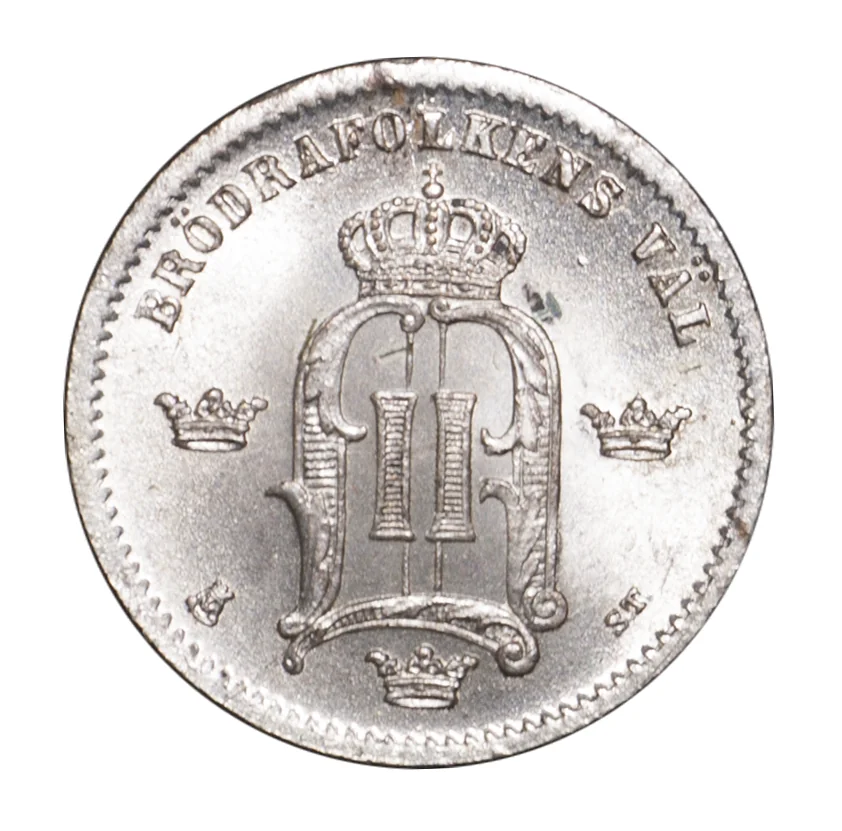
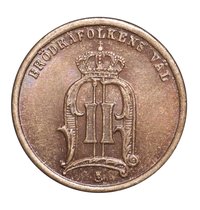
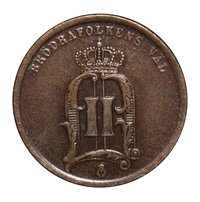
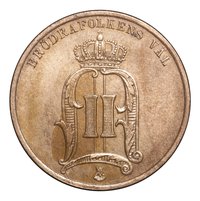
Obverse
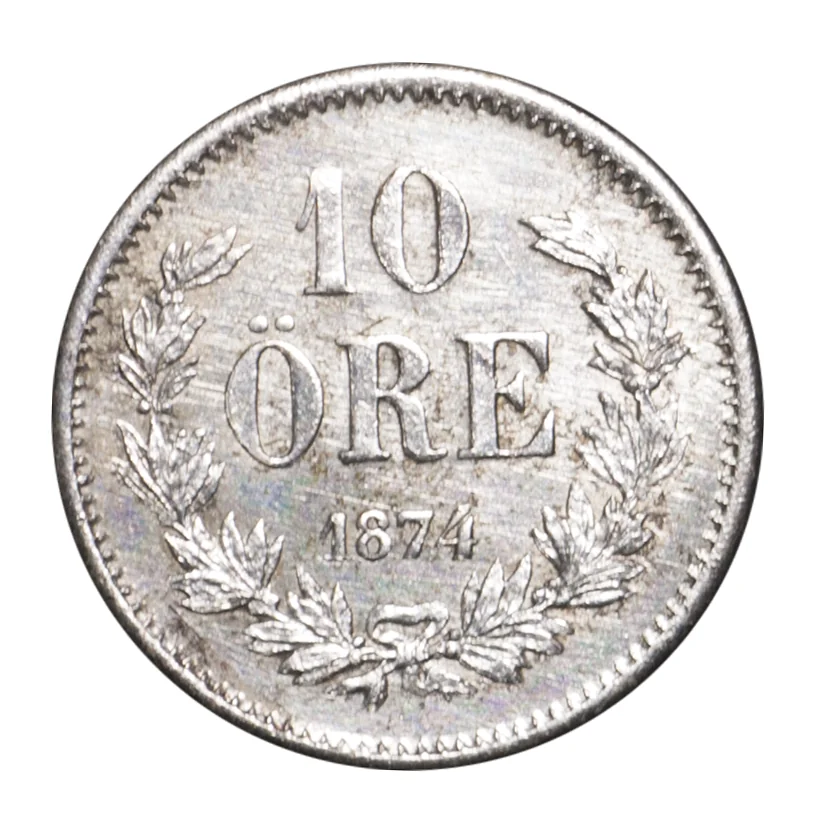
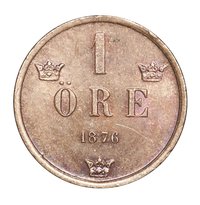
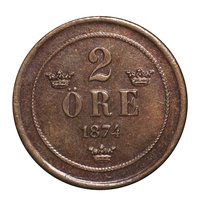
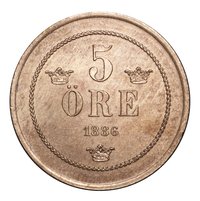
Reverse
Edge
Plain
Mints
| Name | Mark |
|---|---|
| Kungliga Myntet | — |
Mintings
| Year | Mint Mark | Mintage | Quality | Collection |
|---|---|---|---|---|
| 1874 | — | 2,875,000 | ||
| 1875 | — | 1,503,365 | ||
| 1876 | — | 1,814,364 |
Historical background
In 1874, Sweden was on the cusp of a major monetary transformation, transitioning from a complex and outdated system to a modern, standardized one. For centuries, the nation had used the riksdaler riksmynt as its primary unit of account, but the actual circulating currency was a confusing mix of paper notes issued by private banks, silver coins, and even a parallel system of riksdaler specie for international trade. This fragmentation caused practical difficulties for commerce and finance, hindering economic integration and creating exchange rate uncertainties even within the country's own borders.
The decisive push for reform came from the broader Scandinavian Monetary Union, which Sweden formed with Denmark in 1873 and which Norway joined in 1875. The agreement aimed to create a unified currency zone based on the gold standard, replacing the silver-based riksdaler. The new unit was the krona (plural: kronor), meaning "crown," subdivided into 100 öre. The Act of 1874 formally adopted this new currency, pegging it to gold at a fixed rate of 2,480 kronor per kilogram of fine gold, bringing monetary stability and aligning Sweden with the dominant international financial system.
Thus, 1874 represents the pivotal legislative year when Sweden abandoned its old monetary heritage. While the physical introduction of new coins and notes would take several more years, the legal framework was established, setting the nation on a path toward a stable, decimalized, and internationally recognized currency. This move not only facilitated trade with its Nordic neighbors but also integrated Sweden more firmly into the global economy of the late 19th century.
The decisive push for reform came from the broader Scandinavian Monetary Union, which Sweden formed with Denmark in 1873 and which Norway joined in 1875. The agreement aimed to create a unified currency zone based on the gold standard, replacing the silver-based riksdaler. The new unit was the krona (plural: kronor), meaning "crown," subdivided into 100 öre. The Act of 1874 formally adopted this new currency, pegging it to gold at a fixed rate of 2,480 kronor per kilogram of fine gold, bringing monetary stability and aligning Sweden with the dominant international financial system.
Thus, 1874 represents the pivotal legislative year when Sweden abandoned its old monetary heritage. While the physical introduction of new coins and notes would take several more years, the legal framework was established, setting the nation on a path toward a stable, decimalized, and internationally recognized currency. This move not only facilitated trade with its Nordic neighbors but also integrated Sweden more firmly into the global economy of the late 19th century.
Series: 1874 Sweden circulation coins
🌱 Fairly Common