

Obverse
Description:
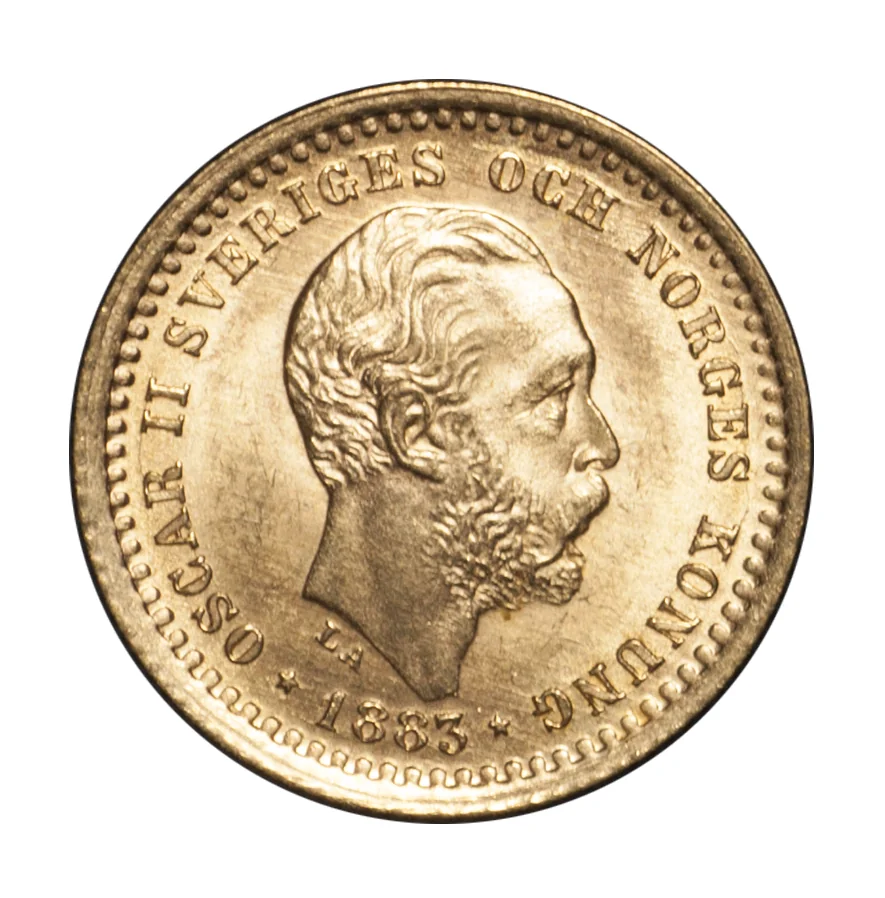
Oscar II facing right, inscription surrounding. Date between stars below.
Inscription:
OSCAR II SVERIGES OCH NORGES KONUNG
LA
⋆ 1882 ⋆
LA
⋆ 1882 ⋆
Translation:
Oscar II, Sweden's and Norway's King
By the grace of God
⋆ 1882 ⋆
By the grace of God
⋆ 1882 ⋆
Script: Latin
Engraver: Lea Ahlborn
Reverse
Description:
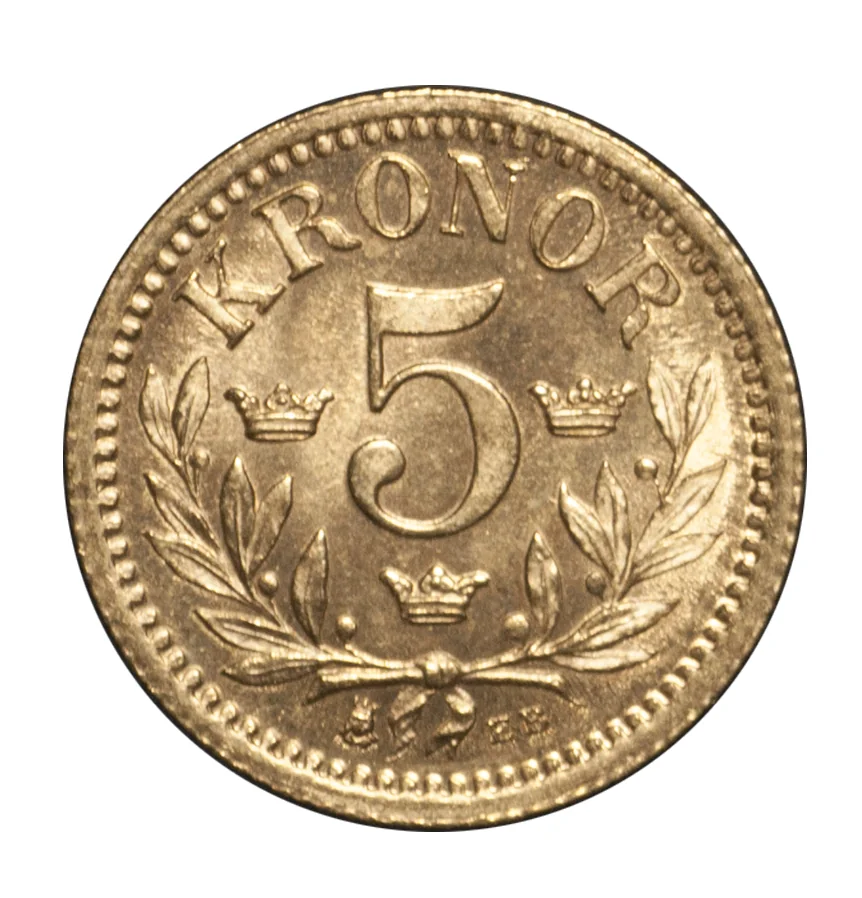
Swedish three crowns and numeral in wreath, text above, mintmarks below.
Inscription:
KRONOR
5
EB
5
EB
Script: Latin
Engraver: Lea Ahlborn
Edge
Reeded
Mints
| Name | Mark |
|---|---|
| Kungliga Myntet | — |
Mintings
| Year | Mint Mark | Mintage | Quality | Collection |
|---|---|---|---|---|
| 1881 | — | 65,000 | ||
| 1882 | — | 30,000 | ||
| 1883 | — | 28,001 | ||
| 1886 | — | 41,740 | ||
| 1894 | — | 51,273 | ||
| 1899 | — | 104,101 |
Historical background
In 1881, Sweden was in the final decades of the Scandinavian Monetary Union, a period of monetary stability underpinned by the gold standard. The country, alongside Denmark, had formed this union in 1873 (with Norway joining in 1875), establishing the krona (krone in Danish/Norwegian) as a shared currency. The core principle was that Swedish kronor, Danish kroner, and Norwegian kroner were legally accepted at par across the three kingdoms, as all were backed by and freely convertible into gold at a fixed rate. This created a de facto single currency area in Scandinavia, facilitating trade and investment.
Domestically, Sweden's currency was managed by the Riksbank, the world's oldest central bank. The nation's money supply was firmly tied to its gold reserves, which instilled confidence and controlled inflation but also meant the economy was susceptible to international gold flows and the business cycles of larger industrial nations. Banknotes in circulation were, in theory, promises to pay gold coin on demand, and the silver riksdaler, the pre-union currency, had been fully phased out. The system was modern and well-regarded, supporting Sweden's ongoing industrial transformation.
However, this stability was not without underlying tensions. The success of the Monetary Union relied entirely on the continued commitment of all member states to maintain strict gold convertibility. While 1881 itself was not a year of crisis, the seeds of future strain were present. Differences in economic policy, the fiscal demands of World War I, and the eventual global move away from the gold standard would later expose the fragility of the arrangement, leading to the union's effective dissolution in the early 20th century. For the time being, however, Sweden enjoyed a sound and internationally integrated currency.
Domestically, Sweden's currency was managed by the Riksbank, the world's oldest central bank. The nation's money supply was firmly tied to its gold reserves, which instilled confidence and controlled inflation but also meant the economy was susceptible to international gold flows and the business cycles of larger industrial nations. Banknotes in circulation were, in theory, promises to pay gold coin on demand, and the silver riksdaler, the pre-union currency, had been fully phased out. The system was modern and well-regarded, supporting Sweden's ongoing industrial transformation.
However, this stability was not without underlying tensions. The success of the Monetary Union relied entirely on the continued commitment of all member states to maintain strict gold convertibility. While 1881 itself was not a year of crisis, the seeds of future strain were present. Differences in economic policy, the fiscal demands of World War I, and the eventual global move away from the gold standard would later expose the fragility of the arrangement, leading to the union's effective dissolution in the early 20th century. For the time being, however, Sweden enjoyed a sound and internationally integrated currency.
⭐ Somewhat Rare