

25 francs cfa – Western African States
Add to wishlist
Circulating commemorative coins
Commemoration: F.A.O.
Context
Years: 1980–2024
Issuer: Western African States
Issuing organization: Central Bank of Western African States
Currency:
(since 1958)
Total mintage: 194,714,800
Material
Diameter: 27 mm
Weight: 8 g
Thickness: 2.2 mm
Shape: Round
Composition: Aluminium bronze
Magnetic: No
Technique: Milled
Alignment: Coin alignment
flip
References
KM: #
Numista: #1800
Value
Exchange value: 25 XOF
Obverse
Description:
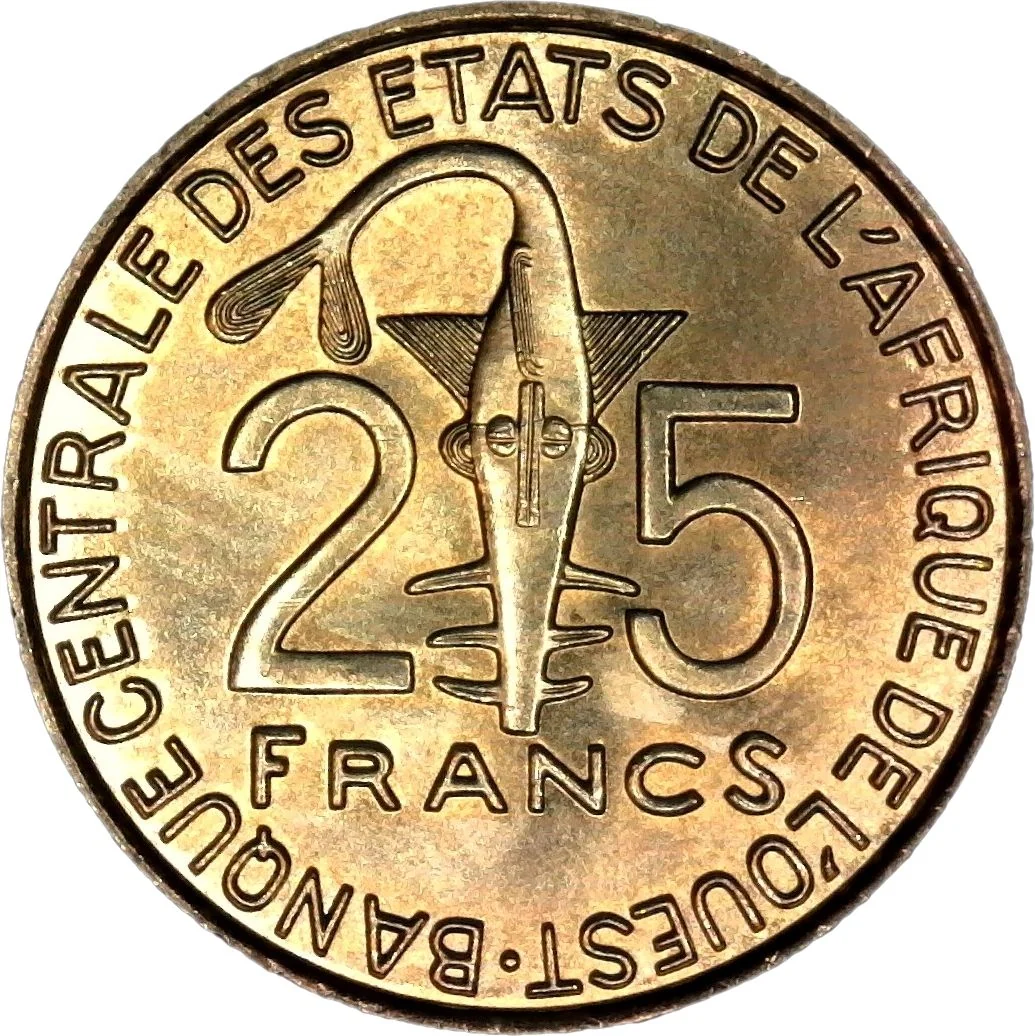
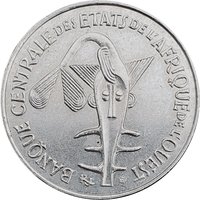
BCEAO emblem and value
Inscription:
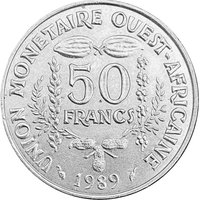
25 FRANCS
BANQUE CENTRALE DES ETATS DE L'AFRIQUE DE L'OUEST
BANQUE CENTRALE DES ETATS DE L'AFRIQUE DE L'OUEST
Translation:
25 FRANCS
CENTRAL BANK OF THE WEST AFRICAN STATES
CENTRAL BANK OF THE WEST AFRICAN STATES
Script: Latin
Language: French
Engraver: Gabriel-Bernard Lucien Georges Bazor
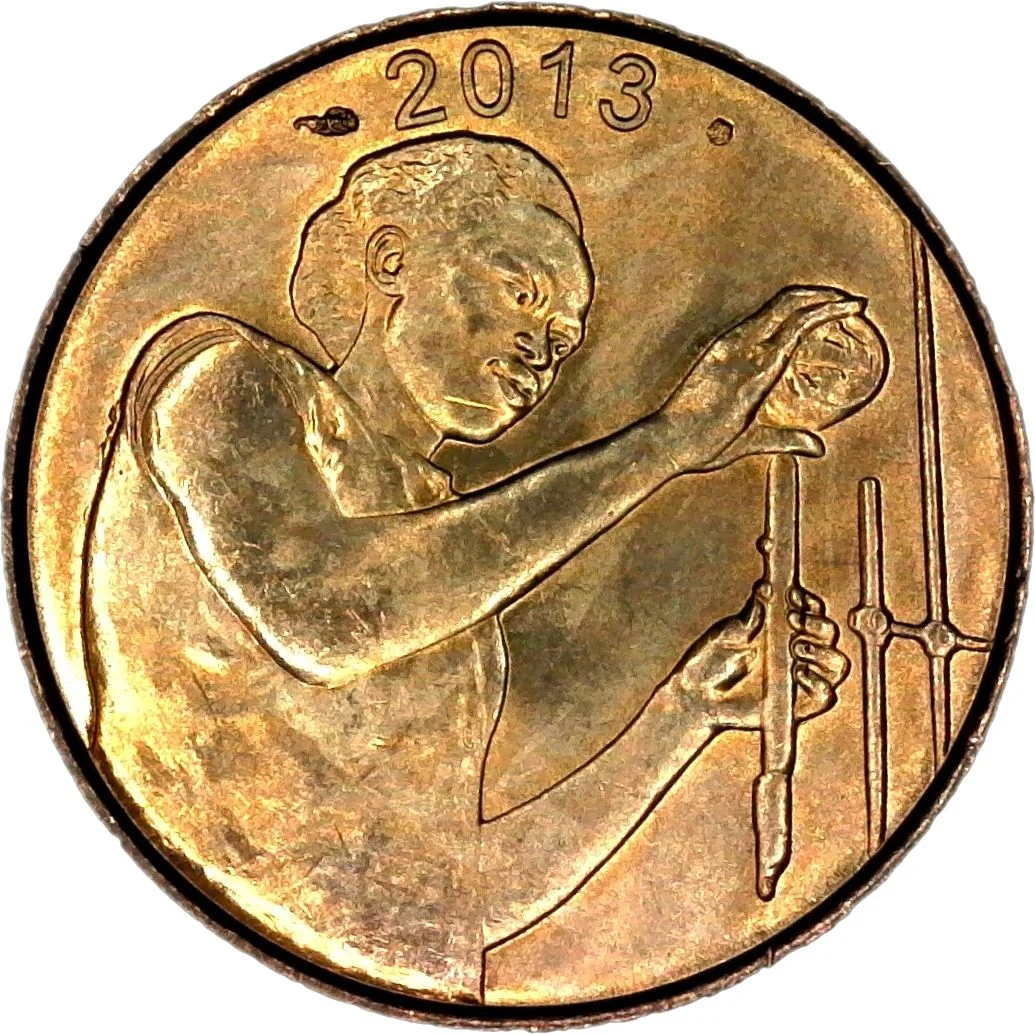
Reverse
Edge
Reeded
Categories
| Organization> FAO |
| Science |
Mints
| Name | Mark |
|---|---|
| Monnaie de Paris | — |
Mintings
| Year | Mint Mark | Mintage | Quality | Collection |
|---|---|---|---|---|
| 1980 | — | 7,825,800 | ||
| 1981 | — | 3,998,400 | ||
| 1982 | — | 8,001,600 | ||
| 1984 | — | 15,311,200 | ||
| 1987 | — | 9,000,000 | ||
| 1989 | — | 17,601,600 | ||
| 1990 | — | 6,000,000 | ||
| 1991 | — | 1,685,000 | ||
| 1992 | — | 6,000,000 | ||
| 1994 | — | 4,089,600 | ||
| 1995 | — | 4,089,600 | ||
| 1996 | — | 18,327,600 | ||
| 1997 | — | 21,940,800 | ||
| 1999 | — | 20,649,600 | ||
| 2000 | — | 17,102,800 | ||
| 2001 | — | 5,380,800 | ||
| 2002 | — | 19,108,800 | ||
| 2003 | — | 5,001,600 | ||
| 2004 | — | 3,600,000 | ||
| 2005 | — | — | ||
| 2006 | — | — | ||
| 2007 | — | — | ||
| 2008 | — | — | ||
| 2009 | — | — | ||
| 2010 | — | — | ||
| 2011 | — | — | ||
| 2012 | — | — | ||
| 2013 | — | — | ||
| 2014 | — | — | ||
| 2015 | — | — | ||
| 2016 | — | — | ||
| 2017 | — | — | ||
| 2018 | — | — | ||
| 2019 | — | — | ||
| 2020 | — | — | ||
| 2021 | — | — | ||
| 2022 | — | — | ||
| 2023 | — | — | ||
| 2024 | — | — |
Historical background
In 1980, the currency landscape of West Africa was predominantly defined by the CFA franc, a colonial-era currency used by two distinct monetary unions. The West African CFA franc (XOF), issued by the BCEAO (Central Bank of West African States), circulated in seven countries: Ivory Coast, Senegal, Niger, Burkina Faso, Mali, Benin, and Togo. Its counterpart, the Central African CFA franc (XAF), was used in a separate bloc further south. Both currencies were pegged at a fixed rate to the French franc (FF 1 = CFA 50) and were fully convertible, guaranteed by the French Treasury through an operations account. This arrangement provided monetary stability and low inflation but came at the cost of ceding national monetary sovereignty to France, a point of increasing political debate.
Economically, the early 1980s marked a turning point as the region faced severe external shocks following a decade of relative prosperity. The global oil crises of the 1970s and the subsequent collapse of commodity prices for key exports like cocoa, coffee, and groundnuts in the early 1980s led to mounting trade deficits and public debt. The fixed peg to the strong French franc, while ensuring stability, also made West African exports more expensive on the world market, exacerbating economic strains. This period set the stage for the structural adjustment programs that would be imposed by the IMF and World Bank later in the decade, with the CFA franc's rigidity becoming a central topic in discussions about economic competitiveness.
Politically, the currency was a symbol of both continuity and fracture. It facilitated financial integration and ease of trade within the Francophone bloc, but it also reinforced a divide with the larger Anglophone economies in the region, notably Nigeria and Ghana, which had their own independent currencies and more volatile monetary policies. Within the CFA zone itself, there was growing intellectual and political discourse questioning the necessity of the French guarantee and the constraints of the peg, though no member state moved to leave the system. Thus, in 1980, the CFA franc stood as a stable yet controversial pillar, operating in a region on the brink of a profound economic crisis that would test its fundamental principles.
Economically, the early 1980s marked a turning point as the region faced severe external shocks following a decade of relative prosperity. The global oil crises of the 1970s and the subsequent collapse of commodity prices for key exports like cocoa, coffee, and groundnuts in the early 1980s led to mounting trade deficits and public debt. The fixed peg to the strong French franc, while ensuring stability, also made West African exports more expensive on the world market, exacerbating economic strains. This period set the stage for the structural adjustment programs that would be imposed by the IMF and World Bank later in the decade, with the CFA franc's rigidity becoming a central topic in discussions about economic competitiveness.
Politically, the currency was a symbol of both continuity and fracture. It facilitated financial integration and ease of trade within the Francophone bloc, but it also reinforced a divide with the larger Anglophone economies in the region, notably Nigeria and Ghana, which had their own independent currencies and more volatile monetary policies. Within the CFA zone itself, there was growing intellectual and political discourse questioning the necessity of the French guarantee and the constraints of the peg, though no member state moved to leave the system. Thus, in 1980, the CFA franc stood as a stable yet controversial pillar, operating in a region on the brink of a profound economic crisis that would test its fundamental principles.
🌱 Very Common