

10 francs cfa – Western African States
Add to wishlist
Circulating commemorative coins
Commemoration: F.A.O.
Context
Years: 1981–2024
Issuer: Western African States
Issuing organization: Central Bank of Western African States
Currency:
(since 1958)
Total mintage: 364,440,000
Material
Diameter: 23.5 mm
Weight: 4 g
Thickness: 1.57 mm
Shape: Round
Composition: Aluminium bronze
Magnetic: No
Technique: Milled
Alignment: Coin alignment
flip
References
KM: #
Numista: #1799
Value
Exchange value: 10 XOF
Obverse
Description:
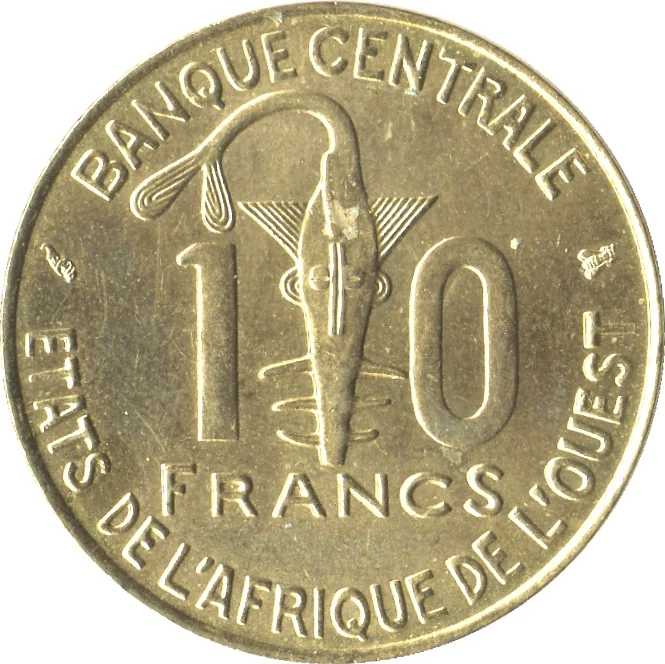
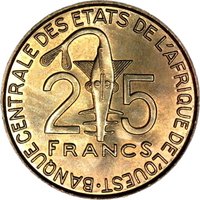
BCEAO emblem and value
Inscription:
BANQUE CENTRALE
10
FRANCS
ETATS DE L'AFRIQUE DE L'OUEST
10
FRANCS
ETATS DE L'AFRIQUE DE L'OUEST
Translation:
Central Bank
10
Francs
States of West Africa
10
Francs
States of West Africa
Script: Latin
Language: French
Engravers: Gabriel Bernard, Lucien Georges Bazor
Reverse
Edge
Plain
Categories
| Object> Container or tableware |
| Organization> FAO |
Mints
| Name | Mark |
|---|---|
| Monnaie de Paris | — |
Mintings
| Year | Mint Mark | Mintage | Quality | Collection |
|---|---|---|---|---|
| 1981 | — | 2,010,000 | ||
| 1982 | — | 23,000,000 | ||
| 1983 | — | 6,000,000 | ||
| 1984 | — | 10,000,000 | ||
| 1985 | — | 5,000,000 | ||
| 1986 | — | 7,500,000 | ||
| 1987 | — | 28,000,000 | ||
| 1989 | — | 40,500,000 | ||
| 1990 | — | 18,000,000 | ||
| 1991 | — | 13,010,000 | ||
| 1992 | — | 4,990,000 | ||
| 1993 | — | 4,400,000 | ||
| 1994 | — | 11,000,000 | ||
| 1995 | — | 12,500,000 | ||
| 1996 | — | 33,300,000 | ||
| 1997 | — | 38,170,000 | ||
| 1999 | — | 49,760,000 | ||
| 2000 | — | 8,300,000 | ||
| 2001 | — | 8,000,000 | ||
| 2002 | — | 28,000,000 | ||
| 2003 | — | 5,000,000 | ||
| 2004 | — | 8,000,000 | ||
| 2005 | — | — | ||
| 2006 | — | — | ||
| 2007 | — | — | ||
| 2008 | — | — | ||
| 2009 | — | — | ||
| 2010 | — | — | ||
| 2011 | — | — | ||
| 2012 | — | — | ||
| 2013 | — | — | ||
| 2014 | — | — | ||
| 2015 | — | — | ||
| 2016 | — | — | ||
| 2017 | — | — | ||
| 2018 | — | — | ||
| 2019 | — | — | ||
| 2020 | — | — | ||
| 2021 | — | — | ||
| 2022 | — | — | ||
| 2023 | — | — | ||
| 2024 | — | — |
Historical background
In 1981, the currency situation in West Africa was largely defined by the operations of two distinct monetary unions, each with its own challenges. The most prominent was the West African CFA franc zone, comprising seven former French colonies (including Ivory Coast, Senegal, and Niger). This currency, pegged to the French franc and guaranteed by France, provided notable monetary stability and facilitated trade with Europe. However, it also symbolized continued French economic influence and offered limited independent monetary policy for member states, a point of growing political debate.
Alongside the CFA zone, the West African Monetary Union (WAMU) managed the shared currency, but the broader region was also home to the Economic Community of West African States (ECOWAS), founded in 1975. By 1981, ECOWAS was actively discussing its own ambitious monetary integration project, envisioning a single currency for its wider, more diverse membership, which included Anglophone giants like Nigeria and Ghana. This created a parallel narrative of potential future regional unity, contrasting with the existing Francophone-centric system.
The year unfolded against a backdrop of global economic turbulence from the oil crises of the 1970s, which heavily impacted both oil-importing and oil-exporting West African nations. While the CFA peg provided a buffer against inflation for its members, other states with independent currencies, like Nigeria’s naira or Ghana’s cedi, faced severe devaluation pressures and economic instability. Thus, the region presented a patchwork of monetary experiences: a relatively stable but externally anchored CFA zone, ambitious plans for pan-ECOWAS integration, and several major economies struggling with severe national currency crises.
Alongside the CFA zone, the West African Monetary Union (WAMU) managed the shared currency, but the broader region was also home to the Economic Community of West African States (ECOWAS), founded in 1975. By 1981, ECOWAS was actively discussing its own ambitious monetary integration project, envisioning a single currency for its wider, more diverse membership, which included Anglophone giants like Nigeria and Ghana. This created a parallel narrative of potential future regional unity, contrasting with the existing Francophone-centric system.
The year unfolded against a backdrop of global economic turbulence from the oil crises of the 1970s, which heavily impacted both oil-importing and oil-exporting West African nations. While the CFA peg provided a buffer against inflation for its members, other states with independent currencies, like Nigeria’s naira or Ghana’s cedi, faced severe devaluation pressures and economic instability. Thus, the region presented a patchwork of monetary experiences: a relatively stable but externally anchored CFA zone, ambitious plans for pan-ECOWAS integration, and several major economies struggling with severe national currency crises.
🌱 Very Common