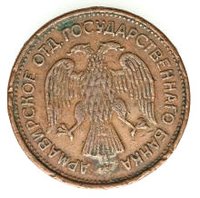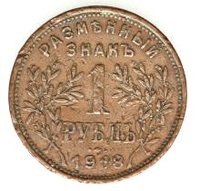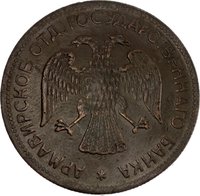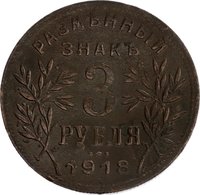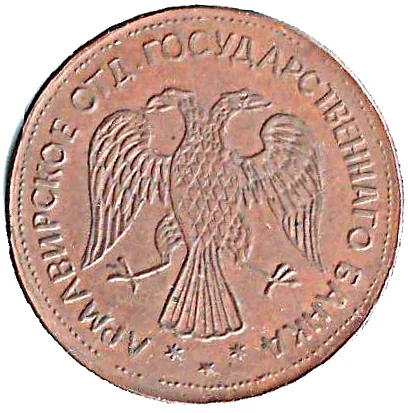
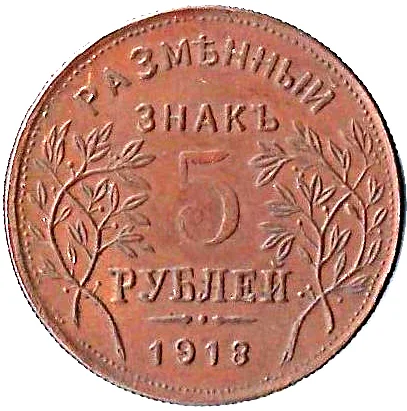
In 1918, Armavir, a key commercial and industrial center in the North Caucasus, found itself at the epicenter of the Russian Civil War's monetary chaos. As the central authority of the Russian state collapsed, the city became a contested prize, changing hands multiple times between the Bolshevik Red Army, the anti-Bolshevik Volunteer White Army, and local Cossack forces. Each shift in power brought a new set of currency decrees, rendering the financial landscape extraordinarily complex and unstable. The primary currencies in circulation were the old Imperial Russian rubles ("Romanovki") and the Provisional Government's "Kerensky" notes, but their value plummeted due to hyperinflation and a crisis of confidence.
This volatile situation was exacerbated by the introduction of competing emergency currencies. Most notably, the city administration, under various short-lived governments, issued its own series of local banknotes, known as
Armavirskie bon (Armavir bonds). These were essentially promissory notes, printed to pay municipal workers and soldiers and to facilitate local trade amidst a crippling shortage of credible cash. Furthermore, the nearby Kuban People's Republic also issued its own Kuban ruble, which circulated in the region. The result was a bewildering mix of paper money, all depreciating rapidly as military fortunes changed and production overtook sound economic backing.
Ultimately, the currency anarchy in Armavir in 1918 reflected the broader disintegration of the Russian economic space. Trust in any paper money evaporated, leading to a widespread retreat to barter and the use of hard commodities like grain, tobacco, and manufactured goods as mediums of exchange. This monetary collapse crippled normal commerce, deepened the humanitarian crisis, and underscored the complete breakdown of civil order, which would only begin to resolve with the Red Army's final and firm capture of the city in early 1920, imposing a single, though still inflationary, Soviet currency.