

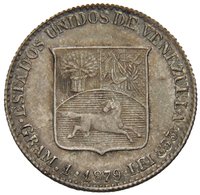
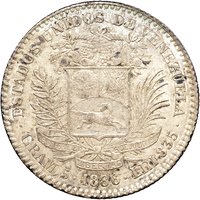
Obverse
Description:
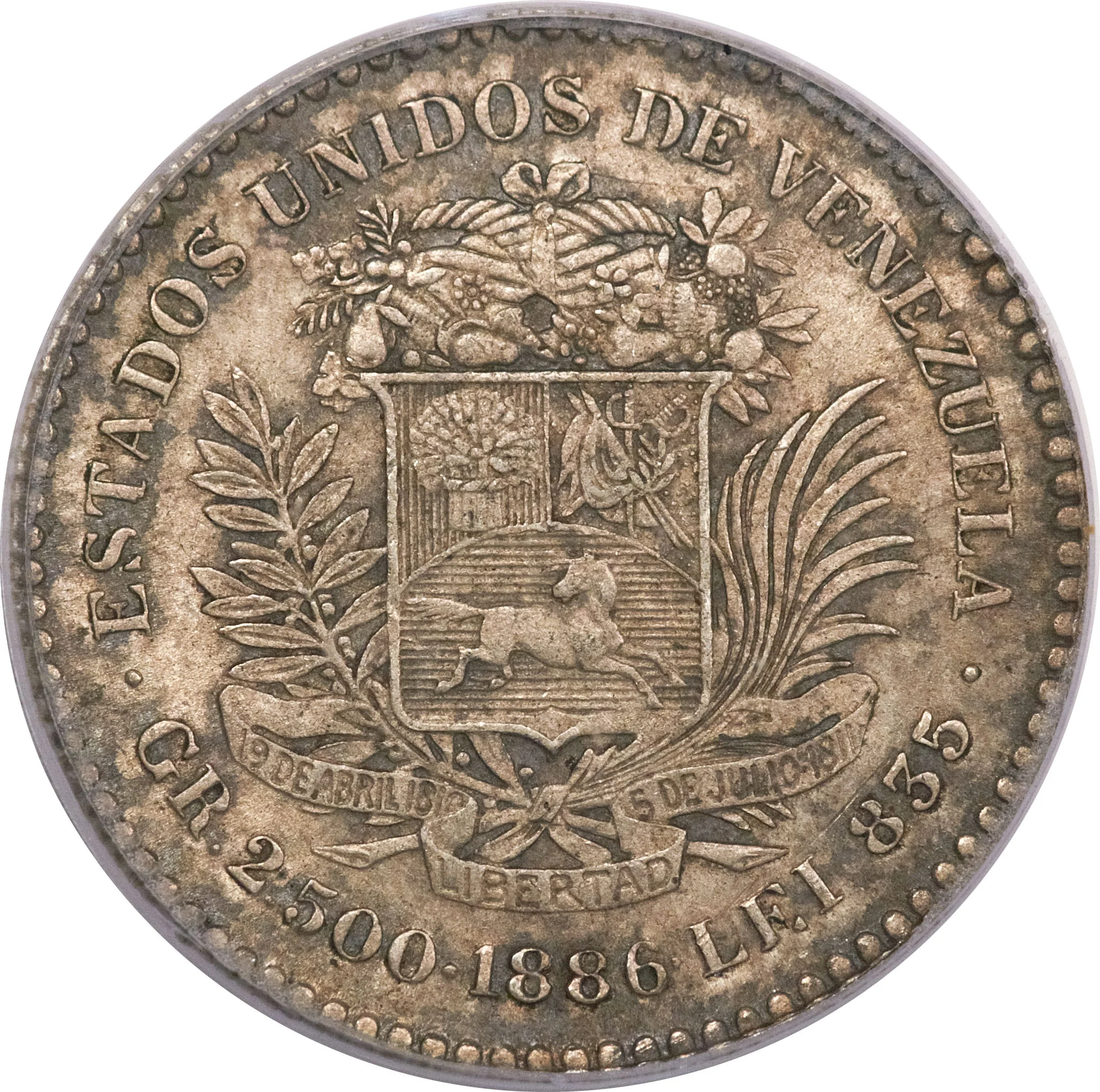
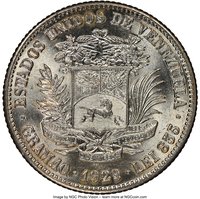
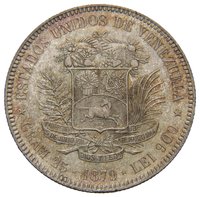
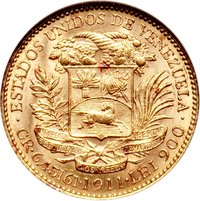
Coat of arms encircled by legend. Weight, date, and fineness below.
Inscription:
•ESTADOS UNIDOS DE VENEZUELA•
GR.2.500•1886•LEI 835
GR.2.500•1886•LEI 835
Translation:
UNITED STATES OF VENEZUELA
GR. 2.500 1886 LEI 835
GR. 2.500 1886 LEI 835
Script: Latin
Language: Spanish
Engraver: Désiré-Albert Barre
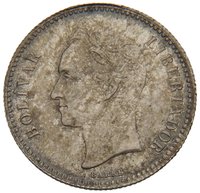
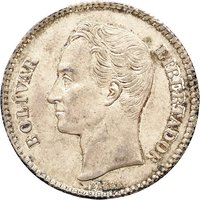
Reverse
Description:
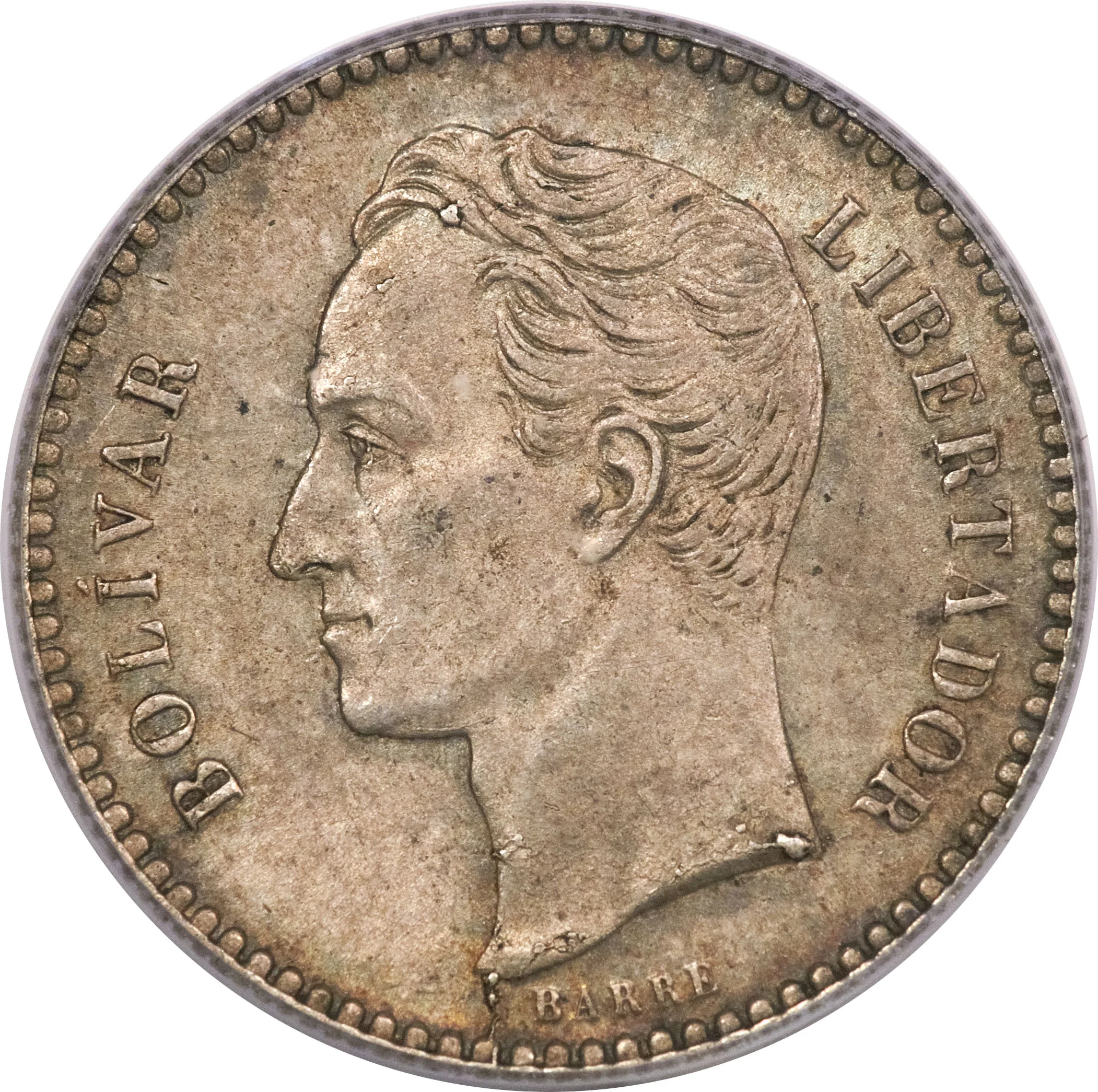
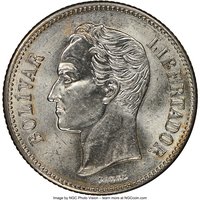
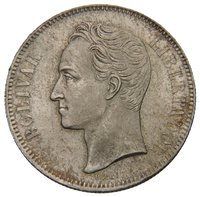
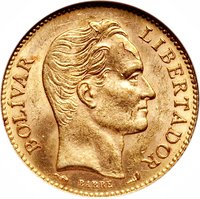
Bust left, flanked by legend. Engraver below.
Inscription:
BOLÍVAR LIBERTADOR
BARRE
BARRE
Translation:
Bolivar Liberator
Barre
Barre
Script: Latin
Language: Spanish
Engraver: Désiré-Albert Barre
Edge
Reeded
Categories
| Animal> Horse |
| Person> Military leader |
| Person> Politician |
| Symbols> Coat of Arms |
| Symbol> Cornucopia |
Mints
| Name | Mark |
|---|---|
| Monnaie de Paris | — |
| United States Mint of Philadelphia | — |
Mintings
| Year | Mint Mark | Mintage | Quality | Collection |
|---|---|---|---|---|
| 1879 | — | 200,000 | ||
| 1886 | — | 300,000 | ||
| 1887 | — | 310,000 | ||
| 1888 | — | 230,000 | ||
| 1889 | — | 80,000 | ||
| 1893 | A | 500,000 | ||
| 1900 | — | — | ||
| 1900 | A | 600,000 | ||
| 1901 | — | 600,000 | ||
| 1903 | — | 200,000 | ||
| 1911 | — | 300,000 | ||
| 1912 | — | 1,920,000 | ||
| 1919 | — | 400,000 | ||
| 1921 | — | — | ||
| 1924 | — | 800,000 | ||
| 1929 | — | 1,340,000 | ||
| 1935 | — | 1,000,000 | ||
| 1936 | — | 600,000 |
Historical background
In 1879, Venezuela was in the final stages of a profound monetary reform initiated by President Antonio Guzmán Blanco, known as the "Ilustre Americano." The preceding decades had been marked by financial chaos, with a circulation of diverse and often devalued coinage from various nations, alongside paper money issued by regional caudillos and private banks. This confusing and unstable system hindered commerce, state revenue collection, and economic development, creating a pressing need for a unified national currency.
Guzmán Blanco's solution, enacted through the Monetary Law of March 31, 1879, was the introduction of the Venezolano (often called the "Guzmán Blanco dollar") as the new unit of account. The reform established a bimetallic system on the French Latin Monetary Union standard, pegging the Venezolano to 4.5 grams of fine silver and defining its value in relation to the gold French franc. A key feature was the demonetization of the old, disparate silver coins, which were recoined into new national currency at the Caracas mint, thereby consolidating monetary sovereignty.
This reform successfully created a stable and uniform currency for the first time in the republic's history, providing a foundation for the commercial boom of the 1880s. The Venezolano remained Venezuela's official currency until 1912, when it was replaced by the Bolívar. The 1879 reform is therefore viewed as a critical, state-building measure that ended a period of monetary anarchy and integrated Venezuela more firmly into the global financial system of the late 19th century.
Guzmán Blanco's solution, enacted through the Monetary Law of March 31, 1879, was the introduction of the Venezolano (often called the "Guzmán Blanco dollar") as the new unit of account. The reform established a bimetallic system on the French Latin Monetary Union standard, pegging the Venezolano to 4.5 grams of fine silver and defining its value in relation to the gold French franc. A key feature was the demonetization of the old, disparate silver coins, which were recoined into new national currency at the Caracas mint, thereby consolidating monetary sovereignty.
This reform successfully created a stable and uniform currency for the first time in the republic's history, providing a foundation for the commercial boom of the 1880s. The Venezolano remained Venezuela's official currency until 1912, when it was replaced by the Bolívar. The 1879 reform is therefore viewed as a critical, state-building measure that ended a period of monetary anarchy and integrated Venezuela more firmly into the global financial system of the late 19th century.
Series: 1879 Venezuela circulation coins
🌱 Fairly Common