

Obverse
Description:
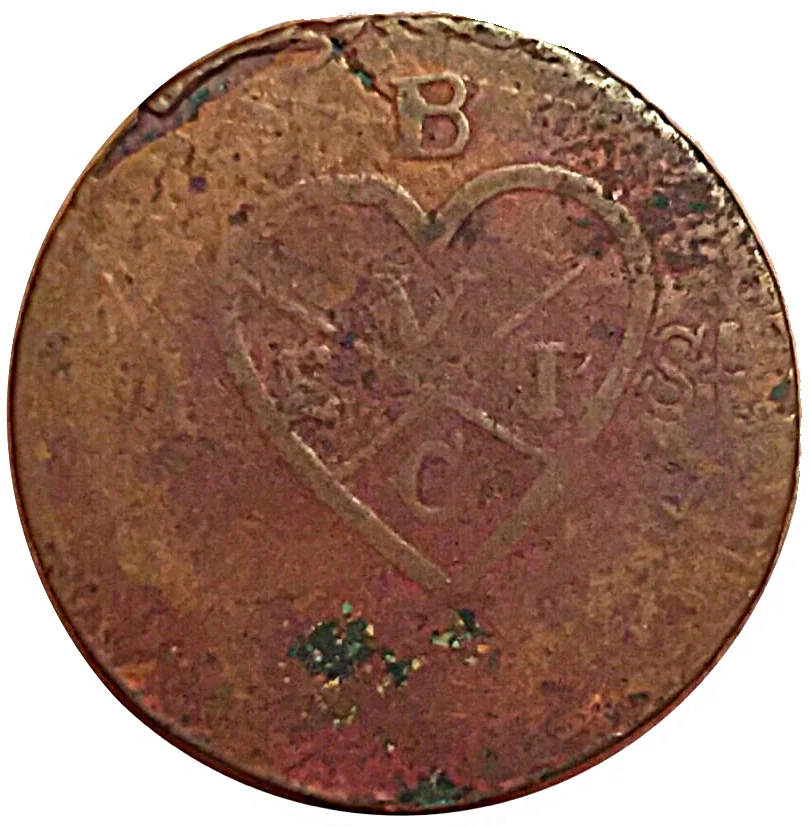
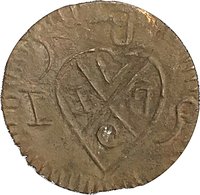
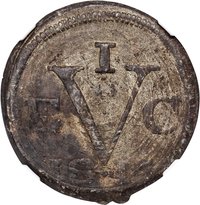
United East India Company mark flanked by denomination, "B" above.
Inscription:
B
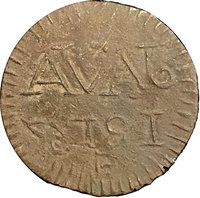
1 St
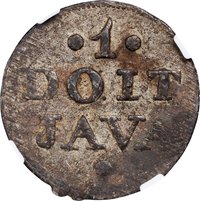
1 St
Script: Latin
Reverse
Edge
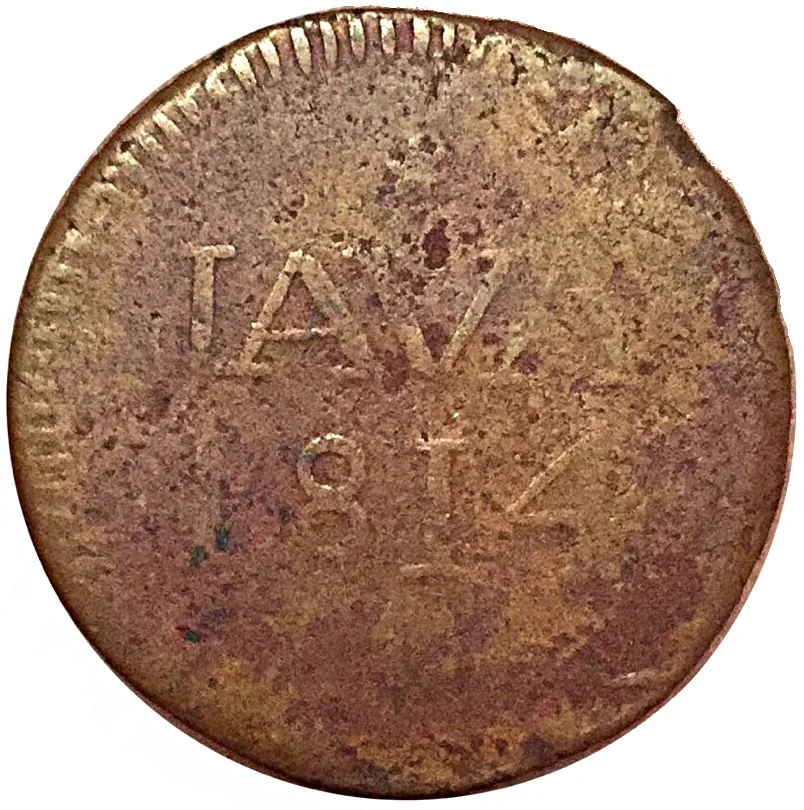
Reeding slanted right
Mints
| Name | Mark |
|---|---|
| Surabaya | Z |
Mintings
| Year | Mint Mark | Mintage | Quality | Collection |
|---|---|---|---|---|
| 1812 | — | — | ||
| 1814 | — | — | ||
| 1815 | — | — |
Historical background
In 1812, Java's currency situation was complex and transitional, reflecting the island's recent change in colonial administration. The island had just been transferred from the Dutch to the British during the Napoleonic Wars, with the British East India Company taking control under Lieutenant-Governor Thomas Stamford Raffles. The monetary system was a chaotic mix of legacy Dutch coins, Spanish silver dollars (the ubiquitous "pieces of eight"), and various local copper duit coins. This patchwork system suffered from severe shortages of official coinage, widespread counterfeiting (especially of the copper coins), and fluctuating exchange rates between the different metallic currencies, which hampered trade and administration.
The British interim government recognized this instability as a major obstacle to economic efficiency and tax collection. Raffles and his council attempted to impose order by standardizing the monetary system on a British imperial basis, declaring the Spanish dollar as the standard silver coin and fixing its value in relation to British gold sterling and the local copper coinage. They also sought to introduce a limited number of British-issued silver coins to facilitate government transactions. However, these measures were largely declarative and could not instantly resolve the fundamental scarcity of trusted, full-bodied specie in circulation.
Consequently, the everyday economy still relied heavily on the devalued and unreliable copper duit for small transactions, while larger trade depended on the heterogeneous mix of silver coins. The situation was further strained by the ongoing global war, which disrupted the flow of silver from Europe. Thus, in 1812, Java's currency landscape was characterized by a tense duality: a new colonial authority attempting to implement a standardized monetary order from the top down, while the practical reality on the ground remained one of metallic confusion, scarcity, and ad-hoc valuation, a legacy that Raffles' subsequent financial reforms would continue to grapple with until the return of the island to Dutch rule in 1816.
The British interim government recognized this instability as a major obstacle to economic efficiency and tax collection. Raffles and his council attempted to impose order by standardizing the monetary system on a British imperial basis, declaring the Spanish dollar as the standard silver coin and fixing its value in relation to British gold sterling and the local copper coinage. They also sought to introduce a limited number of British-issued silver coins to facilitate government transactions. However, these measures were largely declarative and could not instantly resolve the fundamental scarcity of trusted, full-bodied specie in circulation.
Consequently, the everyday economy still relied heavily on the devalued and unreliable copper duit for small transactions, while larger trade depended on the heterogeneous mix of silver coins. The situation was further strained by the ongoing global war, which disrupted the flow of silver from Europe. Thus, in 1812, Java's currency landscape was characterized by a tense duality: a new colonial authority attempting to implement a standardized monetary order from the top down, while the practical reality on the ground remained one of metallic confusion, scarcity, and ad-hoc valuation, a legacy that Raffles' subsequent financial reforms would continue to grapple with until the return of the island to Dutch rule in 1816.
💎 Extremely Rare