

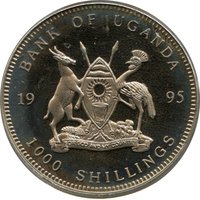
1000 Shillings – Uganda
Uganda
Context
Year: 1995
Issuer: Uganda 
Issuing organization: Bank of Uganda
Period:
(since 1962)
Currency:
(since 1987)
Material
References
KM: #Click to copy to clipboard50
Numista: #179376
Value
Exchange value: 1000 UGX
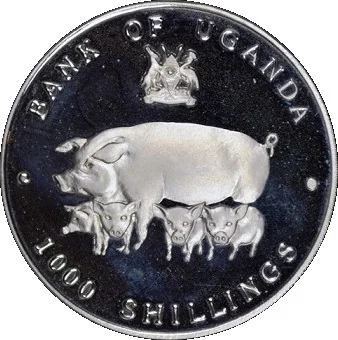
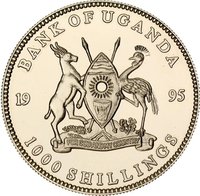
Obverse
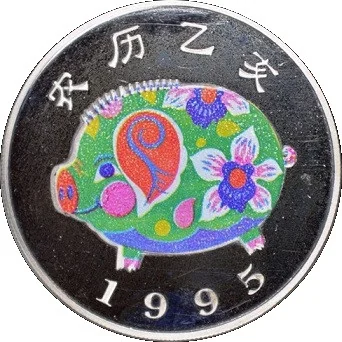
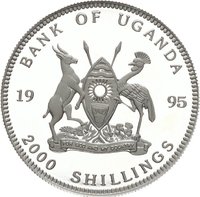
Reverse
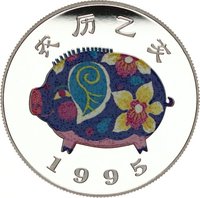
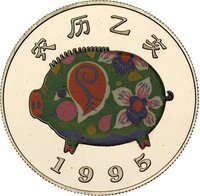
Description:
Stylized left-facing pig.
Inscription:
农 历 乙 亥
1995
1995
Translation:
Year of the Pig, 1995
Scripts: Chinese (simplified), Latin
Language: Chinese
Edge
Reeded
Categories
| Animal> Pig |
| Astrology> Chinese calendar |
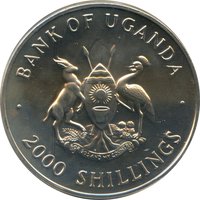
| Symbols> Coat of Arms |
Mintings
| Year | Mint Mark | Mintage | Quality | Collection |
|---|---|---|---|---|
| 1995 | — | — |
Historical background
In 1995, Uganda's currency situation was characterized by a period of remarkable stability and growing confidence under the structural adjustment programs championed by President Yoweri Museveni's government. The Ugandan shilling (UGX), which had been reintroduced in 1987 to replace the hyperinflated old shilling, had weathered its initial turbulent years. By the mid-1990s, a combination of strict fiscal discipline, donor support, and market-liberalizing reforms had tamed the rampant inflation of the late 1980s, bringing it down to an annual rate of approximately 5-10%. This stability was a hard-won achievement that formed the bedrock for economic recovery.
This period was also defined by a critical transition in exchange rate policy. Following the initial "big bang" liberalization of the foreign exchange market in 1990, 1995 fell within a phase where the Bank of Uganda was refining its management of a floating exchange rate system. The shilling's value was primarily determined by market forces within an interbank market, though the central bank maintained a strategic presence to smooth out excessive volatility. The currency experienced a gradual and managed depreciation against major currencies like the US dollar, a trend considered necessary to maintain export competitiveness for key commodities like coffee, which was still the nation's primary foreign exchange earner.
The broader context was Uganda's new constitution, promulgated in 1995, which enshrined principles of economic management and gave the Bank of Uganda operational independence with a primary mandate of ensuring price stability. This legal framework solidified the commitment to the policies that had stabilized the currency. Consequently, 1995 represents a point of consolidation—a year where the painful reforms of the previous decade began to yield tangible results in the form of a predictable currency, setting the stage for the sustained economic growth Uganda would experience in the late 1990s and early 2000s.
This period was also defined by a critical transition in exchange rate policy. Following the initial "big bang" liberalization of the foreign exchange market in 1990, 1995 fell within a phase where the Bank of Uganda was refining its management of a floating exchange rate system. The shilling's value was primarily determined by market forces within an interbank market, though the central bank maintained a strategic presence to smooth out excessive volatility. The currency experienced a gradual and managed depreciation against major currencies like the US dollar, a trend considered necessary to maintain export competitiveness for key commodities like coffee, which was still the nation's primary foreign exchange earner.
The broader context was Uganda's new constitution, promulgated in 1995, which enshrined principles of economic management and gave the Bank of Uganda operational independence with a primary mandate of ensuring price stability. This legal framework solidified the commitment to the policies that had stabilized the currency. Consequently, 1995 represents a point of consolidation—a year where the painful reforms of the previous decade began to yield tangible results in the form of a predictable currency, setting the stage for the sustained economic growth Uganda would experience in the late 1990s and early 2000s.
Series: Chinese calendar

💎 Extremely Rare