

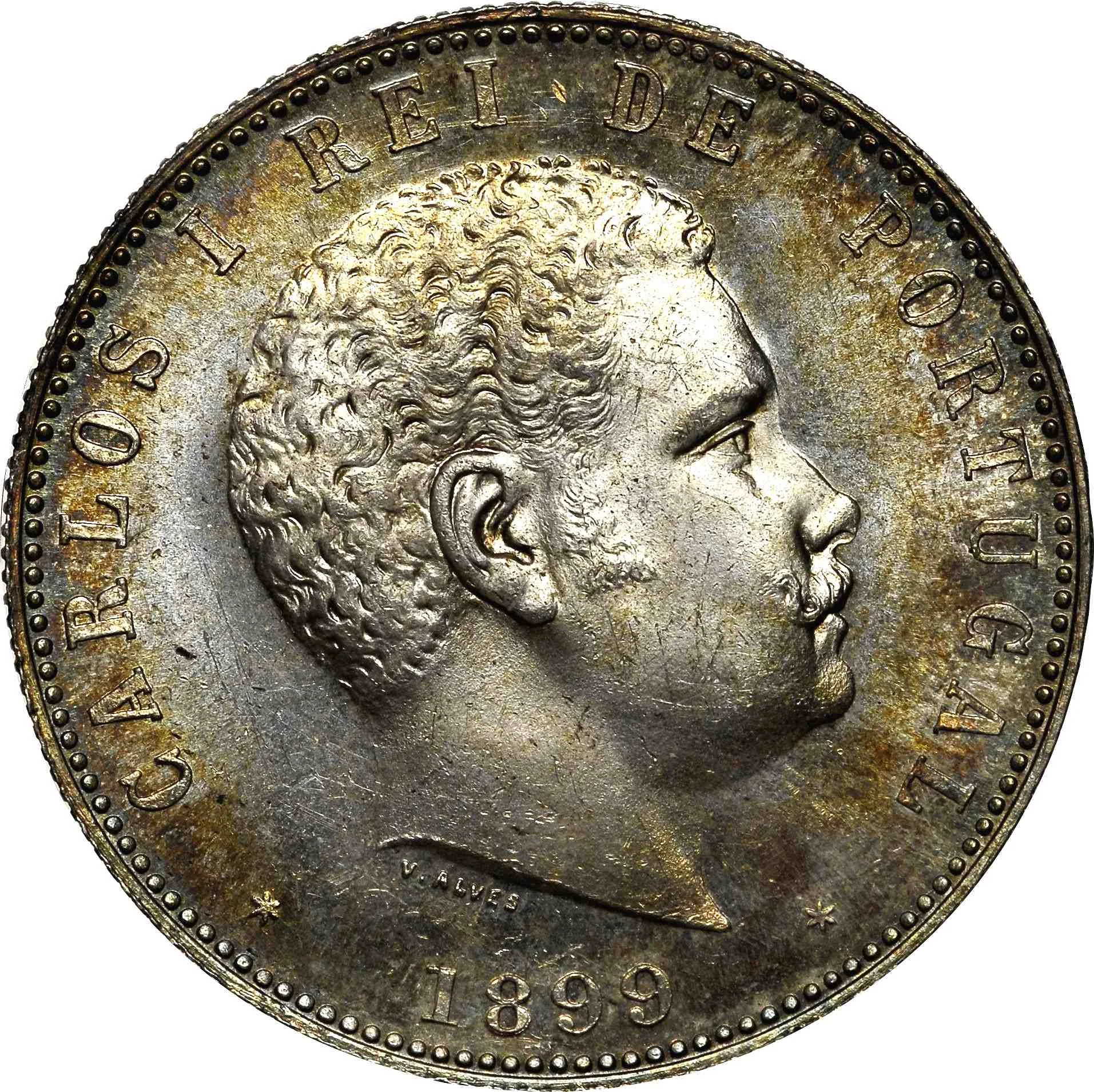
Obverse
Description:
Go right.
Inscription:
CARLOS I REI DE PORTUGAL
V.ALVES
· 1899 ·
V.ALVES
· 1899 ·
Translation:
CARLOS I KING OF PORTUGAL
V. ALVES
· 1899 ·
V. ALVES
· 1899 ·
Script: Latin
Languages: Portuguese, Latin
Engraver: Valancio Alves
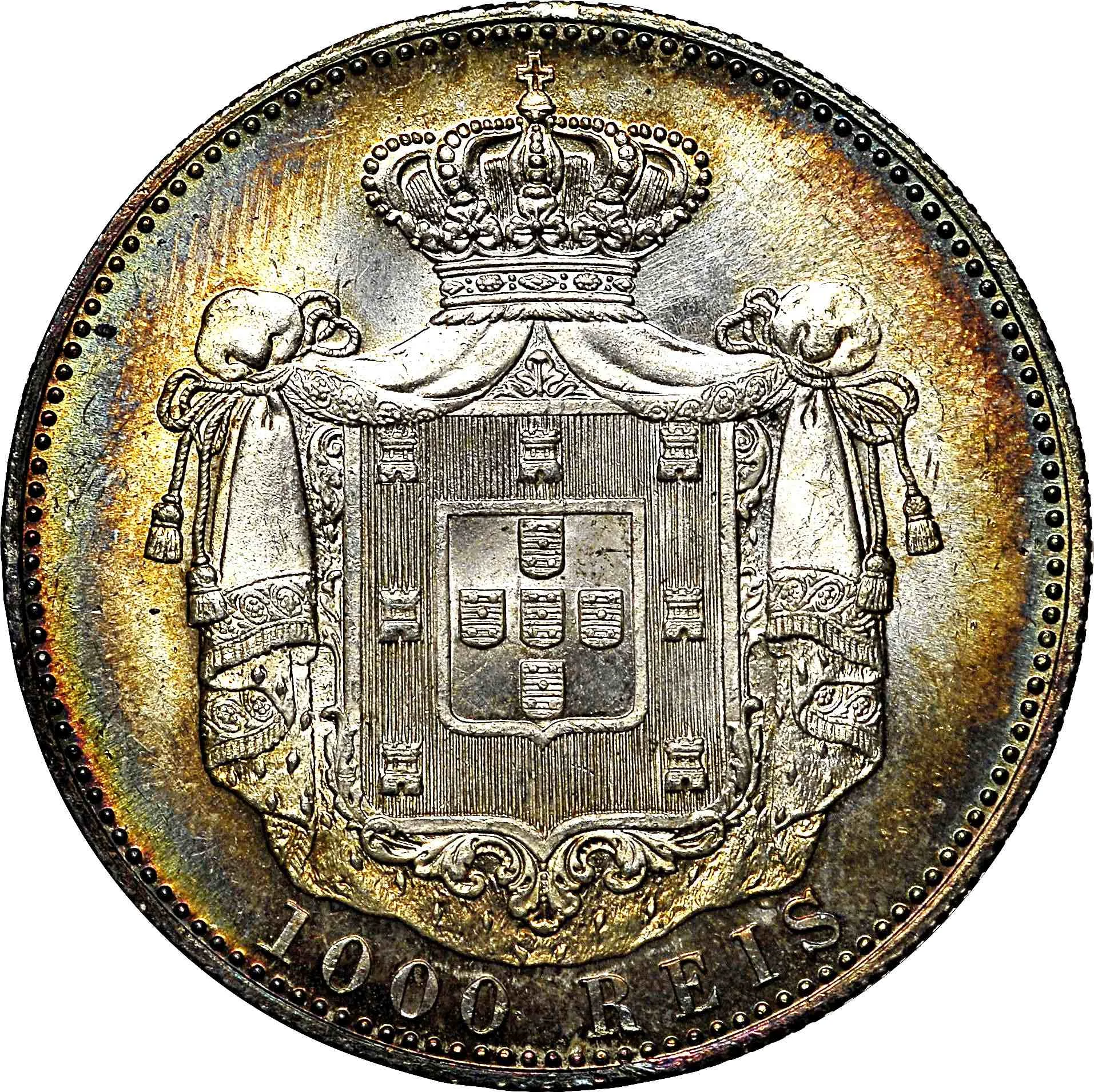
Reverse
Description:
Arms with crown and mantle.
Inscription:
1000 REIS
Script: Latin
Engraver: Valancio Alves
Edge
Reeded
Mints
| Name | Mark |
|---|---|
| Imprensa Nacional - Casa da Moeda | — |
Mintings
| Year | Mint Mark | Mintage | Quality | Collection |
|---|---|---|---|---|
| 1899 | — | 1,500,000 | ||
| 1899 | — | — | Proof | |
| 1900 | — | — |
Historical background
In 1899, Portugal's currency situation was defined by its adherence to the gold standard, a system it had officially embraced in 1854. The national currency was the Portuguese real (plural: réis), a unit of account with a long history but one that was, by the late 19th century, represented in practice by gold coins. The most important of these was the milréis, worth 1,000 réis, which was the common reference for large transactions, government budgets, and foreign exchange. The Banco de Portugal, having gained the sole right of note issue in 1887, issued paper money that was convertible into gold, aiming to ensure monetary stability and facilitate international trade, particularly with its key ally, Britain.
However, this stability was under significant strain. Portugal's economy was burdened by substantial public debt, chronic budget deficits, and a negative balance of trade. The country had suffered a series of financial crises, and the cost of maintaining gold convertibility was high. There was a constant tension between the need for fiscal discipline to uphold the gold standard and the political pressures to finance development and state obligations. Consequently, the Portuguese monetary system was perceived as fragile by international investors, leading to a premium on gold and frequent speculation against the milréis.
Therefore, while officially on the gold standard in 1899, Portugal was in a precarious position, often described as being on the "gold exchange standard" in a limited form, with convertibility maintained more through borrowing and intervention than robust economic fundamentals. This delicate equilibrium would ultimately prove unsustainable, culminating in the suspension of gold convertibility in 1891 for a period, and then definitively after 1914. The year 1899 thus represents a late and tense chapter in Portugal's attempt to project financial credibility within the European monetary order, an effort increasingly undermined by underlying structural weaknesses in its economy.
However, this stability was under significant strain. Portugal's economy was burdened by substantial public debt, chronic budget deficits, and a negative balance of trade. The country had suffered a series of financial crises, and the cost of maintaining gold convertibility was high. There was a constant tension between the need for fiscal discipline to uphold the gold standard and the political pressures to finance development and state obligations. Consequently, the Portuguese monetary system was perceived as fragile by international investors, leading to a premium on gold and frequent speculation against the milréis.
Therefore, while officially on the gold standard in 1899, Portugal was in a precarious position, often described as being on the "gold exchange standard" in a limited form, with convertibility maintained more through borrowing and intervention than robust economic fundamentals. This delicate equilibrium would ultimately prove unsustainable, culminating in the suspension of gold convertibility in 1891 for a period, and then definitively after 1914. The year 1899 thus represents a late and tense chapter in Portugal's attempt to project financial credibility within the European monetary order, an effort increasingly undermined by underlying structural weaknesses in its economy.
🌱 Fairly Common