

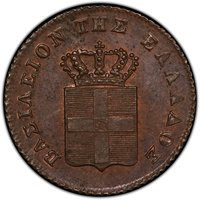
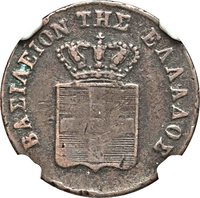
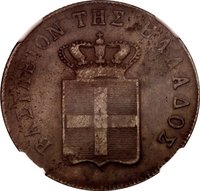
Obverse
Description:
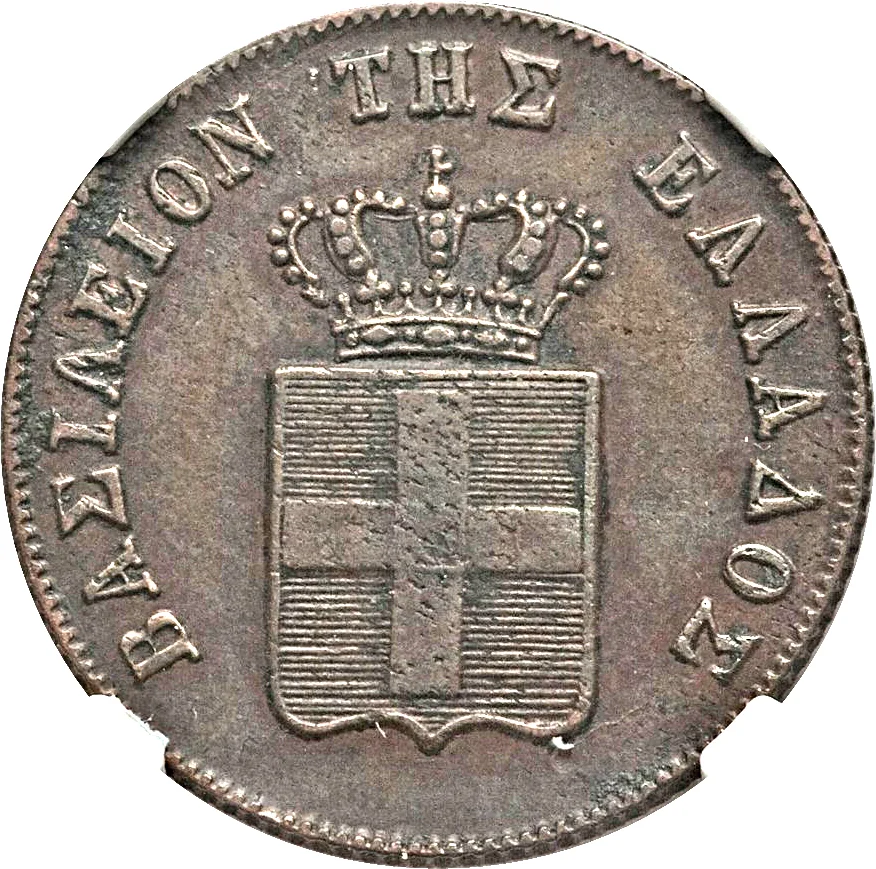
Cross shield, crowned.
Inscription:
ΒΑΣΙΛΕΙΟΝ ΤΗΣ ΕΛΛΑΔΟΣ
Translation:
KINGDOM OF GREECE
Script: Greek
Language: Greek
Engraver: Konrad Lange
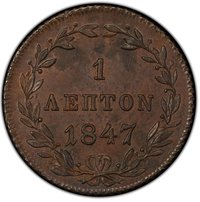
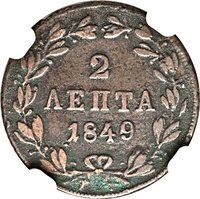
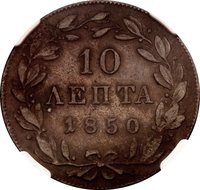
Reverse
Description:
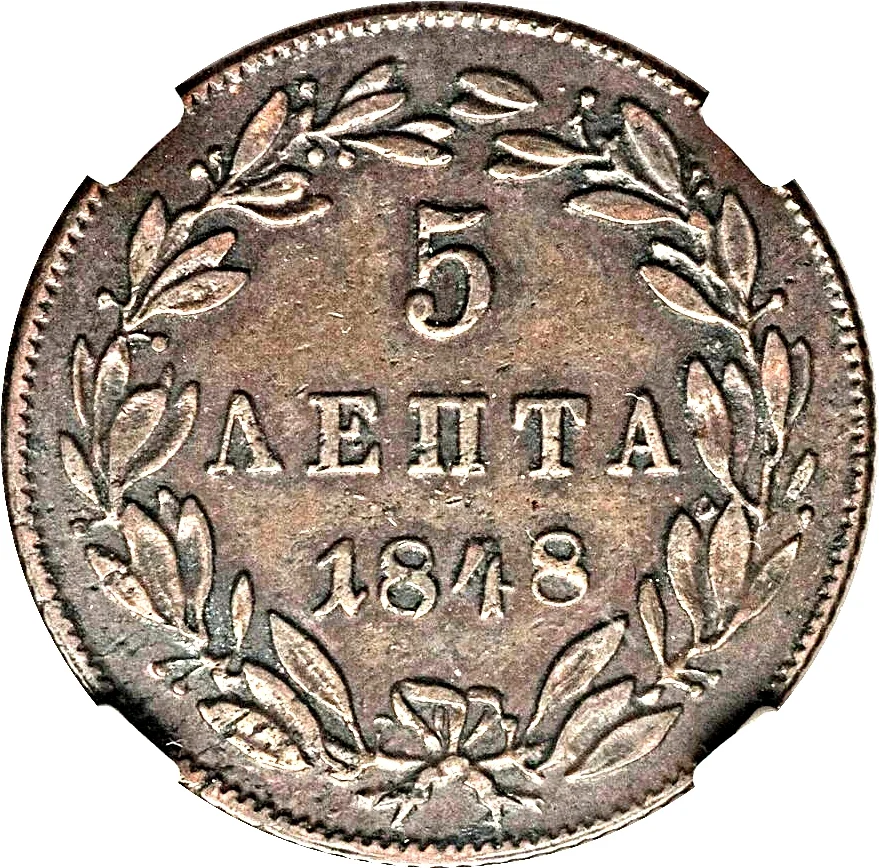
Denomination and date encircled by wreath.
Inscription:
5 ΛΕΠΤΑ 1848
Translation:
Five Lepta 1848
Script: Greek
Language: Greek
Engraver: Konrad Lange
Edge
Reeded
Mints
| Name | Mark |
|---|---|
| Athens Mint | — |
Mintings
| Year | Mint Mark | Mintage | Quality | Collection |
|---|---|---|---|---|
| 1847 | — | 270,000 | ||
| 1848 | — | 394,000 | ||
| 1849 | — | 374,000 |
Historical background
In 1847, the Kingdom of Greece was navigating a complex and precarious currency situation, a direct legacy of its war of independence and its establishment as a modern state. The nation lacked a unified, sovereign monetary system. In circulation was a chaotic mix of foreign coins, primarily the French franc, the British pound sterling, and the Turkish kuruş (piastre), alongside various older Venetian and Ottoman coins. This monetary pluralism created significant challenges for trade, taxation, and economic planning, as exchange rates fluctuated and calculations were cumbersome.
The situation was exacerbated by the severe shortage of small-denomination coinage for everyday transactions. To address this, the government had earlier authorized the minting of low-value copper coins, the lepta (singular: lepton). However, these were often poorly made and susceptible to counterfeiting, further eroding public trust. The state's finances were also chronically weak, burdened by a large public debt from the independence war and reliant on loans from the Great Powers (Britain, France, and Russia), which exercised considerable financial oversight.
Consequently, 1847 fell within a period of transition and mounting pressure for reform. The government, under King Otto, was actively working towards monetary standardization, a process that would culminate just a few years later. In 1848, Greece would formally adopt the phoenix as its national currency, soon to be replaced by the drachma, placing it on the bimetallic (silver and gold) standard of the Latin Monetary Union. Thus, the currency situation in 1847 represents the final years of a fragmented system, with the state poised to impose order through a unified national currency tied to European monetary networks.
The situation was exacerbated by the severe shortage of small-denomination coinage for everyday transactions. To address this, the government had earlier authorized the minting of low-value copper coins, the lepta (singular: lepton). However, these were often poorly made and susceptible to counterfeiting, further eroding public trust. The state's finances were also chronically weak, burdened by a large public debt from the independence war and reliant on loans from the Great Powers (Britain, France, and Russia), which exercised considerable financial oversight.
Consequently, 1847 fell within a period of transition and mounting pressure for reform. The government, under King Otto, was actively working towards monetary standardization, a process that would culminate just a few years later. In 1848, Greece would formally adopt the phoenix as its national currency, soon to be replaced by the drachma, placing it on the bimetallic (silver and gold) standard of the Latin Monetary Union. Thus, the currency situation in 1847 represents the final years of a fragmented system, with the state poised to impose order through a unified national currency tied to European monetary networks.
Series: 1847 Greece circulation coins
⭐ Rare