

1 maravedi – Spain
Add to wishlist
Spain
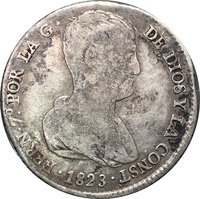
Obverse
Description:
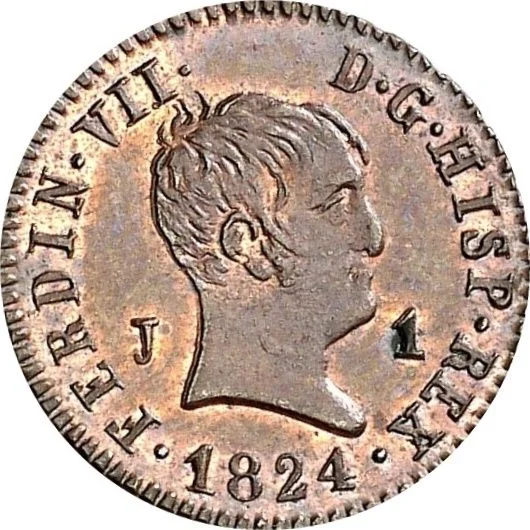
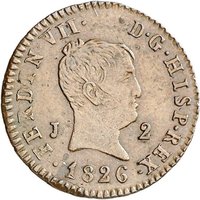
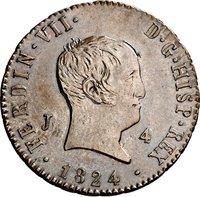
King Fernando VII facing right.
Inscription:
FERDIN · VII· D · G · HISP · REX
J 1
· 1824 ·
J 1
· 1824 ·
Translation:
FERDINAND VII, BY THE GRACE OF GOD, KING OF SPAIN
J 1
1824
J 1
1824
Script: Latin
Language: Latin
Engraver: Félix Sagau y Dalmau de Galcerán
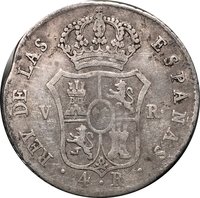
Reverse
Description:
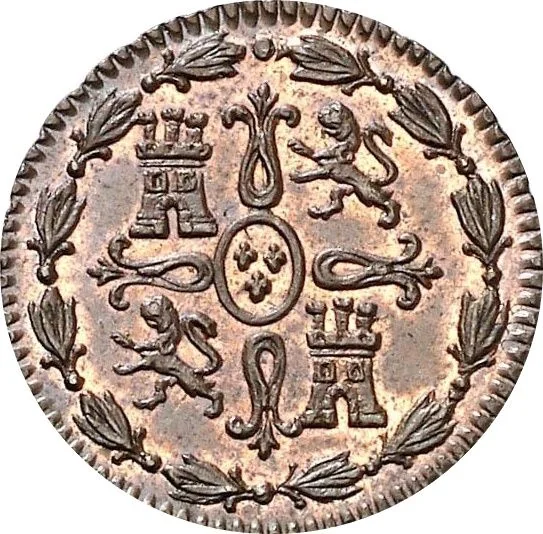
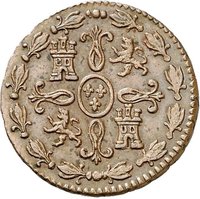
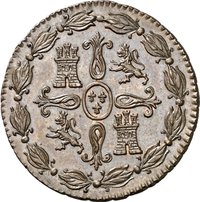
Cross of Don Pelayo featuring castles and lions for Castile and Leon, a central Bourbon fleur-de-lis oval, and a perimeter wreath.
Engraver: Félix Sagau y Dalmau de Galcerán
Edge
Categories
| Animal> Feline |
| Building> Castle or fortification |
| Symbol> Fleur-de-lis |
| Symbol> Cross |
| Symbol> Wreath |
Mints
| Name | Mark |
|---|---|
| Jubia Mint | J |
Mintings
| Year | Mint Mark | Mintage | Quality | Collection |
|---|---|---|---|---|
| 1824 | J | — |
Historical background
In 1824, Spain's currency situation was chaotic and deeply symptomatic of the nation's broader political and economic crisis following the Peninsular War and the loss of most of its American empire. The country operated on a bimetallic system of gold escudos and silver reales, but decades of war had devastated state finances. To fund the conflict against Napoleon and later the royalist campaigns in the Americas, successive governments had resorted to issuing vast quantities of debased coinage and paper money, leading to severe inflation and a collapse in public trust. The most notorious instrument was the vales reales (royal bonds), first issued in 1780, which had effectively become a discredited paper currency trading at a fraction of its face value.
The year itself fell within the tumultuous "Ominous Decade" (1823-1833), following the restoration of the absolutist King Ferdinand VII by French intervention. The government, under severe fiscal strain, attempted to stabilize the monetary system through the Real Cédula de 14 de febrero de 1824. This decree aimed to retire the devalued vales reales and other paper, offering a complex conversion into new 5% bonds, but the terms were highly unfavorable to holders. The result was not stabilization but a forced consolidation of the state's debt, effectively a partial default that further eroded financial confidence. Meanwhile, in daily commerce, a confusing variety of older, newer, and foreign coins (especially French francs and British sovereigns) circulated at fluctuating values, creating a dysfunctional and fragmented monetary environment.
This monetary disorder directly hampered economic recovery and state-building. The lack of a reliable, uniform currency discouraged investment and complicated trade, both internally and externally. The state's inability to manage its finances or guarantee the value of its money reflected the profound weakness of the absolutist regime, which relied on unsustainable borrowing and confiscatory measures rather than modern fiscal reform. Thus, the currency chaos of 1824 was not merely a technical financial issue but a core element of Spain's struggle to adapt to its diminished geopolitical and economic reality in the post-Napoleonic era.
The year itself fell within the tumultuous "Ominous Decade" (1823-1833), following the restoration of the absolutist King Ferdinand VII by French intervention. The government, under severe fiscal strain, attempted to stabilize the monetary system through the Real Cédula de 14 de febrero de 1824. This decree aimed to retire the devalued vales reales and other paper, offering a complex conversion into new 5% bonds, but the terms were highly unfavorable to holders. The result was not stabilization but a forced consolidation of the state's debt, effectively a partial default that further eroded financial confidence. Meanwhile, in daily commerce, a confusing variety of older, newer, and foreign coins (especially French francs and British sovereigns) circulated at fluctuating values, creating a dysfunctional and fragmented monetary environment.
This monetary disorder directly hampered economic recovery and state-building. The lack of a reliable, uniform currency discouraged investment and complicated trade, both internally and externally. The state's inability to manage its finances or guarantee the value of its money reflected the profound weakness of the absolutist regime, which relied on unsustainable borrowing and confiscatory measures rather than modern fiscal reform. Thus, the currency chaos of 1824 was not merely a technical financial issue but a core element of Spain's struggle to adapt to its diminished geopolitical and economic reality in the post-Napoleonic era.
✨ Legendary