

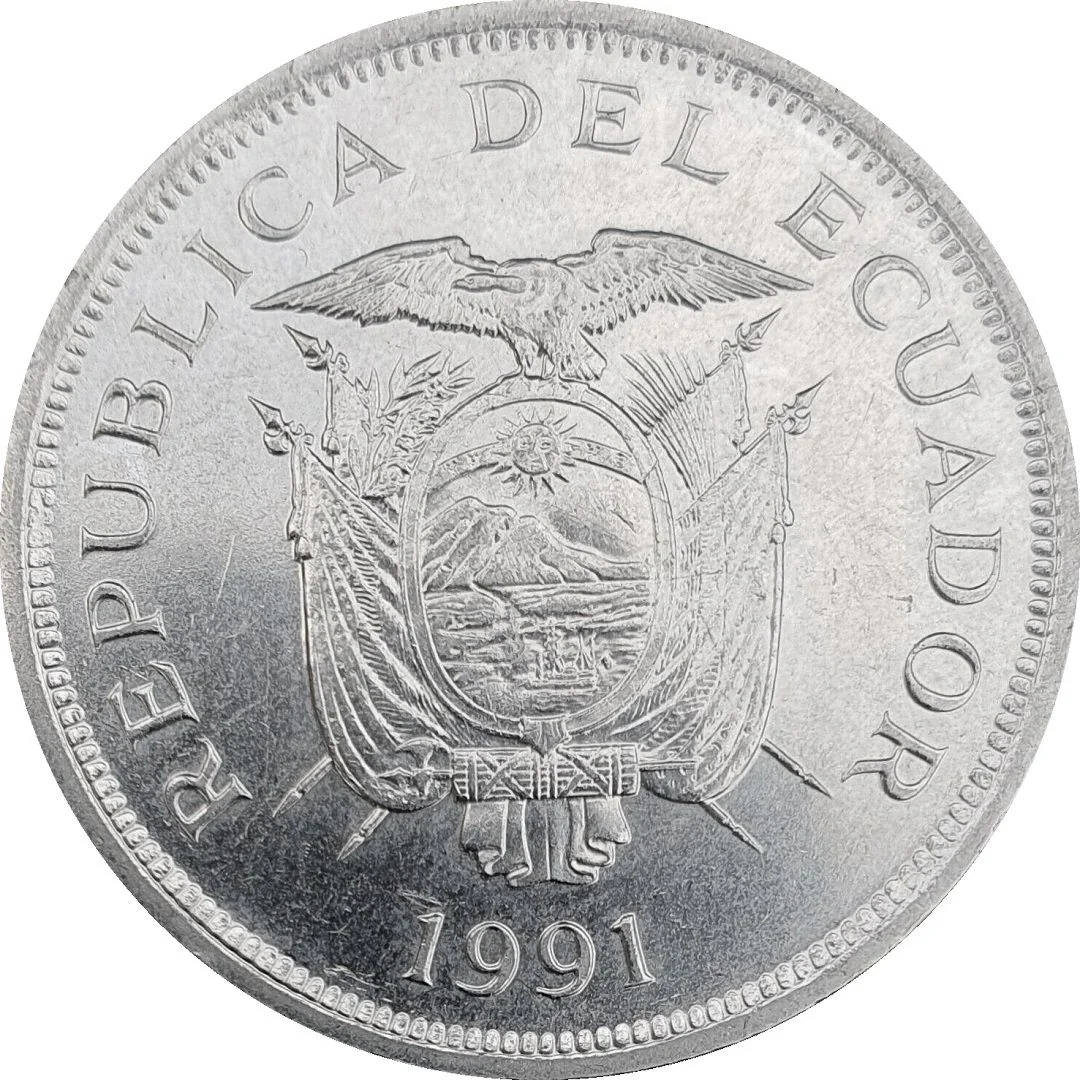
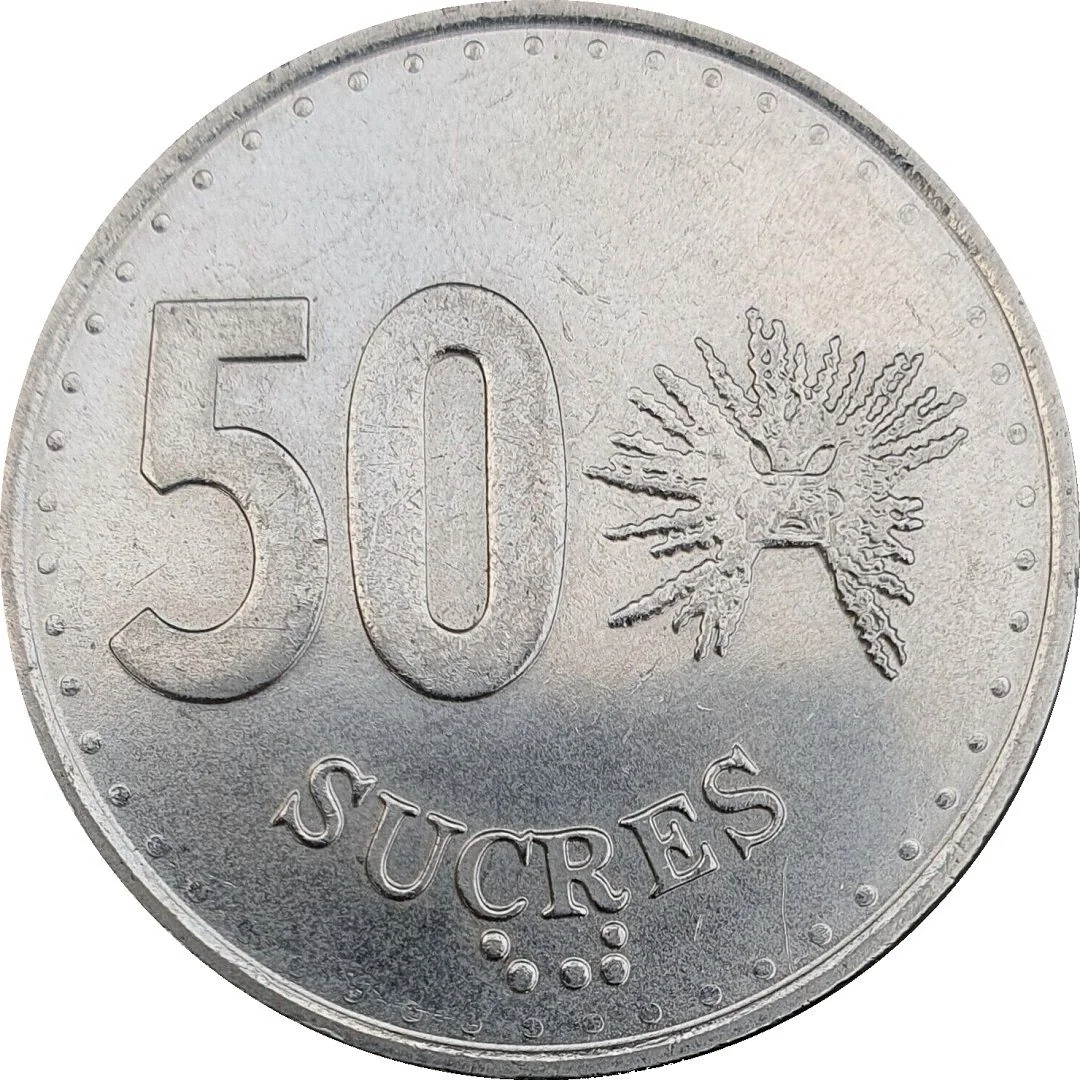
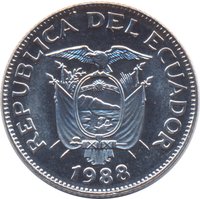
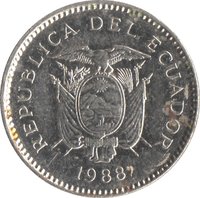
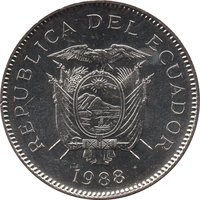
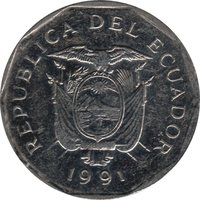
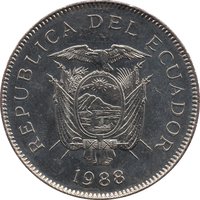
Obverse
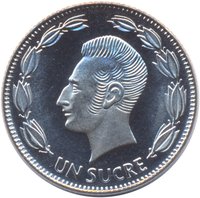
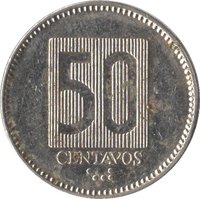
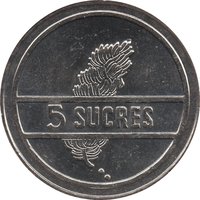
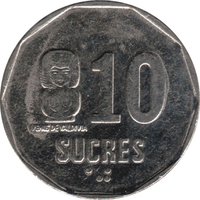
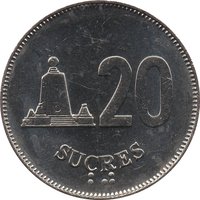
Reverse
Edge
Reeded
Categories
| Symbols> Coat of Arms |
Mints
| Name | Mark |
|---|---|
| Sherritt Mint | — |
Mintings
| Year | Mint Mark | Mintage | Quality | Collection |
|---|---|---|---|---|
| 1988 | — | 25 | Proof | |
| 1988 | — | 100,000 | ||
| 1991 | — | 50,000,000 |
Historical background
In 1988, Ecuador was mired in a profound economic and currency crisis, the culmination of years of fiscal mismanagement, external shocks, and political instability. The nation was struggling under the weight of massive foreign debt from the 1970s oil boom, while global oil prices—its primary export—had collapsed in the early 1980s. This led to chronic budget deficits, which the government financed through rampant money printing by the Central Bank. The result was hyperinflation, which peaked at over 85% in 1988, devastating purchasing power and eroding public trust in the national currency, the sucre.
The currency situation was characterized by a severely devaluing sucre within a complex system of multiple exchange rates. The government maintained an overvalued official rate for essential imports and debt servicing, while a parallel "free" market rate reflected the currency's true, plummeting value. This system created a lucrative black market for dollars, encouraged capital flight, and distorted the entire economy. Successive administrations attempted stabilization plans, but a lack of political will for sustained austerity, coupled with powerful opposition from business and labor groups, rendered these efforts ineffective.
Consequently, 1988 stands as a pivotal year that demonstrated the complete failure of existing monetary policy. The hyperinflation and exchange rate chaos crippled economic planning, impoverished the middle and working classes, and set the stage for even more drastic measures in the 1990s. The crisis of this period fundamentally undermined confidence in the sucre, planting the early seeds for the radical dollarization solution that would be adopted over a decade later in the year 2000.
The currency situation was characterized by a severely devaluing sucre within a complex system of multiple exchange rates. The government maintained an overvalued official rate for essential imports and debt servicing, while a parallel "free" market rate reflected the currency's true, plummeting value. This system created a lucrative black market for dollars, encouraged capital flight, and distorted the entire economy. Successive administrations attempted stabilization plans, but a lack of political will for sustained austerity, coupled with powerful opposition from business and labor groups, rendered these efforts ineffective.
Consequently, 1988 stands as a pivotal year that demonstrated the complete failure of existing monetary policy. The hyperinflation and exchange rate chaos crippled economic planning, impoverished the middle and working classes, and set the stage for even more drastic measures in the 1990s. The crisis of this period fundamentally undermined confidence in the sucre, planting the early seeds for the radical dollarization solution that would be adopted over a decade later in the year 2000.
Series: 1988 Ecuador circulation coins
🌱 Very Common