

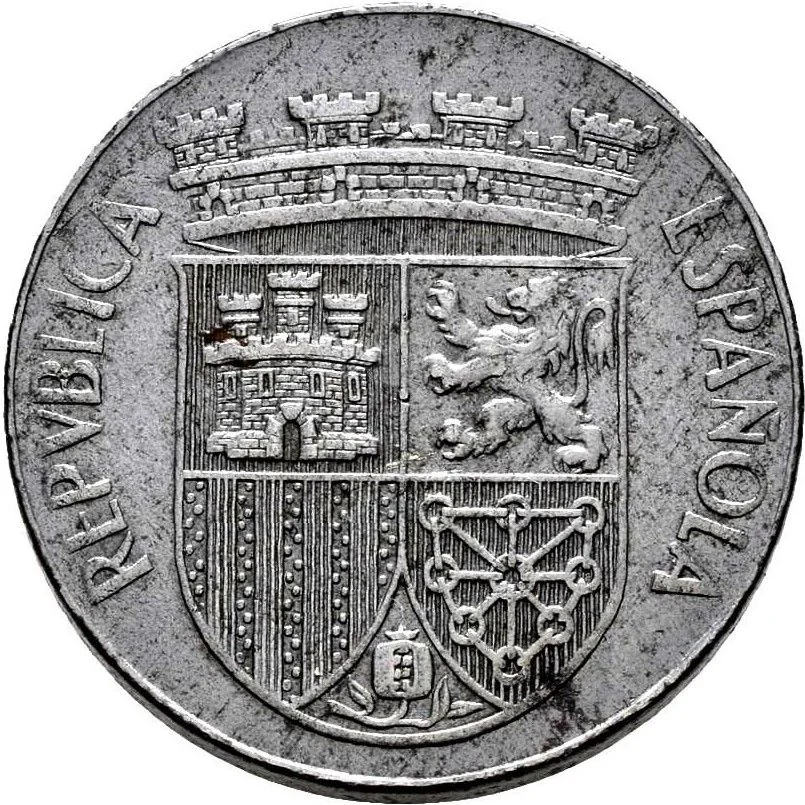
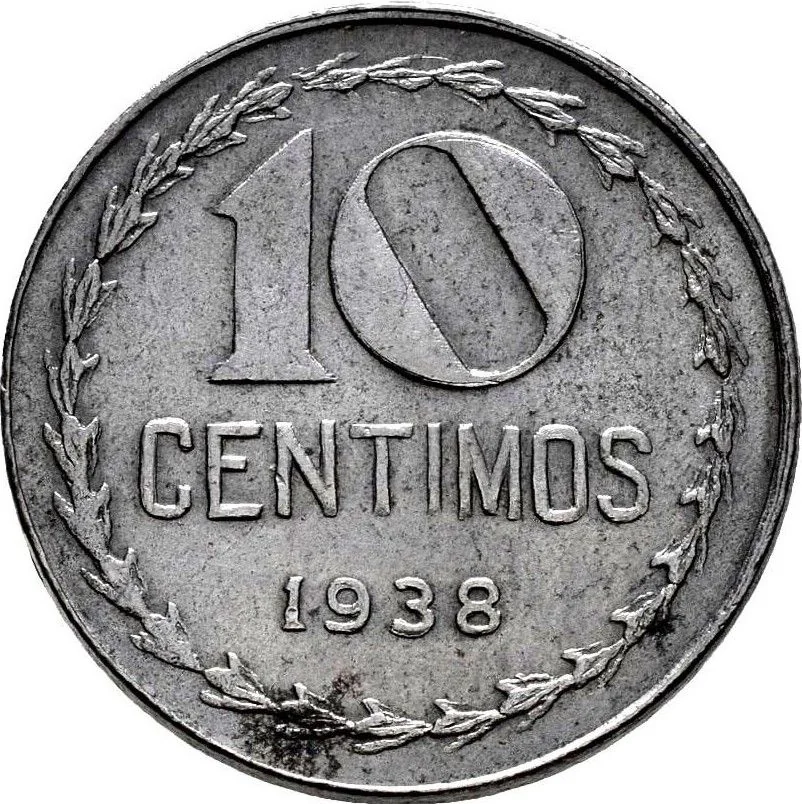
10 centimos – Spain
Add to wishlist
Spain
Obverse
Reverse
Edge
Plain
Categories
| Symbols> Coat of Arms |
| Symbol> Wreath |
Mints
| Name | Mark |
|---|---|
| Royal Mint of Madrid | — |
Mintings
| Year | Mint Mark | Mintage | Quality | Collection |
|---|---|---|---|---|
| 1938 | — | 1,000 |
Historical background
By 1938, the Spanish Civil War had entered its third and decisive year, and the financial system of the Republican zone was in a state of advanced collapse. The conflict had caused massive economic dislocation, with industrial and agricultural production shattered and the treasury drained by the immense costs of war. To finance its struggle, the Republican government had resorted to massive money printing, leading to hyperinflation. The value of the Republican peseta plummeted, both internally and on the limited foreign exchange markets, while gold and foreign currency reserves—much of which had been sent to the Soviet Union in 1936 to pay for arms—were nearly exhausted.
The currency situation was characterized by a stark duality. In the Nationalist zone under Franco, the financial picture was more stable. Backed by credit from fascist Italy and Nazi Germany and controlling most of Spain's agricultural lands, the Nationalists managed their currency more conservatively. They enforced the use of their own peseta notes and maintained greater control over prices, creating a perception of relative strength. Consequently, a severe black market for currency exchange flourished, where Republican pesetas were traded for Nationalist pesetas, French francs, or U.S. dollars at dramatically depreciated rates, often just a fraction of their official value.
This monetary chaos profoundly impacted daily life in the Republican zone. Soaring prices for basic necessities like food and fuel far outpaced wages, leading to widespread deprivation and hunger among the civilian population. Barter increasingly replaced cash transactions, and the government's attempts to impose price controls and rationing were largely ineffective. The collapsing currency was both a symptom and a cause of the Republic's disintegrating social and economic fabric, undermining morale and accelerating its internal collapse well before the final military defeat in March 1939.
The currency situation was characterized by a stark duality. In the Nationalist zone under Franco, the financial picture was more stable. Backed by credit from fascist Italy and Nazi Germany and controlling most of Spain's agricultural lands, the Nationalists managed their currency more conservatively. They enforced the use of their own peseta notes and maintained greater control over prices, creating a perception of relative strength. Consequently, a severe black market for currency exchange flourished, where Republican pesetas were traded for Nationalist pesetas, French francs, or U.S. dollars at dramatically depreciated rates, often just a fraction of their official value.
This monetary chaos profoundly impacted daily life in the Republican zone. Soaring prices for basic necessities like food and fuel far outpaced wages, leading to widespread deprivation and hunger among the civilian population. Barter increasingly replaced cash transactions, and the government's attempts to impose price controls and rationing were largely ineffective. The collapsing currency was both a symptom and a cause of the Republic's disintegrating social and economic fabric, undermining morale and accelerating its internal collapse well before the final military defeat in March 1939.
⭐ Rare