

20 Pesetas – Spain
Spain
Context
Year: 1892
Issuer: Spain 
Ruler: Alfonso XIII
Currency:
(1868—2001)
Demonetized: Yes
Total mintage: 2,430,327
Material
References
KM: #Click to copy to clipboard701
Numista: #17586
Value
Exchange value: 20 ESP
Bullion value: $969.51
Obverse
Description:
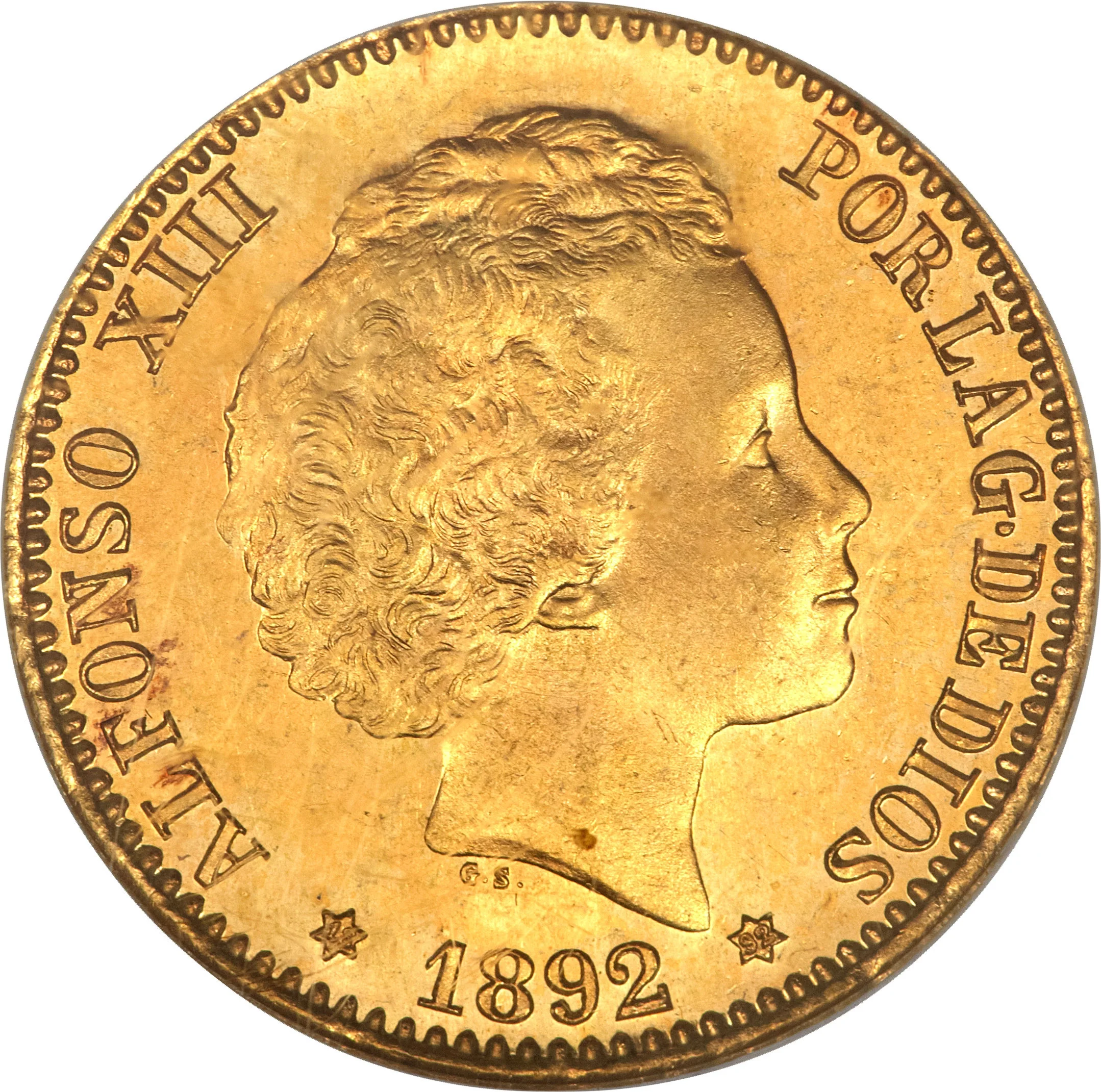
Young King Alfonso XIII facing right.
Inscription:
ALFONSO XIII POR LA G· DE DIOS
G· S·
🟌 1892 🟌
G· S·
🟌 1892 🟌
Translation:
By the grace of God, Alfonso XIII King
1892
1892
Script: Latin
Language: Spanish
Engraver: Gregorio Sellán y González
Reverse
Description:
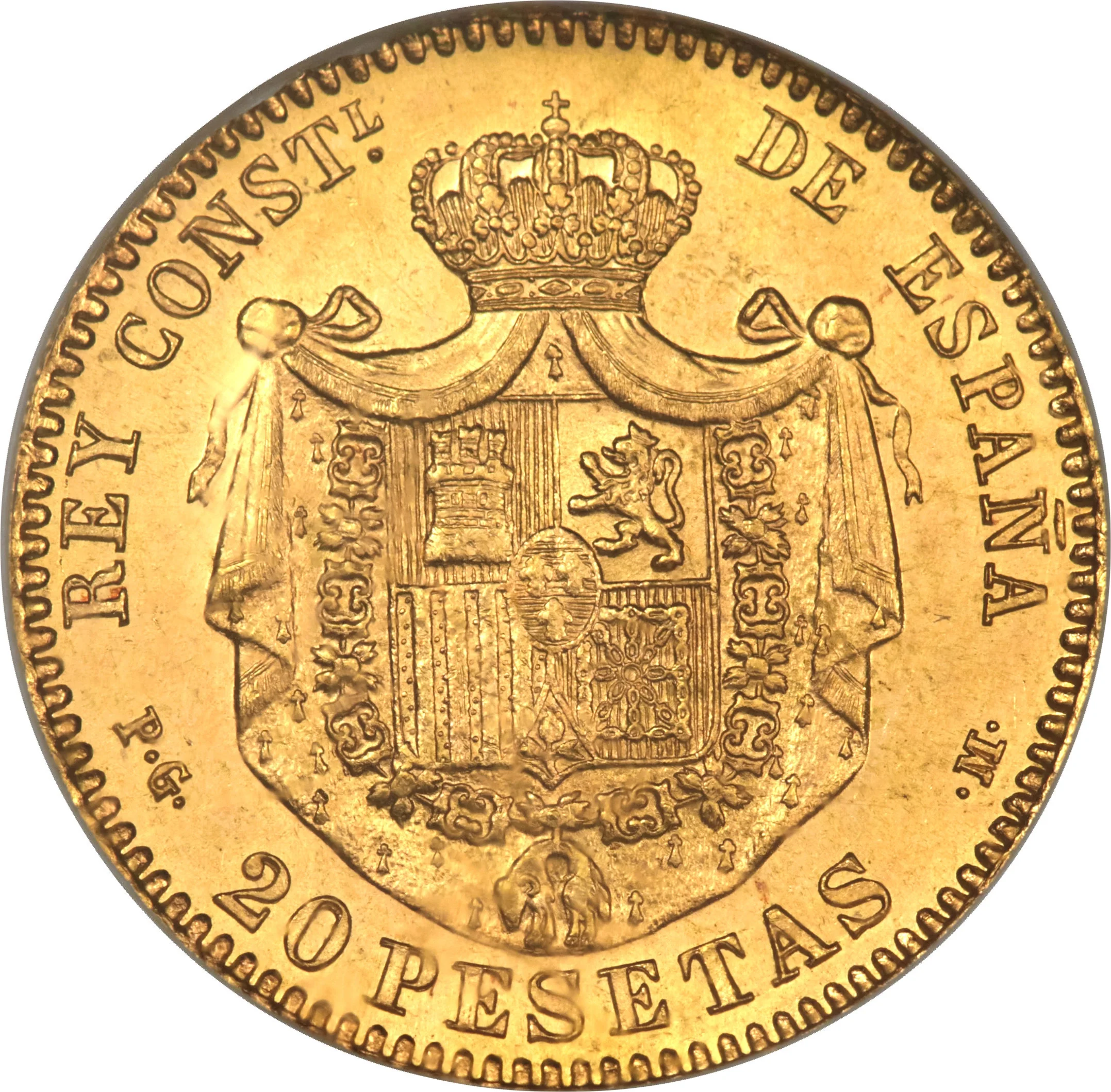
Draped and crowned Spanish coat of arms with the Golden Fleece.
Inscription:
REY CONSTL. DE ESPAÑA
P·G· 20 PESETAS ·M·
P·G· 20 PESETAS ·M·
Translation:
KING CONSTITUTIONAL OF SPAIN
P·G· 20 PESETAS ·M·
P·G· 20 PESETAS ·M·
Script: Latin
Language: Spanish
Engraver: Gregorio Sellán y González
Edge
Categories
| Person> Monarch |
| Symbols> Coat of Arms |
Mints
| Name | Mark |
|---|---|
| Royal Mint of Madrid | (🟌) |
Mintings
| Year | Mint Mark | Mintage | Quality | Collection |
|---|---|---|---|---|
| 1892 | 🟌 | 2,430,327 |
Historical background
In 1892, Spain's currency situation was defined by the enduring legacy of the peseta, which had been introduced in 1868 to replace the complex and outdated system of reales and escudos. The goal was monetary unification and modernization, aligning Spain with the Latin Monetary Union's bimetallic (gold and silver) standard. However, by the 1890s, the system was under severe strain. A global fall in the price of silver had caused the intrinsic value of silver coinage to drop below its face value, leading to the widespread hoarding and export of gold coins. This effectively pushed Spain off the gold standard, leaving it on a de facto and unstable silver standard, which isolated its economy from major European trading partners.
The financial context was one of profound crisis, exacerbated by the loss of most of Spain's remaining colonial empire following the Spanish-American War of 1898. In 1892, the state was grappling with chronic budget deficits, a massive public debt, and a loss of international financial confidence. The Bank of Spain, which held the exclusive right of note issue, struggled to maintain currency convertibility. Speculation against the peseta was rampant, and the currency's external value fluctuated wildly, creating uncertainty for trade and investment.
Consequently, the period was marked by intense debate between "metalistas" (advocates for a return to a strict metallic standard, preferably gold) and "papelistas" (those who accepted a fiduciary system based on banknotes). The government's attempts at reform were piecemeal and largely ineffective in 1892, setting the stage for more drastic measures in the coming decade. The fundamental instability would culminate in the Law of Monetary Reform of 1899, which officially established a gold exchange standard and devalued the peseta, formally recognizing the depreciation that the market had already inflicted upon it.
The financial context was one of profound crisis, exacerbated by the loss of most of Spain's remaining colonial empire following the Spanish-American War of 1898. In 1892, the state was grappling with chronic budget deficits, a massive public debt, and a loss of international financial confidence. The Bank of Spain, which held the exclusive right of note issue, struggled to maintain currency convertibility. Speculation against the peseta was rampant, and the currency's external value fluctuated wildly, creating uncertainty for trade and investment.
Consequently, the period was marked by intense debate between "metalistas" (advocates for a return to a strict metallic standard, preferably gold) and "papelistas" (those who accepted a fiduciary system based on banknotes). The government's attempts at reform were piecemeal and largely ineffective in 1892, setting the stage for more drastic measures in the coming decade. The fundamental instability would culminate in the Law of Monetary Reform of 1899, which officially established a gold exchange standard and devalued the peseta, formally recognizing the depreciation that the market had already inflicted upon it.
💎 Very Rare