

10 Pesetas – Spain
Spain
Context
Years: 1878–1962
Issuer: Spain 
Ruler: Alfonso XII
Currency:
(1868—2001)
Demonetization: 14 March 1937
Total mintage: 51,743
Material
References
KM: #Click to copy to clipboard677
Numista: #17552
Value
Exchange value: 10 ESP
Bullion value: $484.00
Obverse
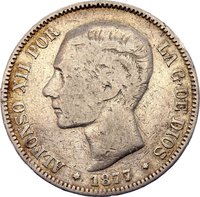
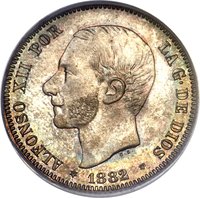
Description:
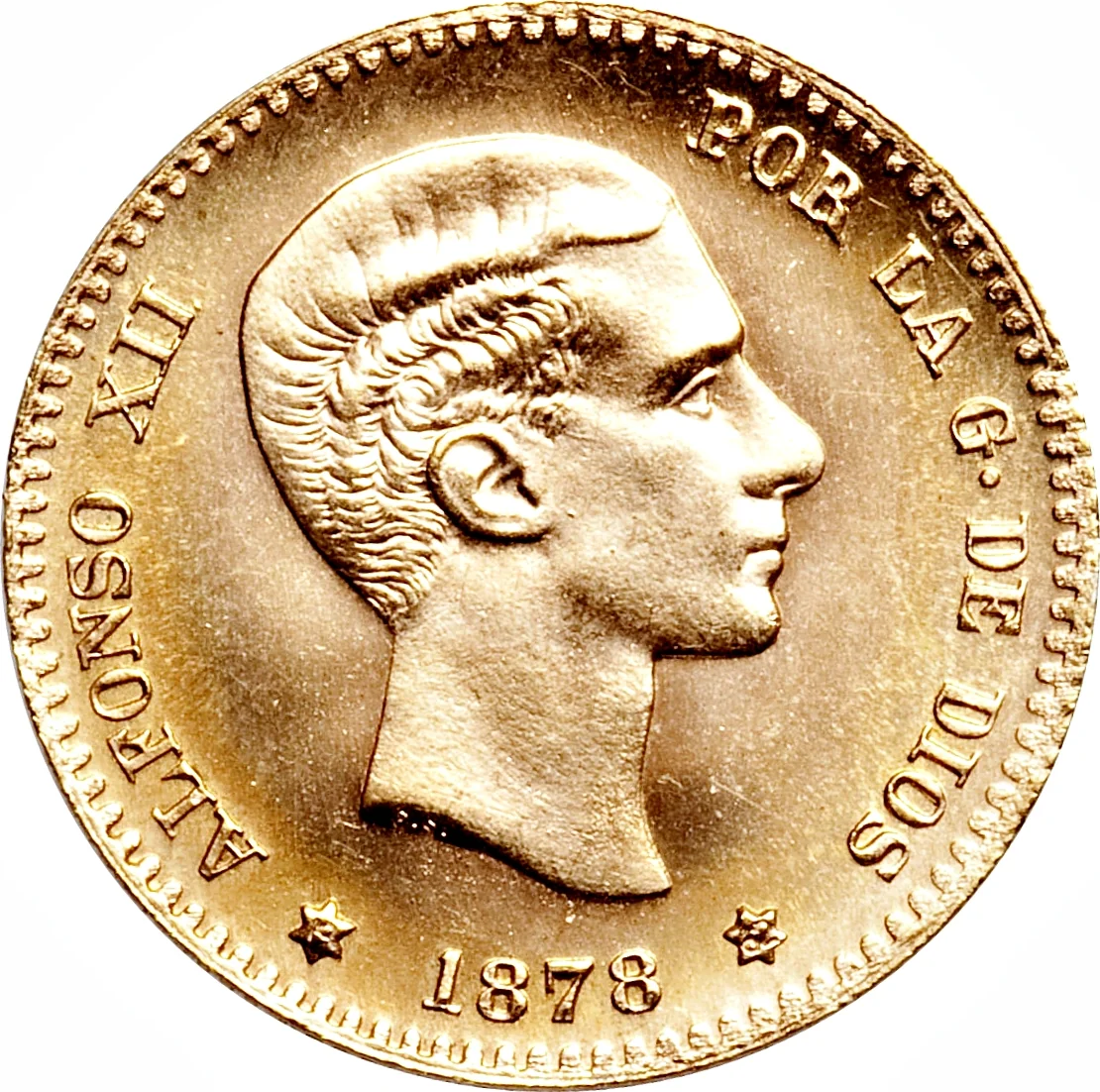
King Alfonso XII facing right.
Inscription:
ALFONSO XII POR LA G· DE DIOS
G· S·
🟌 1878 🟌
G· S·
🟌 1878 🟌
Translation:
By the grace of God, Alfonso XII
Sovereign of Spain
🟌 1878 🟌
Sovereign of Spain
🟌 1878 🟌
Script: Latin
Language: Spanish
Engraver: Gregorio Sellán y González
Reverse
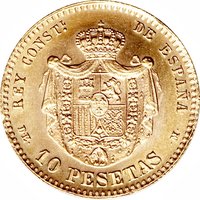
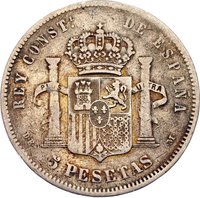
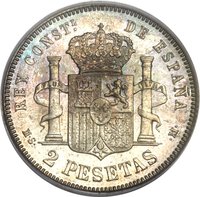
Description:
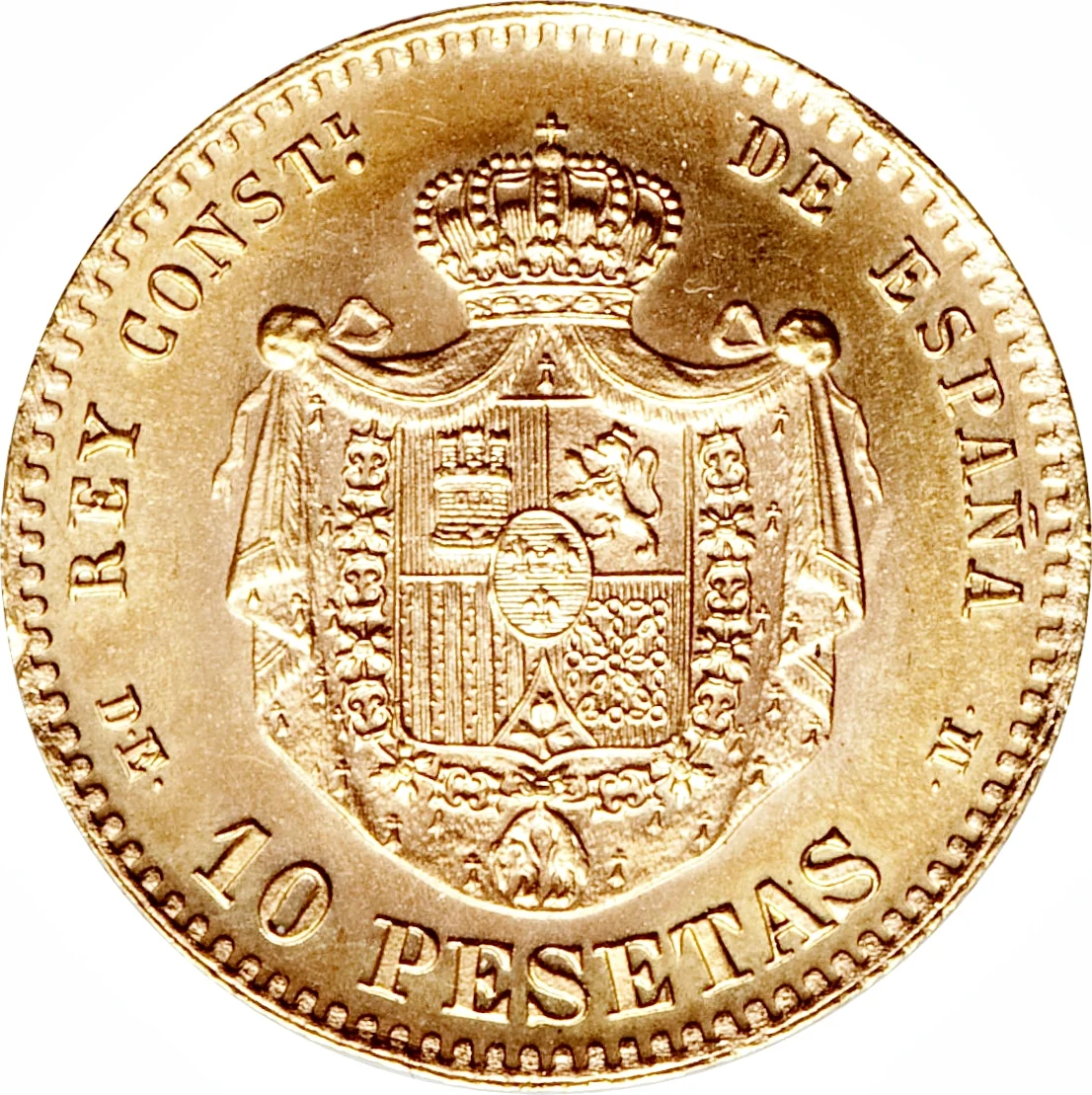
Draped and crowned Spanish coat of arms with the Golden Fleece.
Inscription:
REY CONSTL. DE ESPAÑA
D · E · 10 PESETAS · M ·
D · E · 10 PESETAS · M ·
Translation:
KING CONSTITUTIONAL OF SPAIN
D · E · 10 PESETAS · M ·
D · E · 10 PESETAS · M ·
Script: Latin
Language: Spanish
Engraver: Gregorio Sellán y González
Edge
Reeded
Categories
| Person> Monarch |
| Symbols> Coat of Arms |
Mints
| Name | Mark |
|---|---|
| Royal Mint of Madrid | (🟌) |
Mintings
| Year | Mint Mark | Mintage | Quality | Collection |
|---|---|---|---|---|
| 1878 | 🟌 | — | ||
| 1879 | 🟌 | 33,247 | ||
| 1961 | — | 496 | ||
| 1962 | — | 18,000 |
Historical background
In 1878, Spain was navigating a complex monetary landscape defined by the aftermath of the "Guerra Chica" (Little War) and the broader process of national monetary unification. The country operated on a bimetallic system in theory, based on the Latin Monetary Union standards, but in practice, it suffered from a severe shortage of precious metal coinage. Much of the circulating medium consisted of low-quality fractional silver coins, overvalued banknotes from the Bank of Spain, and a plethora of older regional and foreign coins, leading to confusion and inefficiency in everyday commerce.
The critical issue was the existence of two parallel currency units: the real and the escudo, which were awkwardly related. This dual system, a legacy of Spain's fragmented financial past, hampered trade and state accounting. Furthermore, the government was grappling with significant public debt and a need for economic modernization, which required a stable and trustworthy currency to attract investment and facilitate growth. The instability was exacerbated by the recent Third Carlist War (ended 1876), which had drained treasury reserves and disrupted economic activity.
Consequently, 1878 fell within a pivotal decade of reform that would culminate in the Peseta Law of June 26, 1864, and the final decree of October 19, 1868, which had officially established the peseta as Spain's sole monetary unit. Therefore, by 1878, the peseta was in the process of consolidating its position, aiming to replace the old chaotic system with a modern, decimal-based currency (1 peseta = 100 céntimos) tied to the gold standard. The year thus represents a point of transition, where the old monetary disorders were still felt, but the institutional framework for a unified national currency was being actively implemented to foster economic integration and stability.
The critical issue was the existence of two parallel currency units: the real and the escudo, which were awkwardly related. This dual system, a legacy of Spain's fragmented financial past, hampered trade and state accounting. Furthermore, the government was grappling with significant public debt and a need for economic modernization, which required a stable and trustworthy currency to attract investment and facilitate growth. The instability was exacerbated by the recent Third Carlist War (ended 1876), which had drained treasury reserves and disrupted economic activity.
Consequently, 1878 fell within a pivotal decade of reform that would culminate in the Peseta Law of June 26, 1864, and the final decree of October 19, 1868, which had officially established the peseta as Spain's sole monetary unit. Therefore, by 1878, the peseta was in the process of consolidating its position, aiming to replace the old chaotic system with a modern, decimal-based currency (1 peseta = 100 céntimos) tied to the gold standard. The year thus represents a point of transition, where the old monetary disorders were still felt, but the institutional framework for a unified national currency was being actively implemented to foster economic integration and stability.
⭐ Somewhat Rare