

40 Centavos – Puerto Rico
United States
Context
Year: 1896
Country: United States 
Issuer: Puerto Rico
Ruler: Alfonso XIII
Currency:
(1890—1900)
Demonetization: 12 April 1900
Total mintage: 725,002
Material
References
KM: #Click to copy to clipboard23
Numista: #17452
Value
Bullion value: $23.15
Obverse
Description:
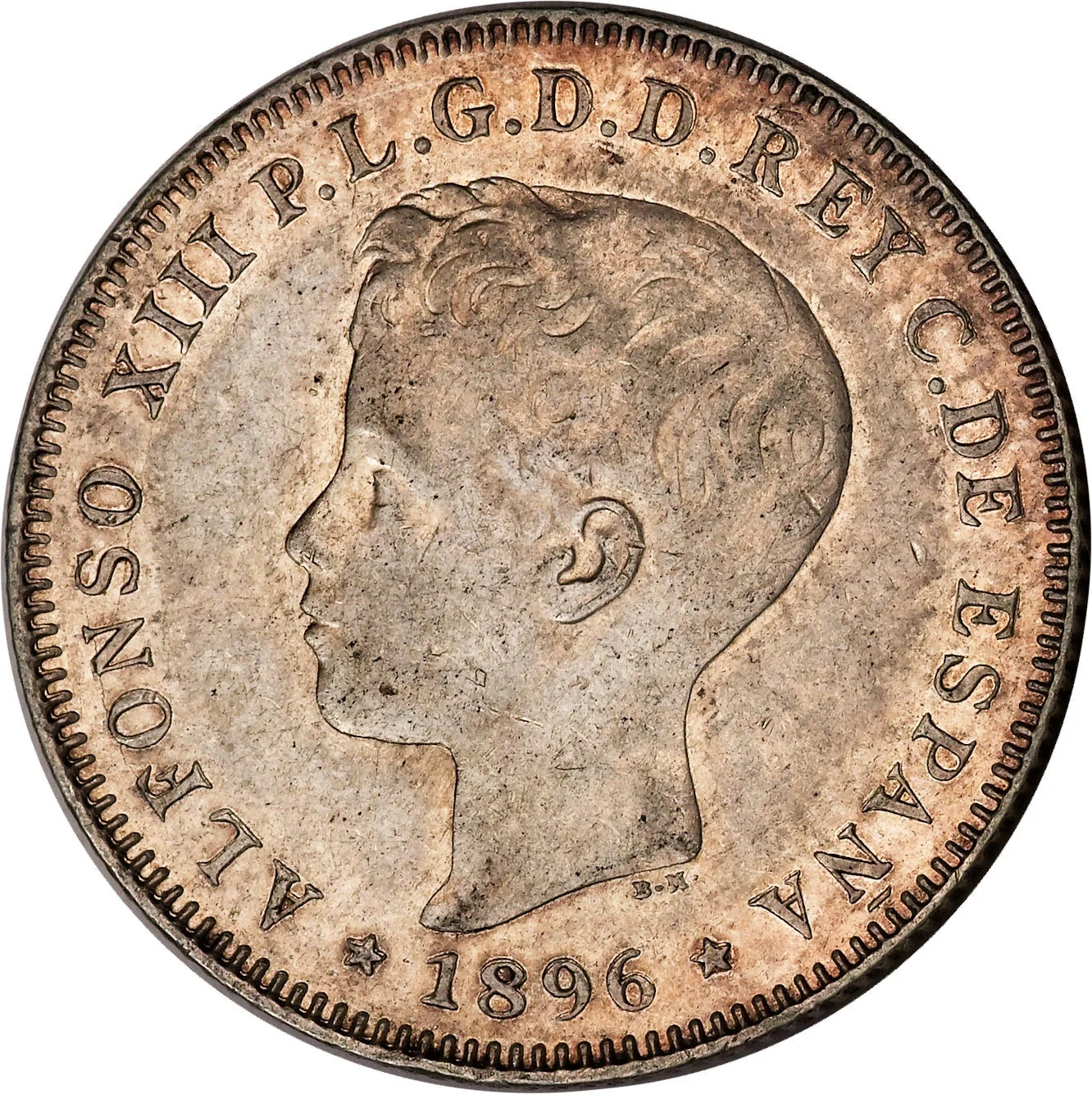
Alfonso XIII left bust. Legend: "ALFONSO XIII REY CONSTITUCIONAL DE ESPAÑA" (Alfonso XIII, constitutional king of Spain).
Inscription:
ALFONSO XIII P.L.G.D.D. REY C. DE ESPANA
B.M.
* 1896 *
B.M.
* 1896 *
Translation:
ALFONSO XIII BY THE GRACE OF GOD KING OF SPAIN
B.M.
* 1896 *
B.M.
* 1896 *
Script: Latin
Engraver: Bartolomé Maura Montaner
Reverse
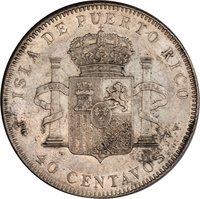
Description:
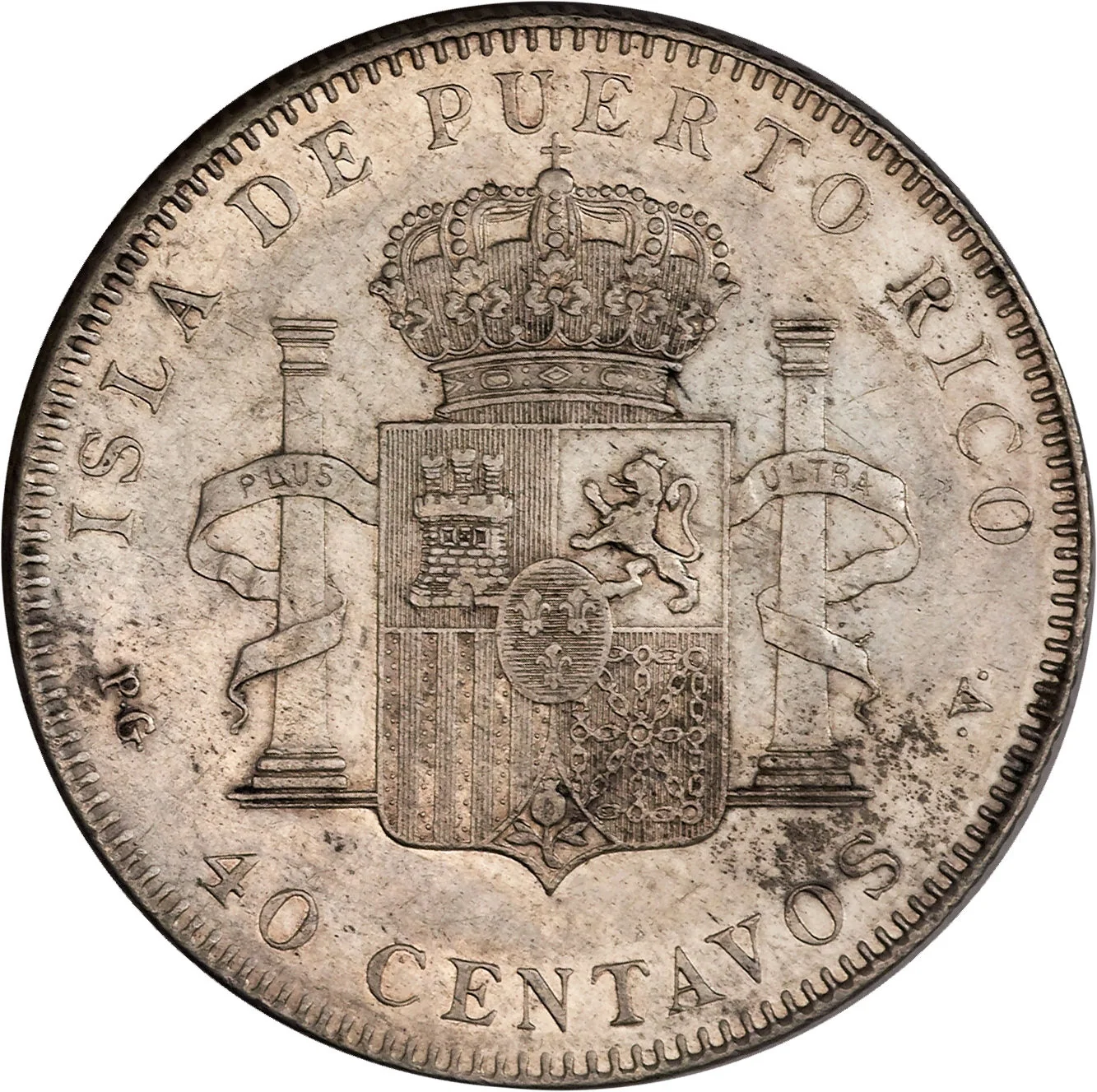
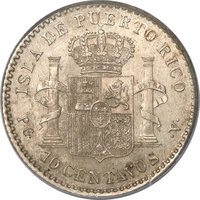
Arms between columns. Mint initials: P, G, V.
Inscription:
ISLA DE PUERTO RICO
PLUS ULTRA
P·G· 40 CENTAVOS ·V·
PLUS ULTRA
P·G· 40 CENTAVOS ·V·
Script: Latin
Engraver: Bartolomé Maura Montaner
Edge
Reeded
Mints
| Name | Mark |
|---|---|
| Royal Mint of Madrid | — |
Mintings
| Year | Mint Mark | Mintage | Quality | Collection |
|---|---|---|---|---|
| 1896 | PGV | 725,002 |
Historical background
In 1896, Puerto Rico's currency situation was a complex and unstable legacy of Spanish colonial rule, directly tied to the island's economic distress. The official currency was the Puerto Rican peso, a distinct currency pegged to the Spanish peseta. However, decades of fiscal mismanagement by Madrid had led to severe devaluation and a profound lack of public confidence. The local peso was notoriously weak, its value fluctuating wildly and often trading at a significant discount compared to major international currencies like the U.S. dollar. This instability crippled trade and investment, exacerbating the poverty that followed the decline of the coffee and sugar sectors.
Compounding the problem was a chaotic circulation of multiple foreign coins. Due to the weak local currency, Spanish coins of various denominations, Mexican silver pesos, and increasingly, U.S. dollars, all circulated simultaneously. This created a confusing and inefficient monetary environment where daily transactions required constant calculation of exchange rates. The U.S. dollar, in particular, was gaining prominence due to growing commercial ties with the United States, foreshadowing the imminent political change. The system was essentially bimetallic, relying on both silver and gold coins, which further complicated its stability in a global era of shifting precious metal values.
Ultimately, the currency crisis of 1896 was a symptom of Puerto Rico's broader colonial stagnation and a primary cause of social discontent. Merchants and plantation owners struggled with unpredictable finances, while the working class bore the brunt of inflation and uncertainty. This fragile economic reality set the stage for the monetary transformation that would follow the U.S. invasion in 1898. The Foraker Act of 1900 would soon abolish the Puerto Rican peso entirely, fixing the exchange rate and making the U.S. dollar the sole legal tender, abruptly ending the island's distinct monetary system but bringing the stability that the 1896 situation so desperately lacked.
Compounding the problem was a chaotic circulation of multiple foreign coins. Due to the weak local currency, Spanish coins of various denominations, Mexican silver pesos, and increasingly, U.S. dollars, all circulated simultaneously. This created a confusing and inefficient monetary environment where daily transactions required constant calculation of exchange rates. The U.S. dollar, in particular, was gaining prominence due to growing commercial ties with the United States, foreshadowing the imminent political change. The system was essentially bimetallic, relying on both silver and gold coins, which further complicated its stability in a global era of shifting precious metal values.
Ultimately, the currency crisis of 1896 was a symptom of Puerto Rico's broader colonial stagnation and a primary cause of social discontent. Merchants and plantation owners struggled with unpredictable finances, while the working class bore the brunt of inflation and uncertainty. This fragile economic reality set the stage for the monetary transformation that would follow the U.S. invasion in 1898. The Foraker Act of 1900 would soon abolish the Puerto Rican peso entirely, fixing the exchange rate and making the U.S. dollar the sole legal tender, abruptly ending the island's distinct monetary system but bringing the stability that the 1896 situation so desperately lacked.
⭐ Rare