


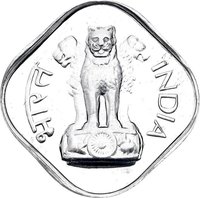
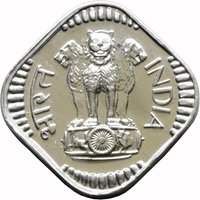
Obverse
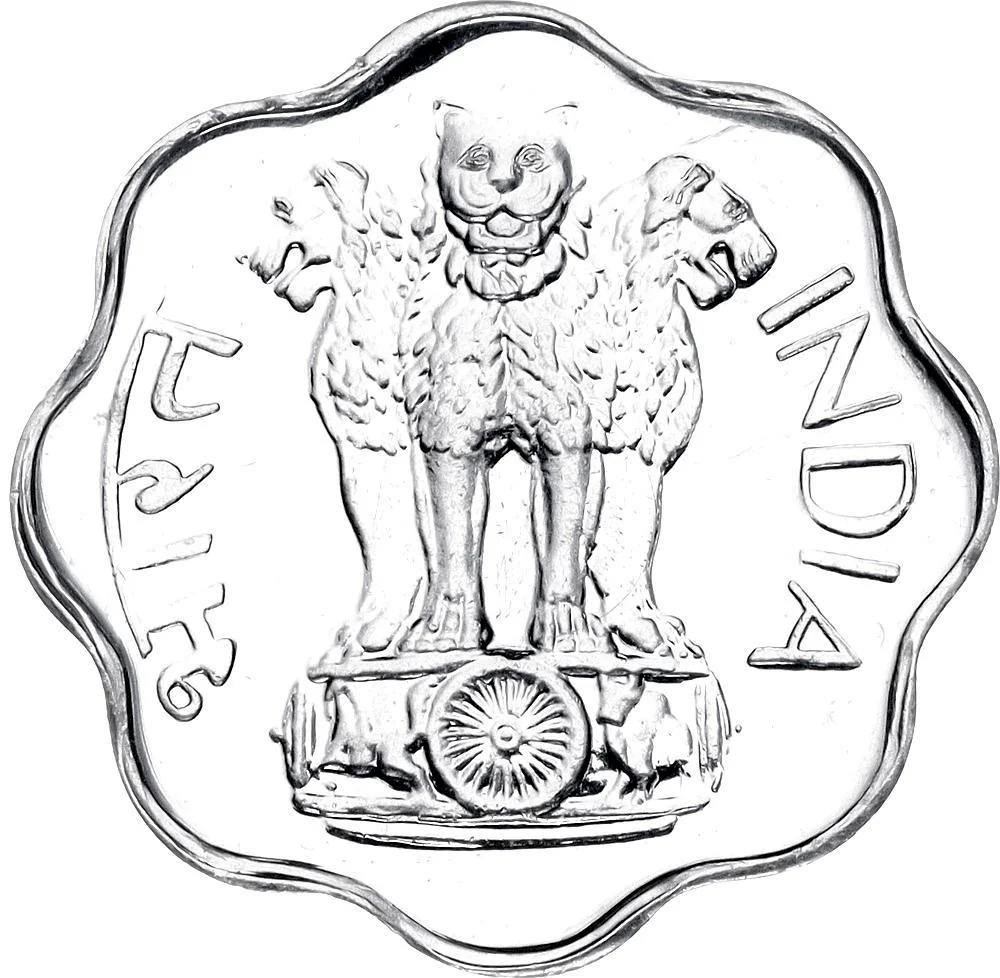
Description:
The Ashoka Pillar's lion capital.
Inscription:
भारत INDIA
Translation:
India
Scripts: Devanagari, Latin
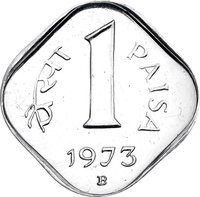
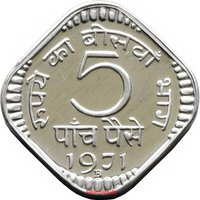
Reverse
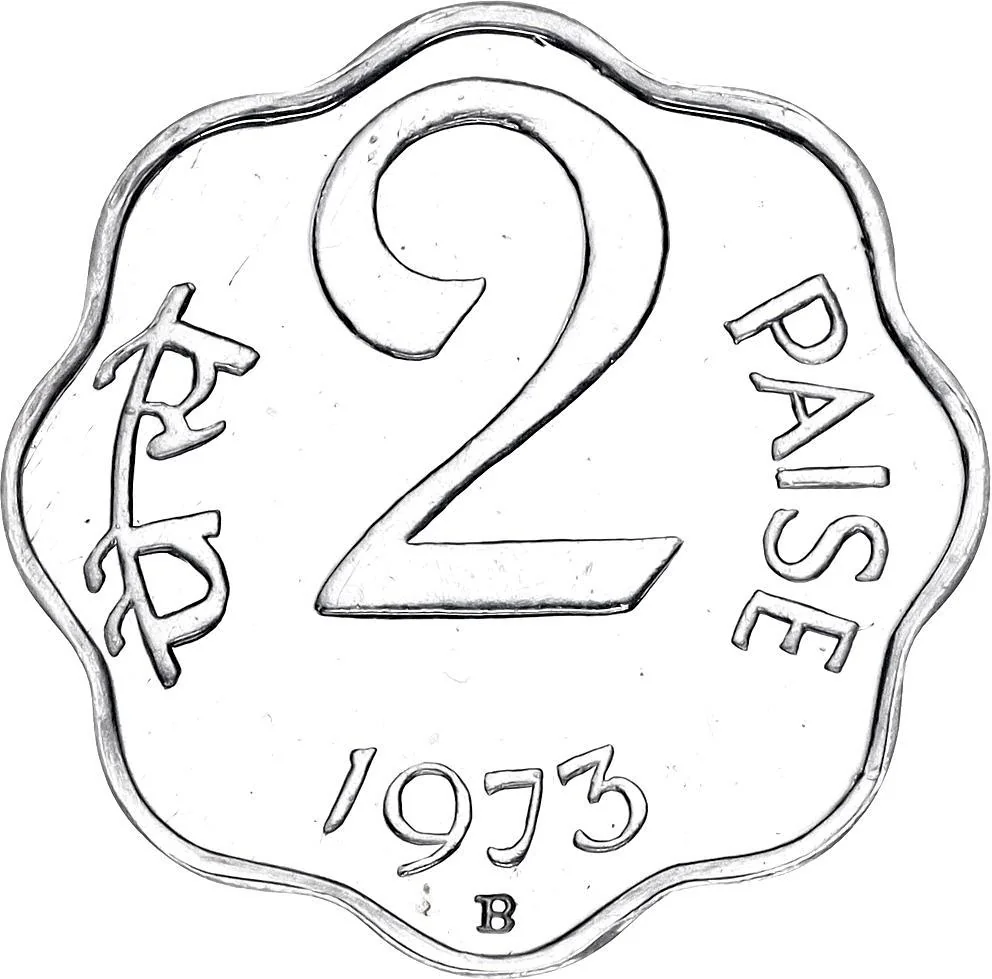
Description:
Denomination and date below.
Inscription:
पैसे 2 PAISE
1967
1967
Translation:
Paise 2 Paise
1967
1967
Scripts: Devanagari, Latin
Edge
Plain
Mints
| Name | Mark |
|---|---|
| Hyderabad | ★ |
| Mumbai / Bombay | ♦ & B |
| Kolkata / Calcutta / Murshidabad | No mint mark |
Mintings
| Year | Mint Mark | Mintage | Quality | Collection |
|---|---|---|---|---|
| 1965 | — | — | ||
| 1965 | ♦ | 175,770,000 | ||
| 1966 | ♦ | 386,795,000 | ||
| 1966 | — | — | ||
| 1967 | — | — | ||
| 1967 | ♦ | — | ||
| 1968 | — | — | ||
| 1968 | ♦ | 305,205,000 | ||
| 1969 | ♦ | 5,335,000 | ||
| 1969 | B | 9,147 | Proof | |
| 1970 | — | 79,100,000 | ||
| 1970 | ♦ | — | In sets | |
| 1970 | B | 3,046 | Proof | |
| 1971 | — | 207,900,000 | ||
| 1971 | B | 4,375 | Proof | |
| 1972 | — | 261,270,000 | ||
| 1972 | ★ | — | ||
| 1972 | B | 7,895 | Proof | |
| 1973 | ★ | — | ||
| 1973 | — | — | ||
| 1973 | B | 7,562 | Proof | |
| 1974 | — | — | ||
| 1974 | ★ | — | ||
| 1974 | B | — | Proof | |
| 1975 | — | 184,500,000 | ||
| 1975 | B | — | Proof | |
| 1975 | ★ | — | ||
| 1976 | ★ | — | ||
| 1976 | ♦ | 68,140,000 | ||
| 1976 | B | — | Proof | |
| 1977 | ♦ | 251,955,000 | ||
| 1977 | B | — | Proof | |
| 1977 | ★ | — | ||
| 1978 | ♦ | — | ||
| 1978 | ★ | 144,010,000 | ||
| 1978 | B | — | Proof | |
| 1979 | B | — | Proof | |
| 1979 | ★ | — | ||
| 1980 | B | — | Proof | |
| 1981 | B | — | Proof |
Historical background
In 1965, India's currency situation was fundamentally shaped by the fixed exchange rate system of the Bretton Woods era, with the Indian Rupee pegged to the British Pound Sterling, which itself was pegged to the US Dollar. This linkage provided a degree of stability for international trade but also meant that India's monetary policy was heavily influenced by external economic pressures. The period was marked by significant economic strain, primarily due to the costly Indo-Pakistani War of 1965 and the lingering effects of a severe drought, which together depleted foreign exchange reserves and widened the trade deficit. The government, under Prime Minister Lal Bahadur Shastri, was forced to seek urgent external assistance to avert a balance of payments crisis.
A critical development in 1965 was the government's secretive preparation for a potential devaluation of the Rupee, a measure being strongly advocated by international lenders like the World Bank and the United States. These institutions linked further financial aid to economic liberalization and a more realistic exchange rate to boost exports and curb imports. While the actual devaluation would not occur until June 1966, the groundwork and intense negotiations with foreign donors were a defining feature of the 1965 currency and economic policy landscape. Domestically, the Reserve Bank of India managed a complex scenario of controlling money supply to check inflation while also needing to finance government expenditures.
Thus, the currency situation in 1965 was one of precarious stability, underpinned by a fixed peg but besieged by fiscal and geopolitical shocks. It represented a transitional phase where external economic dependencies and the shortcomings of an overvalued currency were becoming untenable. The year set the stage for the major economic policy shift that would follow, as India stood on the brink of devaluation, a move intended to address structural weaknesses but one that would also carry significant political and economic consequences.
A critical development in 1965 was the government's secretive preparation for a potential devaluation of the Rupee, a measure being strongly advocated by international lenders like the World Bank and the United States. These institutions linked further financial aid to economic liberalization and a more realistic exchange rate to boost exports and curb imports. While the actual devaluation would not occur until June 1966, the groundwork and intense negotiations with foreign donors were a defining feature of the 1965 currency and economic policy landscape. Domestically, the Reserve Bank of India managed a complex scenario of controlling money supply to check inflation while also needing to finance government expenditures.
Thus, the currency situation in 1965 was one of precarious stability, underpinned by a fixed peg but besieged by fiscal and geopolitical shocks. It represented a transitional phase where external economic dependencies and the shortcomings of an overvalued currency were becoming untenable. The year set the stage for the major economic policy shift that would follow, as India stood on the brink of devaluation, a move intended to address structural weaknesses but one that would also carry significant political and economic consequences.
🌱 Very Common