

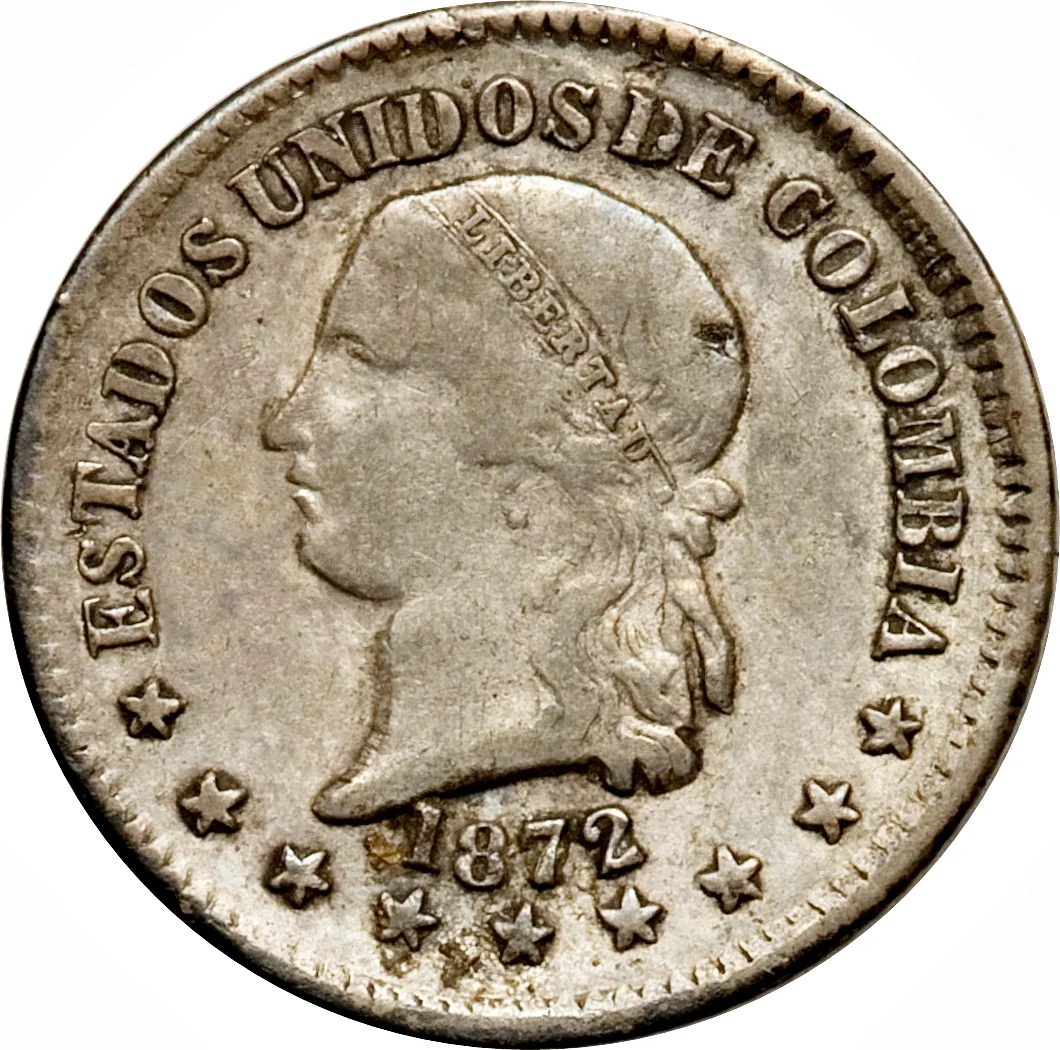
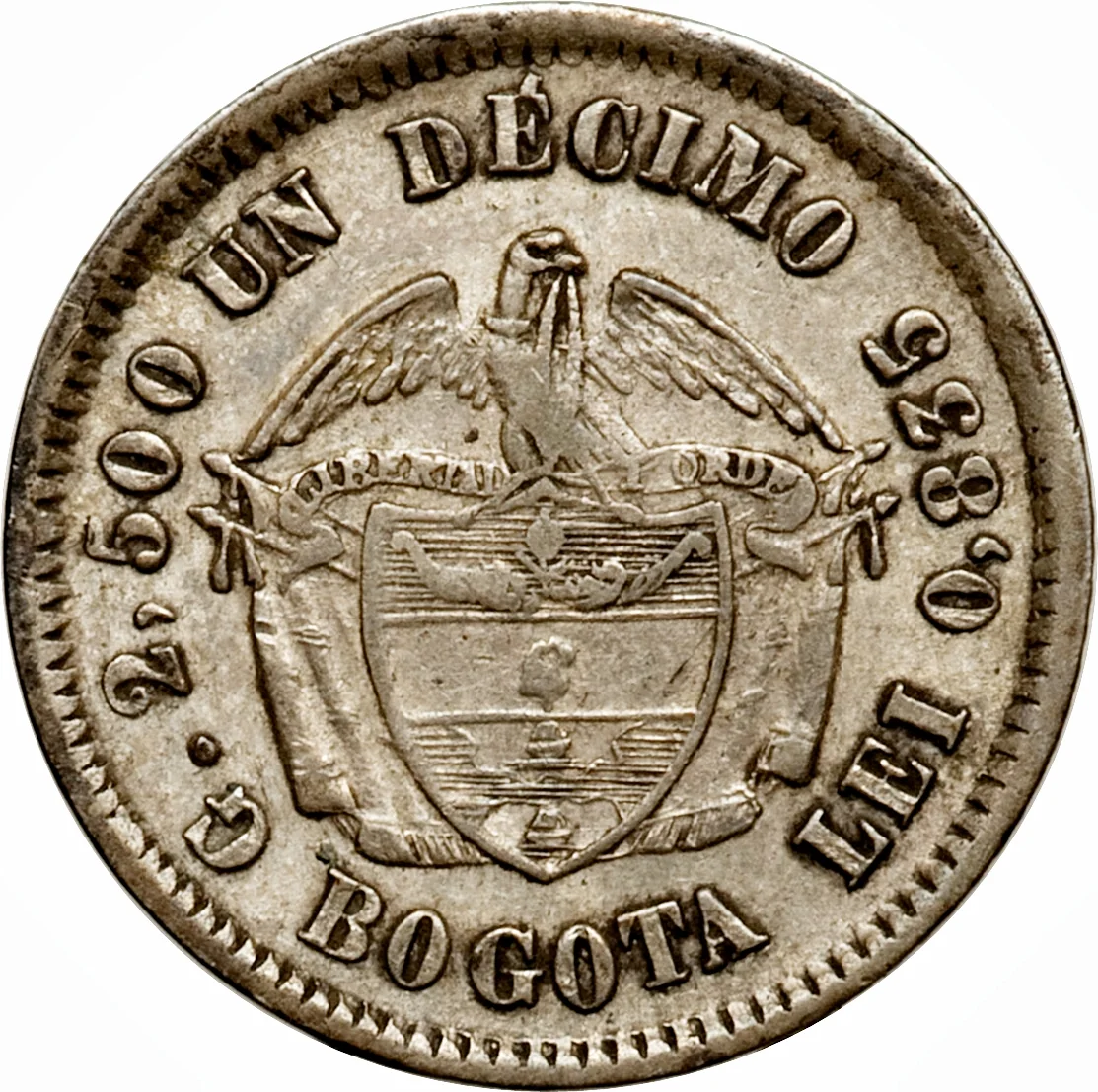
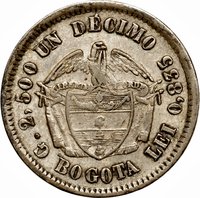
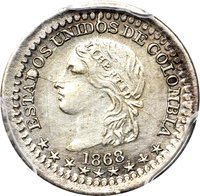
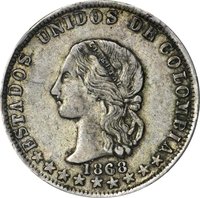
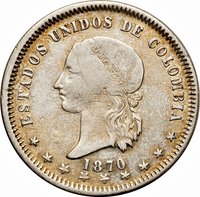
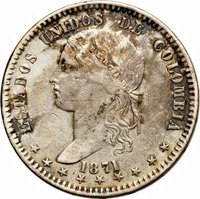
Obverse
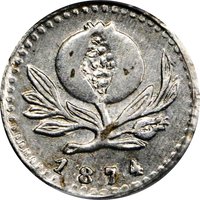
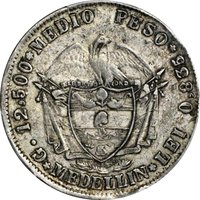
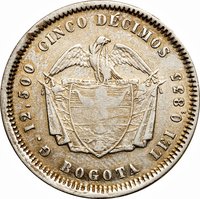
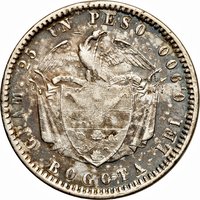
Reverse
Description:
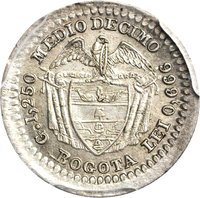
Condor over heraldic flags.
Inscription:
G.2,55 UN DECIMO
LIBERTAD I ORDEN
BOGOTA LEI 0,835
LIBERTAD I ORDEN
BOGOTA LEI 0,835
Script: Latin
Edge
Reeded
Categories
| Symbol> Allegory |
| Symbols> Coat of Arms |
Mints
| Name | Mark |
|---|---|
| Bogota Mint | — |
| Casa de Moneda de Colombia | — |
Mintings
| Year | Mint Mark | Mintage | Quality | Collection |
|---|---|---|---|---|
| 1868 | — | 146,000 | ||
| 1869 | — | 82,000 | ||
| 1870 | — | — | ||
| 1871 | — | 144,000 | ||
| 1872 | — | 133,000 | ||
| 1874 | — | — |
Historical background
In 1868, Colombia existed as the United States of Colombia, a federal republic established by the 1863 constitution of Rionegro. This highly decentralized political framework granted immense fiscal and monetary autonomy to its nine sovereign states. Consequently, the national currency landscape was one of profound fragmentation and complexity. While the federal government in Bogotá minted gold coins (like the cóndor and medio cóndor) and silver coins that were legal tender nationwide, the individual states aggressively exercised their right to issue their own paper money, known as billetes. This resulted in a proliferation of banknotes of varying designs, credibility, and value, circulating primarily within their state of origin.
The economic situation was precarious. The federal treasury was chronically empty, weakened by successive civil wars and limited taxation powers. To finance deficits, both state and federal governments often resorted to excessive money printing, leading to significant inflation and a severe loss of public confidence in paper currency. In everyday commerce, the artificially fixed exchange rate between gold and silver was widely ignored, and the value of state-issued billetes fluctuated wildly based on perceptions of each state's solvency. This created a chaotic monetary environment where transaction costs were high, inter-state trade was hampered, and a general preference for hard specie (gold coins) prevailed among those who could obtain it.
Thus, the currency situation in 1868 was a direct reflection of the nation's political turmoil. The radical federalism of the Rionegro Constitution, while intended to prevent centralized tyranny, had created an unstable and inefficient monetary system. The proliferation of disparate currencies undermined national economic integration and exacerbated inflationary pressures, setting the stage for the monetary reforms and centralizing reaction that would culminate in the Regeneration movement of the 1880s and the eventual adoption of the gold standard.
The economic situation was precarious. The federal treasury was chronically empty, weakened by successive civil wars and limited taxation powers. To finance deficits, both state and federal governments often resorted to excessive money printing, leading to significant inflation and a severe loss of public confidence in paper currency. In everyday commerce, the artificially fixed exchange rate between gold and silver was widely ignored, and the value of state-issued billetes fluctuated wildly based on perceptions of each state's solvency. This created a chaotic monetary environment where transaction costs were high, inter-state trade was hampered, and a general preference for hard specie (gold coins) prevailed among those who could obtain it.
Thus, the currency situation in 1868 was a direct reflection of the nation's political turmoil. The radical federalism of the Rionegro Constitution, while intended to prevent centralized tyranny, had created an unstable and inefficient monetary system. The proliferation of disparate currencies undermined national economic integration and exacerbated inflationary pressures, setting the stage for the monetary reforms and centralizing reaction that would culminate in the Regeneration movement of the 1880s and the eventual adoption of the gold standard.
Series: 1868 Colombia circulation coins
⭐ Rare