

5 sheqalim – Israel
Add to wishlist
Israel
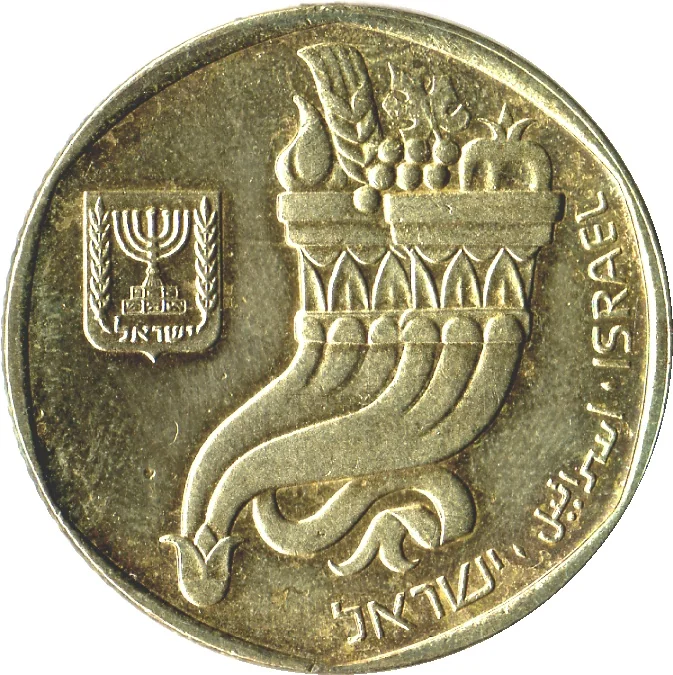
Obverse
Description:
Double cornucopia with ribbon pendant; Israel's emblem.
Inscription:
ישראל
اسرائيل ישראל ISRAEL
اسرائيل ישראל ISRAEL
Translation:
Israel Israel ISRAEL
Engravers: Eliezer Weishoff, Tidhar Dagan
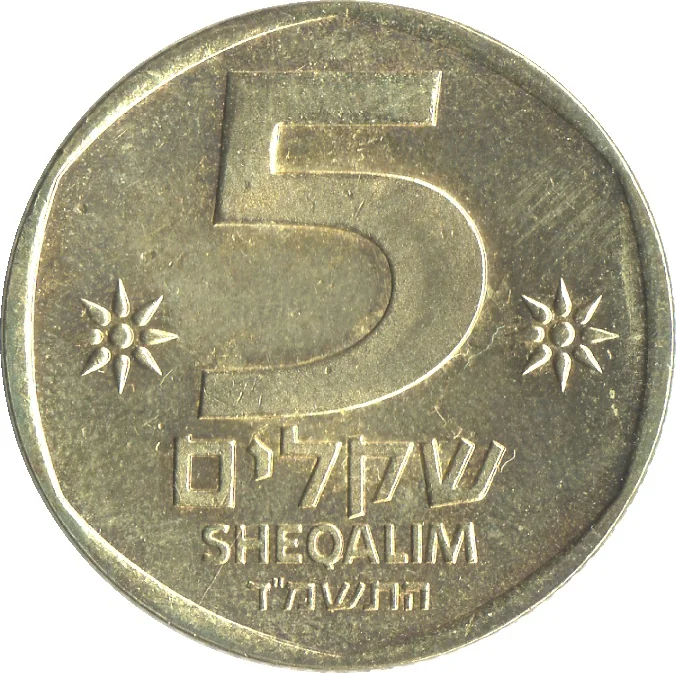
Reverse
Description:
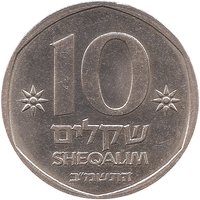
Value, year
Inscription:
5
שקלים
SHEQALIM
התשמ׳׳ד
שקלים
SHEQALIM
התשמ׳׳ד
Translation:
Sheqalim
5744
5744
Language: Hebrew
Engraver: Nathan Karp
Edge
Milled
Categories
| Symbol> Cornucopia |
Mints
| Name | Mark |
|---|---|
| Casa de Moneda de Chile | — |
| Jerusalem | — |
| Kretschmer Mint | — |
| Monnaie de Paris | — |
Mintings
| Year | Mint Mark | Mintage | Quality | Collection |
|---|---|---|---|---|
| 1982 | — | 30,000,000 | ||
| 1983 | — | 994,000 | ||
| 1984 | — | 13,403 | ||
| 1985 | — | 250,000 |
Historical background
In 1982, Israel was grappling with the severe economic consequences of its long-standing battle with hyperinflation, which had been accelerating since the mid-1970s. This period, often called the "Lost Decade," was characterized by annual inflation rates soaring into triple digits, driven by massive government deficits used to fund extensive social programs, a large public sector, and significant military expenditures. The Israeli shekel, which had undergone several re-denominations, was rapidly losing value, causing widespread indexation of prices and wages to the cost-of-living index in a desperate attempt to preserve purchasing power. This created a vicious cycle of inflationary expectations that the existing economic policies could not break.
The currency situation was fundamentally a crisis of confidence and policy. The Bank of Israel routinely monetized government debt, effectively printing money to finance deficits, which directly fueled the inflationary fire. While various partial stabilization plans had been attempted, they failed to address the root causes. By 1982, inflation was entrenched near 130%, and the shekel's exchange rate was managed through a complex, frequently adjusted "sliding peg" system that failed to provide stability. The economy was marked by widespread dollarization, where citizens and businesses increasingly held and transacted in U.S. dollars as a hedge, further undermining the national currency.
This untenable situation set the stage for the historic 1985 Economic Stabilization Plan. The crisis of 1982-1984, which saw inflation peak at nearly 450% in 1984, made it clear that radical, comprehensive action was necessary. The groundwork for this shift began with growing political recognition of the need for drastic fiscal discipline and a cessation of inflationary financing. Thus, the currency turmoil of 1982 represents the peak of a failed policy era, immediately preceding the tough, coordinated reforms that would finally restore price stability and redefine Israel's economic trajectory in the latter half of the 1980s.
The currency situation was fundamentally a crisis of confidence and policy. The Bank of Israel routinely monetized government debt, effectively printing money to finance deficits, which directly fueled the inflationary fire. While various partial stabilization plans had been attempted, they failed to address the root causes. By 1982, inflation was entrenched near 130%, and the shekel's exchange rate was managed through a complex, frequently adjusted "sliding peg" system that failed to provide stability. The economy was marked by widespread dollarization, where citizens and businesses increasingly held and transacted in U.S. dollars as a hedge, further undermining the national currency.
This untenable situation set the stage for the historic 1985 Economic Stabilization Plan. The crisis of 1982-1984, which saw inflation peak at nearly 450% in 1984, made it clear that radical, comprehensive action was necessary. The groundwork for this shift began with growing political recognition of the need for drastic fiscal discipline and a cessation of inflationary financing. Thus, the currency turmoil of 1982 represents the peak of a failed policy era, immediately preceding the tough, coordinated reforms that would finally restore price stability and redefine Israel's economic trajectory in the latter half of the 1980s.
🌱 Very Common