

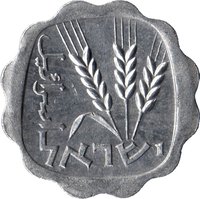
Obverse
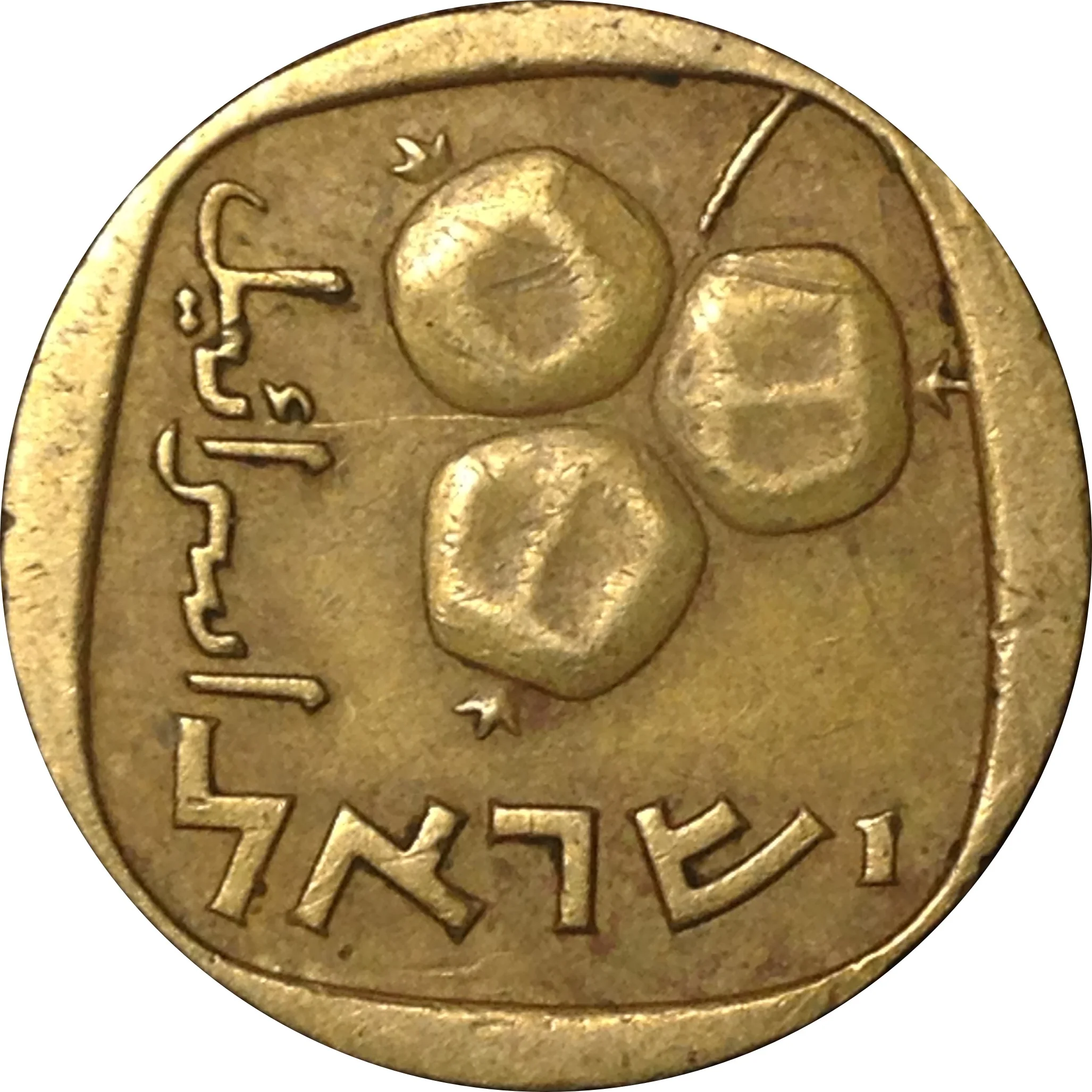
Description:
Three ripe pomegranates.
Inscription:
ישראל اسرائيل
Translation:
Israel Israel
Engravers: Gerd Rothschild, Zeev Lipman
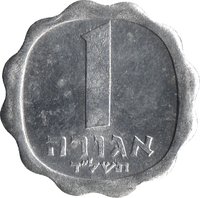
Reverse
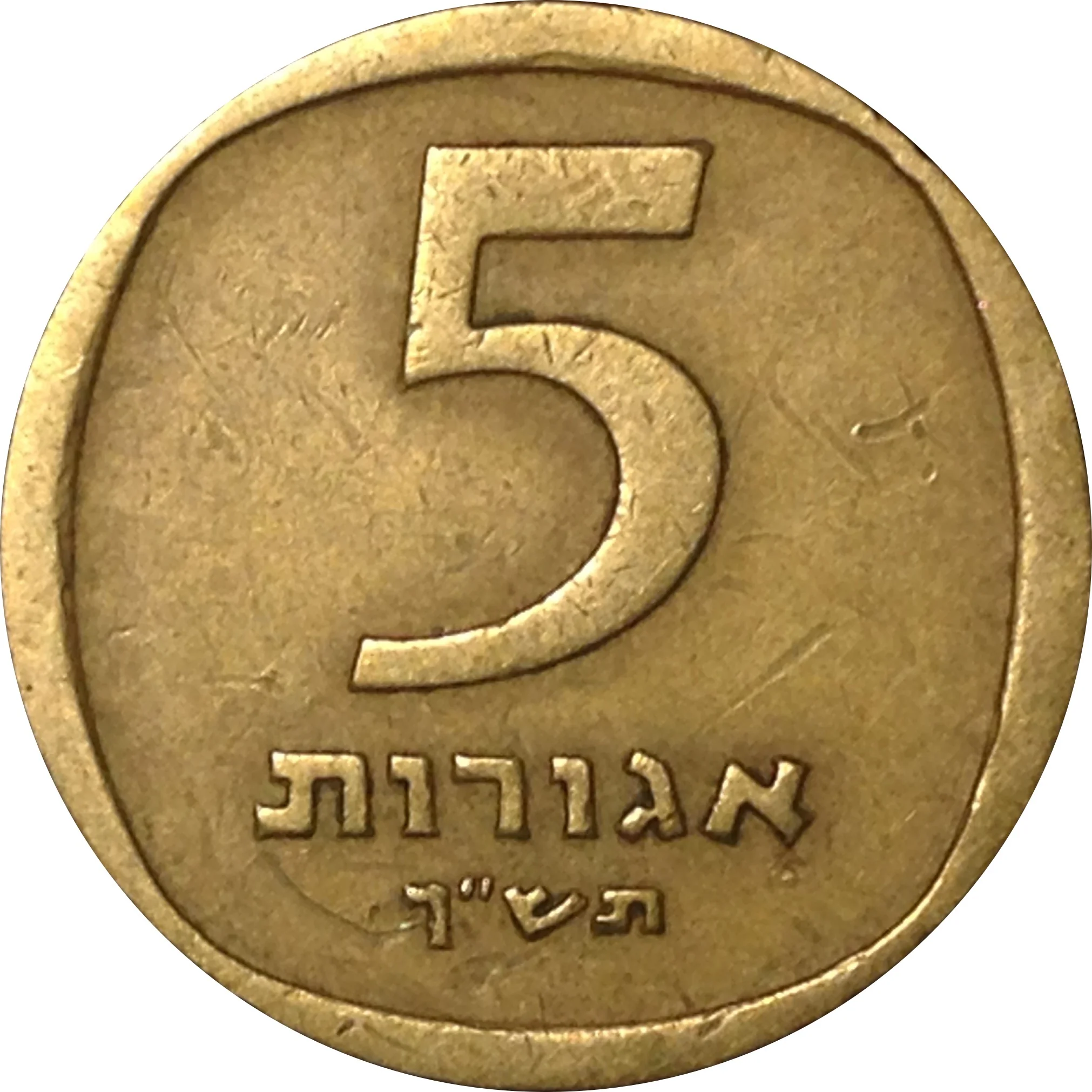
Description:
Value by year.
Inscription:
5
אגורות
תש"ך
אגורות
תש"ך
Translation:
5
Agorot
5720
Agorot
5720
Script: Hebrew
Language: Hebrew
Engravers: Gabriel Shamir, Maxim Shamir
Edge
Plain
Mints
| Name | Mark |
|---|---|
| Government Printer - Israel Mint | — |
| Jerusalem | — |
| Kings Norton Metal Company | — |
| Royal Canadian Mint of Ottawa | — |
Mintings
| Year | Mint Mark | Mintage | Quality | Collection |
|---|---|---|---|---|
| 1960 | — | 8,019,000 | ||
| 1961 | — | 5,000,000 | ||
| 1962 | — | 11,198,000 | ||
| 1963 | — | 1,429,000 | ||
| 1964 | — | 21,451 | ||
| 1965 | — | 201,281 | ||
| 1966 | — | 290,866 | ||
| 1967 | — | 2,195,114 | ||
| 1968 | — | 4,020,000 | ||
| 1969 | — | 2,200,103 | ||
| 1970 | — | 4,004,000 | ||
| 1971 | — | 14,010,000 | ||
| 1972 | — | 9,005,000 | ||
| 1973 | — | 27,720,000 | ||
| 1974 | — | 10,470,000 | ||
| 1975 | — | 10,232,000 |
Historical background
In 1960, Israel's currency, the Israeli lira (often called the "pound" or lira yisraelit), was part of a complex and tightly controlled financial system designed to manage the young state's precarious economic position. The country was still in its formative "austerity" period, characterized by rapid population growth, massive state-led development projects, and a persistent deficit in the balance of payments. To conserve scarce foreign reserves and direct capital toward national priorities like agriculture and defense, the government maintained a multi-tiered exchange rate system. This meant there was not one single value for the lira, but different official rates for different types of transactions (e.g., essential imports versus luxury goods), creating a complex web of subsidies and restrictions.
This regime was underpinned by strict foreign currency controls administered by the Bank of Israel, established just six years prior in 1954. Citizens and businesses could not freely hold or trade foreign currency, and all international transactions required approval. While this protectionist model helped steer the economy through its early challenges, it also led to distortions, encouraging a black market for foreign exchange where the lira traded at a significantly depreciated value compared to the official rates. The system reflected a broader policy of étatism, where the government played a dominant role in all aspects of the economy.
By the end of the 1950s and into 1960, pressures for liberalization were growing. The multi-rate system was cumbersome and seen as a barrier to efficient growth and foreign investment. Consequently, 1960 stood on the eve of significant reform; the following year, in 1961, the government initiated a major currency restructuring. The old lira was replaced by a new Israeli lira at a rate of 1:1, but, more importantly, this was coupled with a substantial devaluation and a simplification of the exchange rate system into a unified, more realistic official rate—a crucial step toward integrating Israel into the global economy.
This regime was underpinned by strict foreign currency controls administered by the Bank of Israel, established just six years prior in 1954. Citizens and businesses could not freely hold or trade foreign currency, and all international transactions required approval. While this protectionist model helped steer the economy through its early challenges, it also led to distortions, encouraging a black market for foreign exchange where the lira traded at a significantly depreciated value compared to the official rates. The system reflected a broader policy of étatism, where the government played a dominant role in all aspects of the economy.
By the end of the 1950s and into 1960, pressures for liberalization were growing. The multi-rate system was cumbersome and seen as a barrier to efficient growth and foreign investment. Consequently, 1960 stood on the eve of significant reform; the following year, in 1961, the government initiated a major currency restructuring. The old lira was replaced by a new Israeli lira at a rate of 1:1, but, more importantly, this was coupled with a substantial devaluation and a simplification of the exchange rate system into a unified, more realistic official rate—a crucial step toward integrating Israel into the global economy.
Series: 1960 Israel circulation coins
🌱 Very Common