

1 dirham – Morocco
Add to wishlist
Morocco
Context
Material
Diameter: 23.82 mm
Weight: 6 g
Thickness: 1.6 mm
Shape: Round
Composition: Copper-nickel
Technique: Milled
Alignment: Coin alignment
flip
References
Y: #
Numista: #1714
Value
Exchange value: 1 MAD
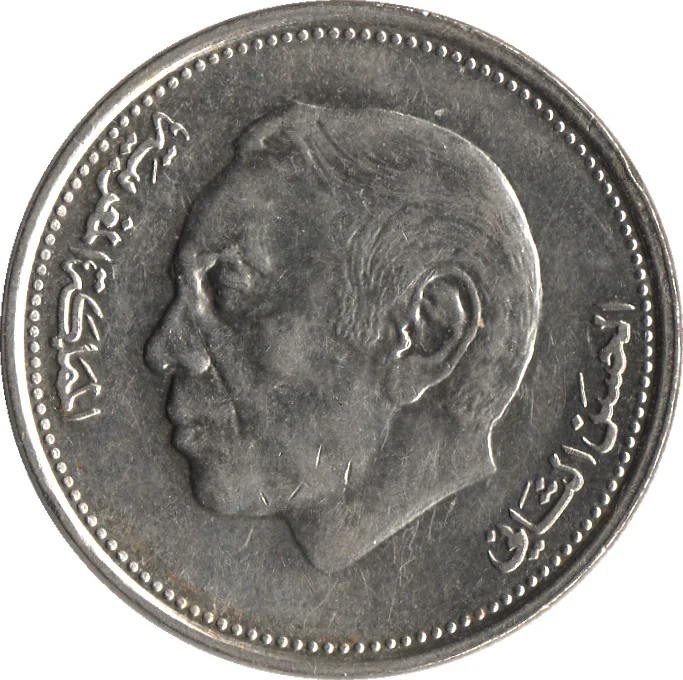
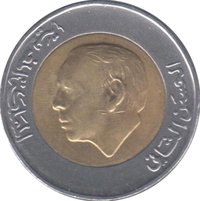
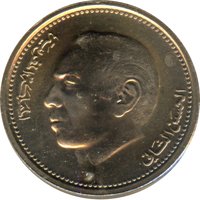
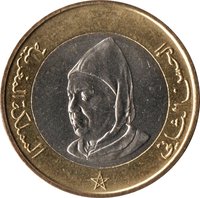
Obverse
Description:
King Hassan II of Morocco.
Inscription:
المملكة المغربية
الحسن الثاني
الحسن الثاني
Translation:
The Moroccan Kingdom
Hassan II
Hassan II
Script: Arabic
Language: Arabic
Engraver: David Wynne
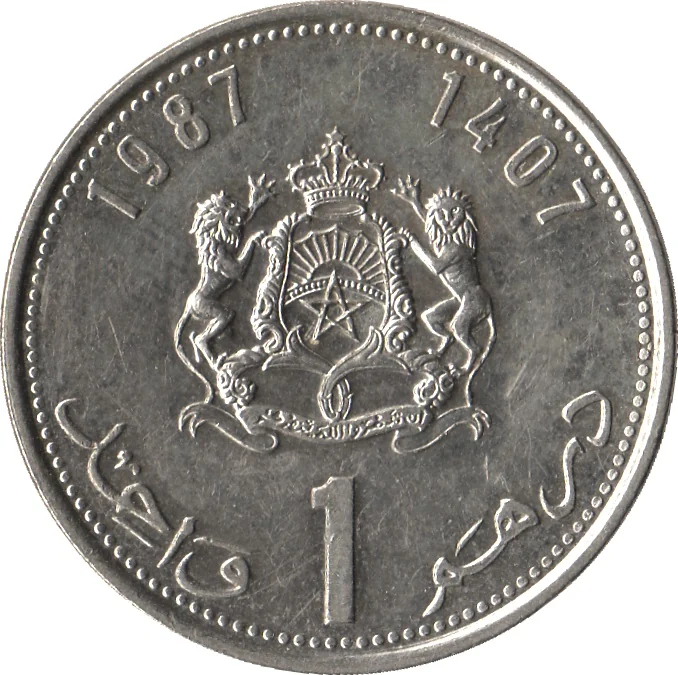
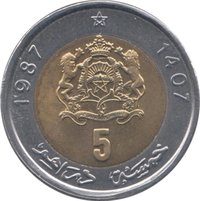
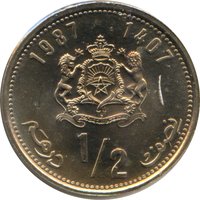
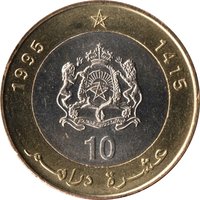
Reverse
Description:
Heraldic emblem
Inscription:
1987 1407
درهم 1 واحد
درهم 1 واحد
Translation:
One Dinar 1 Unit
Language: Arabic
Engraver: David Wynne
Edge
Reeded
Categories
| Symbols> Coat of Arms |
Mints
| Name | Mark |
|---|---|
| Dar As-Sikkah | — |
Mintings
| Year | Mint Mark | Mintage | Quality | Collection |
|---|---|---|---|---|
| 1987 | — | — |
Historical background
In 1987, Morocco's currency situation was characterized by a tightly managed exchange rate regime and ongoing economic liberalization efforts under King Hassan II. The Moroccan dirham (MAD) was not freely convertible and operated under a fixed peg, primarily to a basket of currencies weighted toward the French franc and the US dollar. This system was administered by Bank Al-Maghrib (the central bank) and aimed to provide stability for trade and investment, but it also required significant foreign exchange reserves to maintain and created a disparity between the official rate and a higher black-market rate for hard currencies.
The period was one of structural adjustment, as Morocco worked with the International Monetary Fund (IMF) and the World Bank to address a severe debt crisis from the late 1970s and early 1980s. Key reforms included reducing budget deficits, phasing out subsidies, and encouraging exports. While these measures aimed to stabilize the macroeconomy, they also led to social pressures, including riots in 1984. The currency's fixed peg was a cornerstone of this stabilization policy, intended to control inflation and provide a predictable environment, but it limited monetary policy flexibility.
Looking forward, the late 1980s set the stage for gradual financial reforms that would unfold in the 1990s. The rigid control of the dirham, while providing short-term stability, was increasingly seen as incompatible with the goals of greater trade integration and attracting foreign direct investment. Consequently, 1987 represented a point of transition, where the foundations were being laid for a future move towards a more flexible exchange rate system, which would eventually include a crawling peg and, much later, a widened band system to allow for more market influence on the dirham's value.
The period was one of structural adjustment, as Morocco worked with the International Monetary Fund (IMF) and the World Bank to address a severe debt crisis from the late 1970s and early 1980s. Key reforms included reducing budget deficits, phasing out subsidies, and encouraging exports. While these measures aimed to stabilize the macroeconomy, they also led to social pressures, including riots in 1984. The currency's fixed peg was a cornerstone of this stabilization policy, intended to control inflation and provide a predictable environment, but it limited monetary policy flexibility.
Looking forward, the late 1980s set the stage for gradual financial reforms that would unfold in the 1990s. The rigid control of the dirham, while providing short-term stability, was increasingly seen as incompatible with the goals of greater trade integration and attracting foreign direct investment. Consequently, 1987 represented a point of transition, where the foundations were being laid for a future move towards a more flexible exchange rate system, which would eventually include a crawling peg and, much later, a widened band system to allow for more market influence on the dirham's value.
🌱 Very Common