

50 cents – South Africa
Add to wishlist
South Africa
Context
Years: 1961–1964
Issuer: South Africa
Period:
(since 1961)
Ruler: Elizabeth II
Currency:
(since 1961)
Total mintage: 453,002
Material
References
KM: #
Numista: #17087
Value
Exchange value: 0.50 ZAR
Bullion value: $34.41
Inflation-adjusted value: 58.15 ZAR
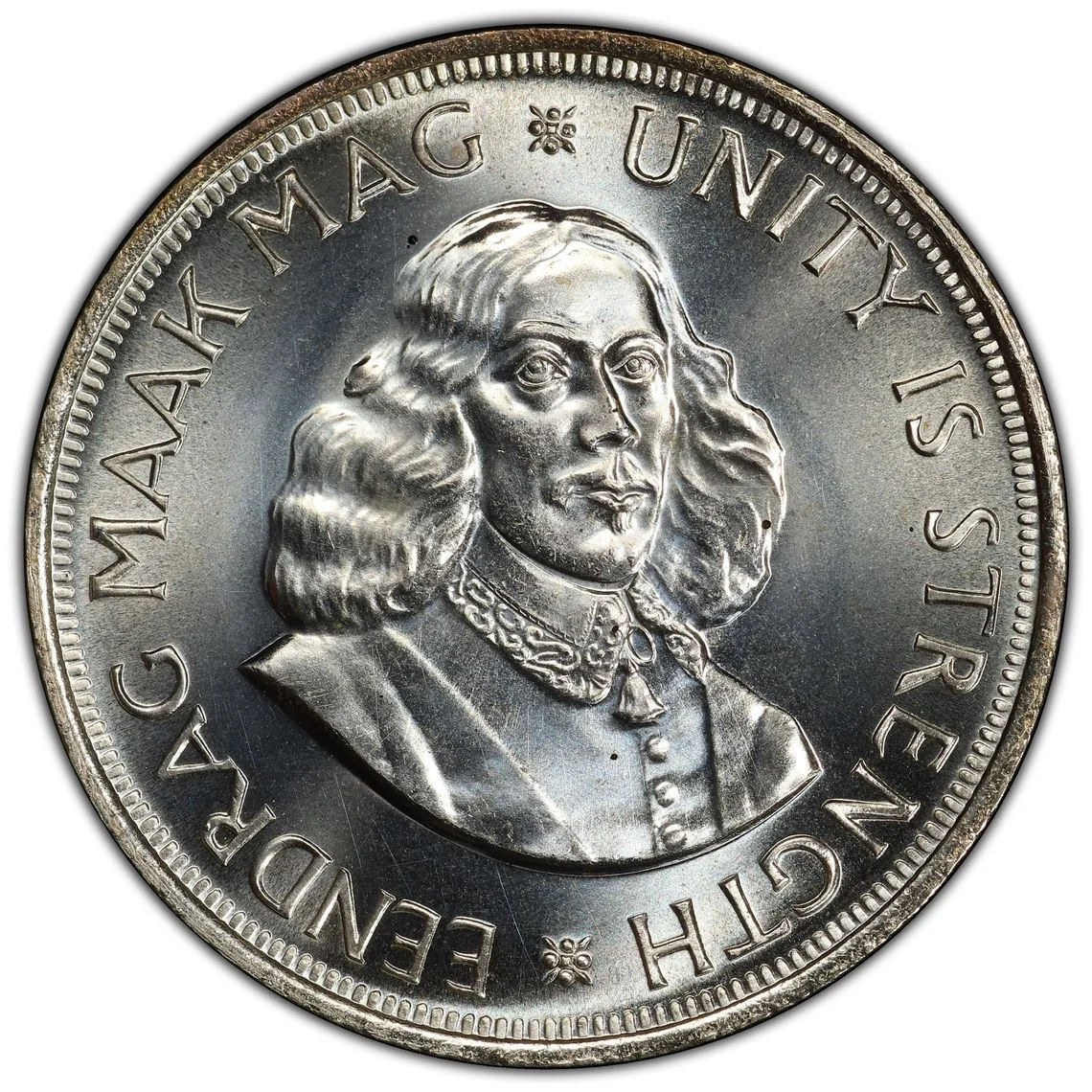
Obverse
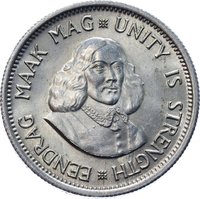
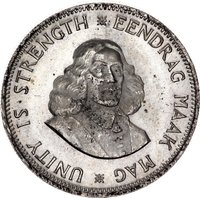
Description:
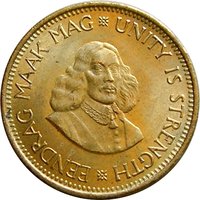
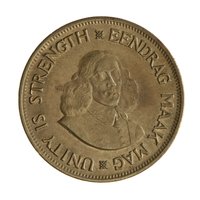
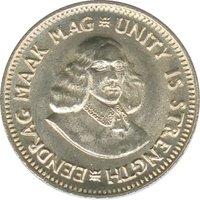
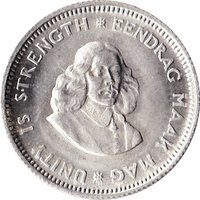
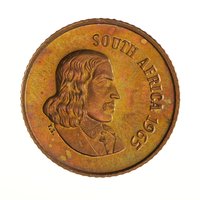
Jan Van Riebeeck bust.
Inscription:
EENDRAG MAAK MAG
UNITY IS STRENGTH
WM
UNITY IS STRENGTH
WM
Translation:
Unity makes strength
Script: Latin
Designer: Willie Myburg
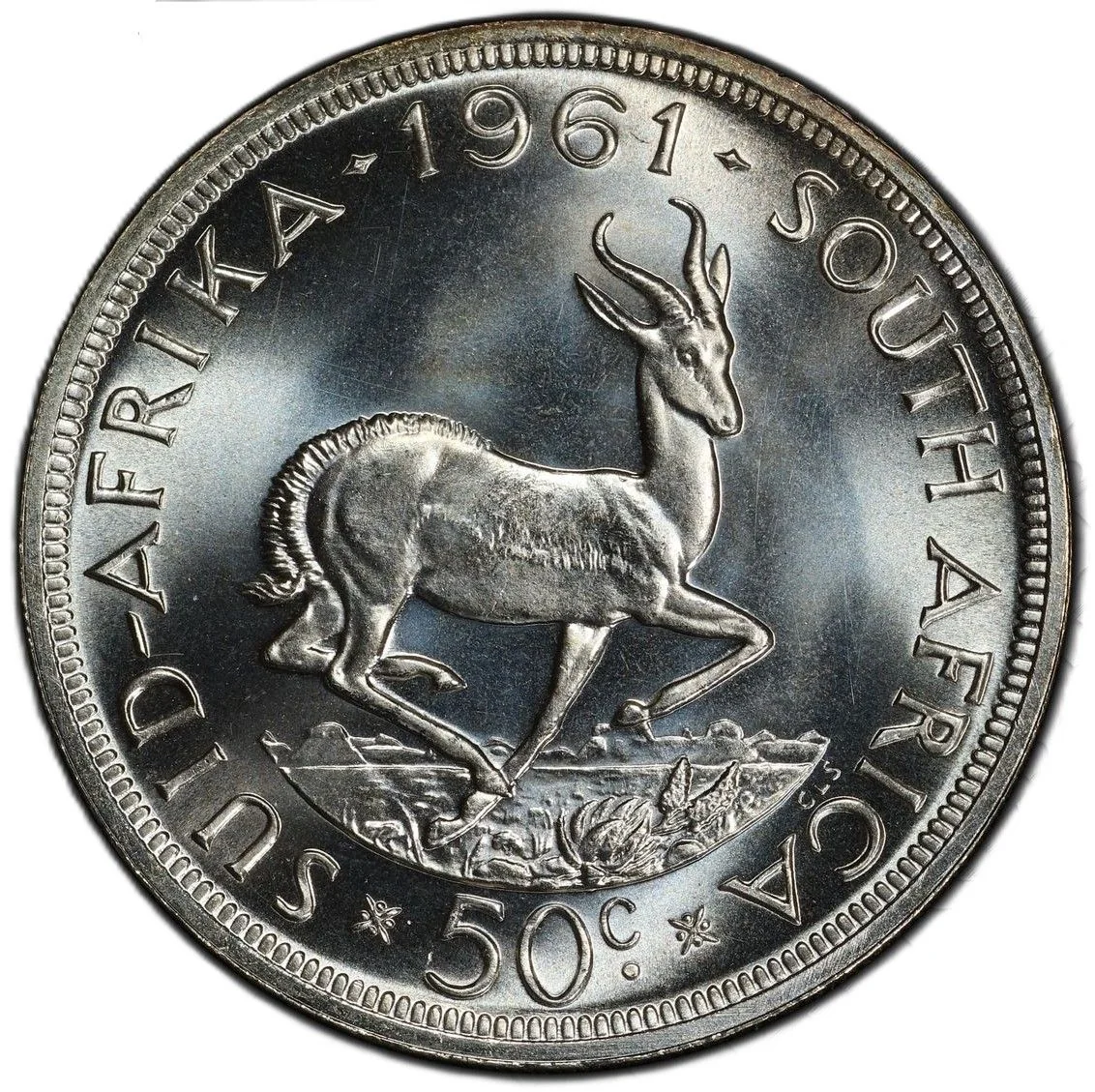
Reverse
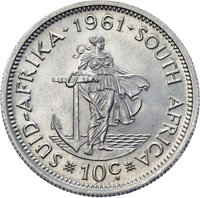
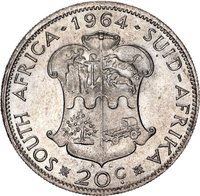
Description:
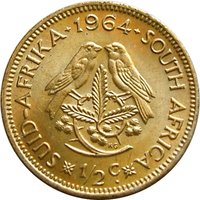
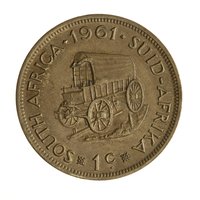
A pronking Springbok, an antelope from South Africa and Namibia featured on the Krugerrand coin.
Inscription:
SUID AFRIKA
1961
SOUTH AFRICA
50c
CLS
1961
SOUTH AFRICA
50c
CLS
Script: Latin
Designer: Coert Laurens Steynberg
Edge
Reeded
Categories
| Animal> Cow |
| Person> Politician |
Mints
| Name | Mark |
|---|---|
| Pretoria | — |
Mintings
| Year | Mint Mark | Mintage | Quality | Collection |
|---|---|---|---|---|
| 1961 | — | 54,530 | ||
| 1961 | — | 20,000 | Prooflike | |
| 1961 | — | 8,530 | Proof | |
| 1962 | — | 6,024 | Prooflike | |
| 1962 | — | 3,844 | Proof | |
| 1962 | — | 21,024 | ||
| 1963 | — | 10,000 | Prooflike | |
| 1963 | — | 157,025 | ||
| 1963 | — | 4,025 | Proof | |
| 1964 | — | 16,000 | Proof | |
| 1964 | — | 25,000 | Prooflike | |
| 1964 | — | 127,000 |
Historical background
In 1961, South Africa's currency situation was fundamentally reshaped by the nation's transition to a republic and its subsequent exit from the Commonwealth. This political shift triggered immediate economic consequences, most notably the abrupt withdrawal of foreign investment and a sharp decline in confidence from traditional British financial partners. The South African Reserve Bank was forced to spend heavily from the country's gold and foreign exchange reserves to defend the value of the South African pound, exposing the vulnerability of a currency still pegged to the sterling area amidst growing international isolation.
In direct response to this crisis, the government moved decisively to establish a new, distinct national currency. On 14 February 1961, the South African pound was formally replaced by the rand, introduced at a parity of two rand to one pound sterling. The decimal-based rand was more than a symbolic break from the British colonial past; it was a practical tool for asserting monetary sovereignty. The new currency was initially pegged to both sterling and the US dollar, a structure designed to provide stability and reassure markets during a period of profound political and economic uncertainty.
Thus, the currency situation of 1961 was defined by a precarious duality: vulnerability and reinvention. While the political events of the year precipitated a financial crisis and capital flight, they also catalysed the creation of a modern, independent monetary system. The introduction of the rand laid the institutional foundation for South Africa's future financial policy, even as the country began to grapple with the long-term economic pressures of apartheid, which would increasingly dictate the rand's fortunes on the global stage.
In direct response to this crisis, the government moved decisively to establish a new, distinct national currency. On 14 February 1961, the South African pound was formally replaced by the rand, introduced at a parity of two rand to one pound sterling. The decimal-based rand was more than a symbolic break from the British colonial past; it was a practical tool for asserting monetary sovereignty. The new currency was initially pegged to both sterling and the US dollar, a structure designed to provide stability and reassure markets during a period of profound political and economic uncertainty.
Thus, the currency situation of 1961 was defined by a precarious duality: vulnerability and reinvention. While the political events of the year precipitated a financial crisis and capital flight, they also catalysed the creation of a modern, independent monetary system. The introduction of the rand laid the institutional foundation for South Africa's future financial policy, even as the country began to grapple with the long-term economic pressures of apartheid, which would increasingly dictate the rand's fortunes on the global stage.
🌱 Common