


100 Francs (Statue of Liberty) – France
Non-circulating coins
Commemoration: Centenary of the Statue of Liberty (1886-1986)
Series: 100 francs Statue de la Liberté
France
Context
Year: 1986
Issuer: France 
Period:
(since 1958)
Currency:
(1960—2001)
Demonetization: 17 February 2002
Total mintage: 1,250
Material
Diameter: 31 mm
Weight: 15.39 g
Shape: Round
Composition: 90% Palladium
Standard: Silver half ounce
Technique: Milled
References
KM: #Click to copy to clipboard960d
Numista: #169404
Value
Exchange value: 100 FRF
Inflation-adjusted value: 212.12 FRF
Obverse
Description:
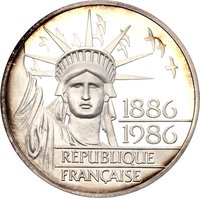
The Statue of Liberty, flanked by eleven birds, bears the dates "1886-1986" and the inscription "FRENCH REPUBLIC."
Inscription:
1886
1986
RÉPUBLIQUE
FRANÇAISE
1986
RÉPUBLIQUE
FRANÇAISE
Translation:
ONE FRANC
1886
1986
REPUBLIC
FRENCH
1886
1986
REPUBLIC
FRENCH
Script: Latin
Language: French
Engraver: Atelier de Gravure (A.G.M.M.)
Designer: Michel Durand-Mégret
Reverse
Description:
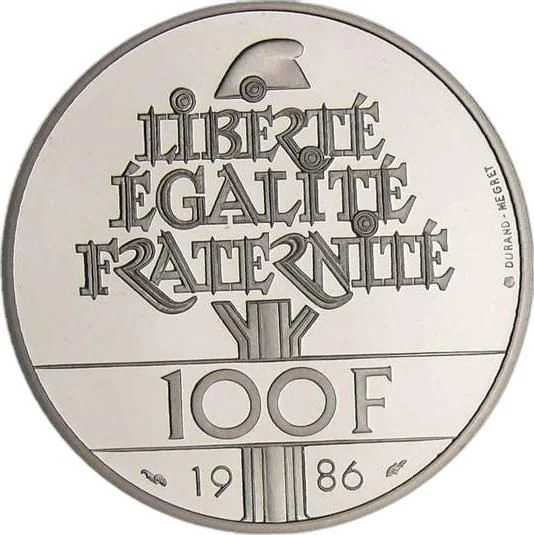
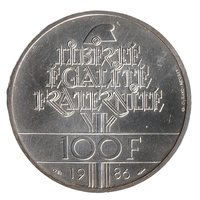
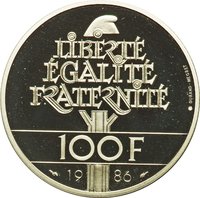
A tree with a Phrygian cap carries the motto "LIBERTY EQUALITY FRATERNITY". Adapted from a drawing by Michel Durand-Megret, it is crossed by a band showing the face value.
Inscription:
LIBERTÉ
ÉGALITÉ
FRATERNITÉ
100F
19 86
ÉGALITÉ
FRATERNITÉ
100F
19 86
Translation:
LIBERTY
EQUALITY
FRATERNITY
100F
19 86
EQUALITY
FRATERNITY
100F
19 86
Script: Latin
Language: French
Engraver: Atelier de Gravure (A.G.M.M.)
Designer: Michel Durand-Mégret
Edge
Mints
| Name | Mark |
|---|---|
| Monnaie de Paris | — |
Mintings
| Year | Mint Mark | Mintage | Quality | Collection |
|---|---|---|---|---|
| 1986 | — | 1,250 | Proof |
Historical background
In 1986, France found itself navigating a complex and challenging currency environment, shaped by both domestic political shifts and its commitments to the European Monetary System (EMS). The year began with the historic election of a center-right "cohabitation" government, with Jacques Chirac as Prime Minister serving under Socialist President François Mitterrand. This government came to power with a platform of economic liberalization, including a pledge to halt the inflationary spiral and strengthen the franc, which was seen as a cornerstone of French economic credibility within Europe.
The franc's stability was under constant pressure within the EMS's Exchange Rate Mechanism (ERM). While the system aimed to reduce exchange rate volatility, it required member currencies to remain within narrow bands against each other, particularly the Deutsche Mark. The French franc, however, frequently tested the weaker limits of its band, prompting repeated and costly interventions by the Banque de France. These interventions involved selling foreign reserves (primarily Deutsche Marks) to buy francs, a drain on resources aimed at defending a parity that markets often viewed as overvalued given France's higher inflation relative to Germany.
Ultimately, the situation culminated in a major realignment of the EMS in April 1986. Faced with sustained speculative pressure and the political will to prioritize anti-inflationary policies, the Chirac government agreed to an 8% devaluation of the franc against the Deutsche Mark. This move, while a technical adjustment within the rules of the system, was a significant political event. It was framed not as a defeat but as a necessary recalibration to restore competitiveness and allow for a stricter, market-oriented domestic policy—the franc fort (strong franc) policy—which would define French economic strategy for the next decade and deepen its commitment to European monetary integration.
The franc's stability was under constant pressure within the EMS's Exchange Rate Mechanism (ERM). While the system aimed to reduce exchange rate volatility, it required member currencies to remain within narrow bands against each other, particularly the Deutsche Mark. The French franc, however, frequently tested the weaker limits of its band, prompting repeated and costly interventions by the Banque de France. These interventions involved selling foreign reserves (primarily Deutsche Marks) to buy francs, a drain on resources aimed at defending a parity that markets often viewed as overvalued given France's higher inflation relative to Germany.
Ultimately, the situation culminated in a major realignment of the EMS in April 1986. Faced with sustained speculative pressure and the political will to prioritize anti-inflationary policies, the Chirac government agreed to an 8% devaluation of the franc against the Deutsche Mark. This move, while a technical adjustment within the rules of the system, was a significant political event. It was framed not as a defeat but as a necessary recalibration to restore competitiveness and allow for a stricter, market-oriented domestic policy—the franc fort (strong franc) policy—which would define French economic strategy for the next decade and deepen its commitment to European monetary integration.
Series: 100 francs Statue de la Liberté










✨ Legendary