

10 rials – Iran
Add to wishlist
Standard circulation coins
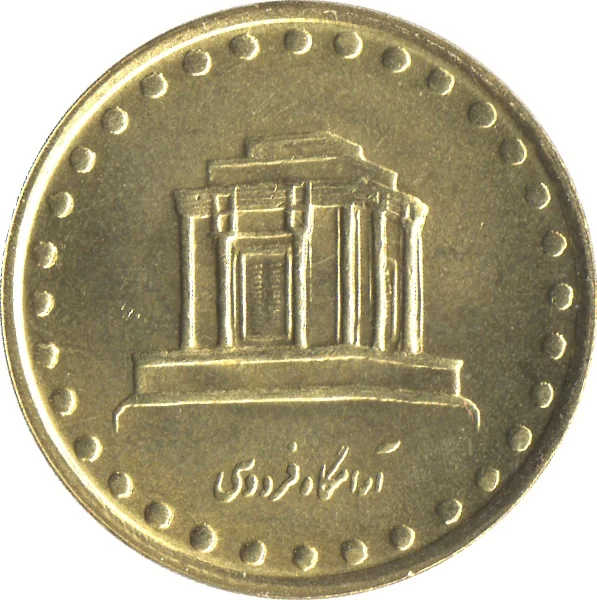
Commemoration: (fr) Tombeau de Ferdousi, poète perse du Xéme siècle
Series: 1992 Iran circulation coins
Iran
Context
Material
Diameter: 21 mm
Weight: 3 g
Thickness: 0.97 mm
Shape: Round
Composition: Aluminium bronze
Magnetic: No
Technique: Milled
Alignment: Coin alignment
flip
References
KM: #
Numista: #1693
Value
Exchange value: 10 IRR
Obverse
Description:
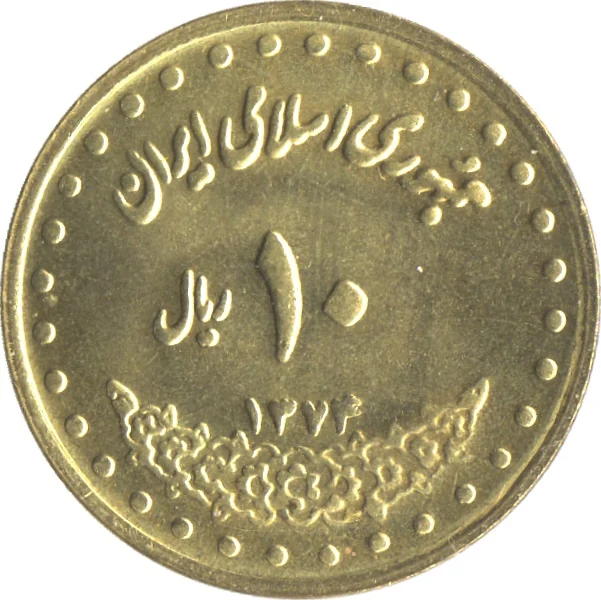
Inscription and floral sprig within beaded circle, divided by value and date.
Inscription:
جمُهوری اسلامی ايران
١٠ ریال
١٣٧۴
١٠ ریال
١٣٧۴
Translation:
Islamic Republic of Iran
10 Rials
1374
10 Rials
1374
Language: Persian
Reverse
Description:
Ferdowsi's tomb in Tus, encircled by beads.
Inscription:
آرامگاه فردوسی
Translation:
Tomb of Ferdowsi
Language: Persian
Edge
Reeded
Mintings
| Year | Mint Mark | Mintage | Quality | Collection |
|---|---|---|---|---|
| 1992 | — | — | ||
| 1993 | — | — | ||
| 1994 | — | — | ||
| 1995 | — | — | ||
| 1996 | — | — | ||
| 1997 | — | — |
Historical background
In 1992, Iran's currency situation was defined by the severe and lingering economic consequences of the Iran-Iraq War (1980-1988) and the challenges of post-war reconstruction under a state-dominated economy. The government, led by President Akbar Hashemi Rafsanjani, pursued a policy of economic liberalization and attempted to attract foreign investment, but these efforts were constrained by a complex multi-tiered exchange rate system. This system created a significant gap between the official rate (used for imports of essential goods like food and medicine) and the much higher unofficial market rate, fostering a lucrative environment for rent-seeking and corruption.
The primary pressure on the Iranian rial stemmed from a combination of high inflation, estimated at around 25-30% annually, and a substantial budget deficit financed by money creation from the central bank. Falling oil prices in the early 1990s exacerbated the crisis, reducing the state's primary source of hard currency revenue needed to support the fixed official exchange rate and fund imports. Consequently, foreign exchange reserves were depleted, and the country faced a persistent balance of payments deficit, leading to growing external debt and import restrictions that stifled industrial production.
Ultimately, the distortions of the multi-exchange rate regime proved unsustainable. In a significant policy shift, the Iranian government moved towards unification in 1993, formally devaluing the rial and collapsing several of the official rates. However, the 1992 period was the culmination of these pressures, characterized by a widening black-market premium, severe scarcity of hard currency for businesses, and an economy struggling to transition from wartime mobilization to stable growth amidst significant structural inefficiencies and international isolation.
The primary pressure on the Iranian rial stemmed from a combination of high inflation, estimated at around 25-30% annually, and a substantial budget deficit financed by money creation from the central bank. Falling oil prices in the early 1990s exacerbated the crisis, reducing the state's primary source of hard currency revenue needed to support the fixed official exchange rate and fund imports. Consequently, foreign exchange reserves were depleted, and the country faced a persistent balance of payments deficit, leading to growing external debt and import restrictions that stifled industrial production.
Ultimately, the distortions of the multi-exchange rate regime proved unsustainable. In a significant policy shift, the Iranian government moved towards unification in 1993, formally devaluing the rial and collapsing several of the official rates. However, the 1992 period was the culmination of these pressures, characterized by a widening black-market premium, severe scarcity of hard currency for businesses, and an economy struggling to transition from wartime mobilization to stable growth amidst significant structural inefficiencies and international isolation.
Series: 1992 Iran circulation coins
🌱 Very Common