

2 euro (Andreas Kalvos) – Greece
Add to wishlist
Circulating commemorative coins
Commemoration: Andreas Kalvos - 150 years in memoriam
Greece
Context
Material
References
KM: #
Numista: #169094
Value
Exchange value: 2 EUR
Inflation-adjusted value: 2.34 EUR
Obverse
Description:
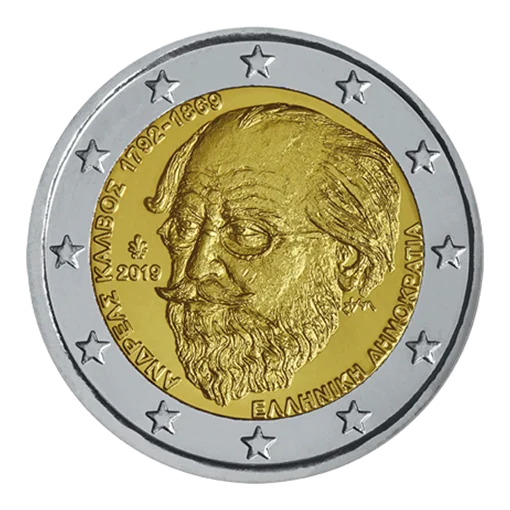
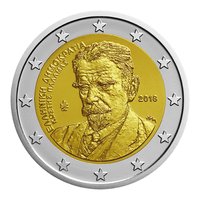
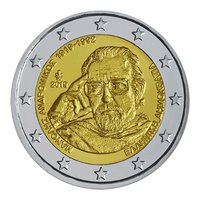
Andreas Kalvos (1792-1869), a major modern Greek poet from Zante, blended neoclassicism and Romanticism. The coin features his portrait, his name and dates, "Hellenic Republic," the mint year and mark, the artist's monogram, and the European flag's 12 stars on the outer ring.
Inscription:
ΑΝΔΡΕΑΣ ΚΑΛΒΟΣ 1792-1869
2019
ΕΛΛΗΝΙΚΗ ΔΗΜΟΚΡΑΤΙΑ
2019
ΕΛΛΗΝΙΚΗ ΔΗΜΟΚΡΑΤΙΑ
Translation:
ANDREAS KALVOS 1792-1869
2019
HELLENIC REPUBLIC
2019
HELLENIC REPUBLIC
Script: Greek
Language: Greek
Engraver: Geórgios Stamatópoulos
Reverse
Edge
Categories
| Art> Literature |
| Map |
| Event> Death anniversary |
| Mustache/Beard |
Mints
| Name | Mark |
|---|---|
| National Mint of the Bank of Greece | — |
Mintings
| Year | Mint Mark | Mintage | Quality | Collection |
|---|---|---|---|---|
| 2019 | — | 748,500 | ||
| 2019 | — | 1,500 | Proof |
Historical background
In 2019, Greece was in the final stages of a prolonged and severe economic crisis that had dominated the previous decade. The country had exited its third and final international bailout program in August 2018, having received over €260 billion in loans from the European Commission, the European Central Bank (ECB), and the International Monetary Fund (IMF). However, 2019 was a year of fragile transition, marked by the continued oversight of its creditors and the challenge of regaining full market access. The primary currency concern was not an imminent exit from the Eurozone—a specter known as "Grexit" that had loomed large in 2015—but rather the sustainability of its public debt and the health of its banking sector within the euro framework.
The domestic currency situation was characterized by the persistence of capital controls, a legacy of the 2015 crisis. These controls, though significantly relaxed by 2019, still limited cash withdrawals and cross-border transactions, acting as a reminder of the banking system's past fragility. The Greek economy remained fully euro-based, but confidence was a key issue; both citizens and international investors were wary of potential future shocks. The government, under the newly elected center-right New Democracy party of Kyriakos Mitsotakis, prioritized policies aimed at spurring growth, attracting investment, and securing further debt relief to solidify the country's position within the single currency.
Ultimately, 2019 was a year of cautious optimism and technical normalization. Greece successfully issued new long-term bonds, signaling a gradual return to market financing. The focus shifted from emergency liquidity and existential threats to the arduous tasks of reducing high unemployment, managing a still-massive public debt burden (over 180% of GDP), and reforming the economy to ensure long-term stability within the Eurozone. The currency situation was stable but underpinned by the hard-won and still-precarious credibility achieved after years of austerity and international supervision.
The domestic currency situation was characterized by the persistence of capital controls, a legacy of the 2015 crisis. These controls, though significantly relaxed by 2019, still limited cash withdrawals and cross-border transactions, acting as a reminder of the banking system's past fragility. The Greek economy remained fully euro-based, but confidence was a key issue; both citizens and international investors were wary of potential future shocks. The government, under the newly elected center-right New Democracy party of Kyriakos Mitsotakis, prioritized policies aimed at spurring growth, attracting investment, and securing further debt relief to solidify the country's position within the single currency.
Ultimately, 2019 was a year of cautious optimism and technical normalization. Greece successfully issued new long-term bonds, signaling a gradual return to market financing. The focus shifted from emergency liquidity and existential threats to the arduous tasks of reducing high unemployment, managing a still-massive public debt burden (over 180% of GDP), and reforming the economy to ensure long-term stability within the Eurozone. The currency situation was stable but underpinned by the hard-won and still-precarious credibility achieved after years of austerity and international supervision.
Series: Greece 2 euro commemoratives
🌱 Common