

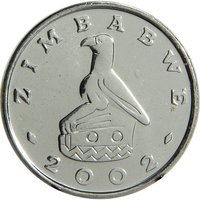
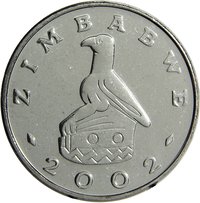
Obverse
Description:
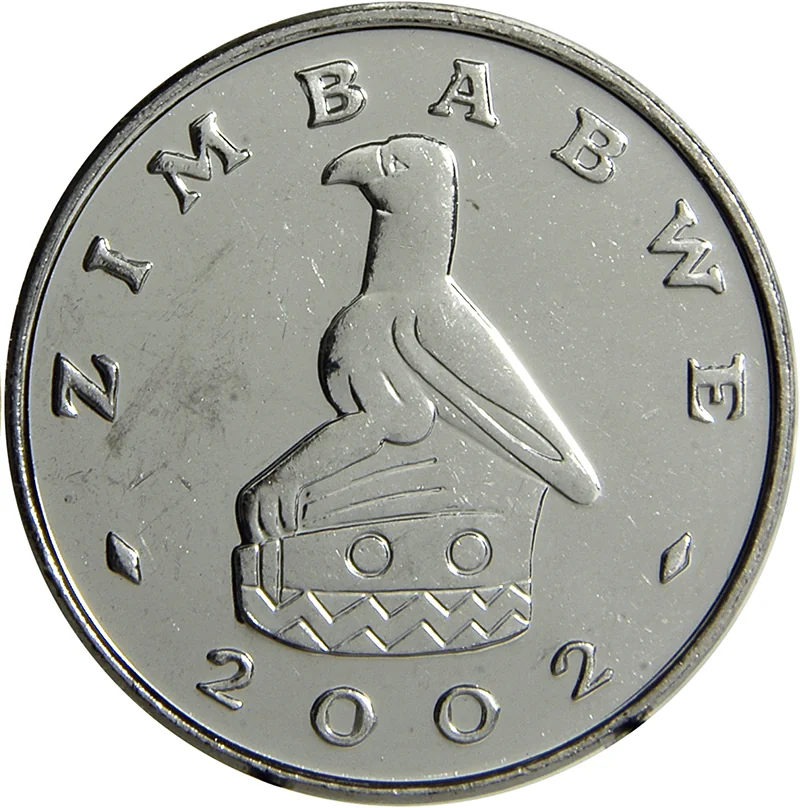
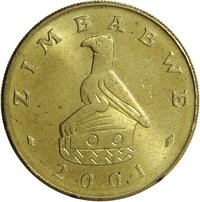
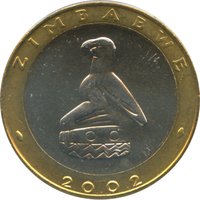
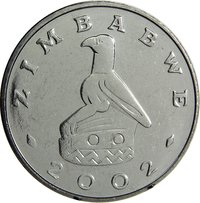
The famous Zimbabwe Bird, a protective sculpture from the 12th-14th century capital of the Monomotapa Empire, carved by the Shona people's ancestors.
Inscription:
ZIMBABWE
2002
2002
Script: Latin
Engraver: Barry Stanton
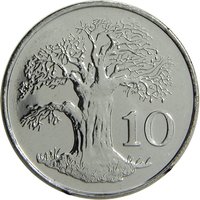
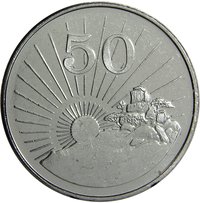
Reverse
Description:
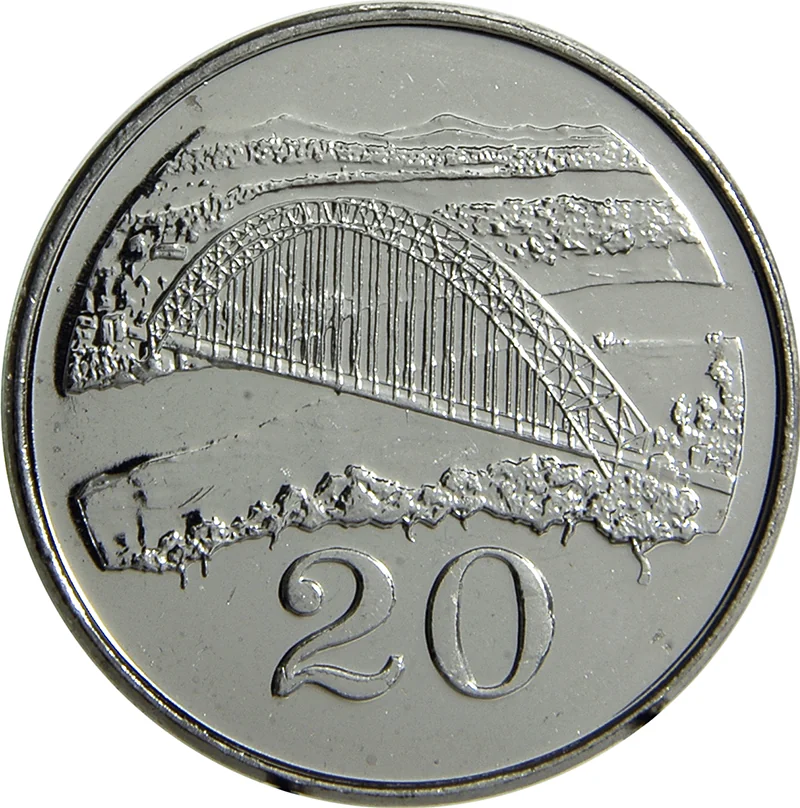
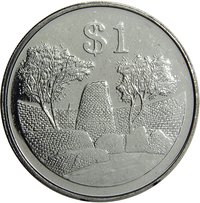
Birchenough Bridge over the Sabi River.
Inscription:
20
Script: Latin
Engraver: Jeff Huntly
Edge
Plain
Mints
| Name | Mark |
|---|---|
| Zimbabwe Mint | — |
Mintings
| Year | Mint Mark | Mintage | Quality | Collection |
|---|---|---|---|---|
| 2001 | — | — | ||
| 2002 | — | — | ||
| 2003 | — | — |
Historical background
By 2001, Zimbabwe was in the throes of a severe and accelerating economic crisis, with its currency situation at the heart of the turmoil. The Zimbabwean dollar, introduced in 1980 to replace the Rhodesian dollar, had begun a steep decline. This was primarily driven by the government's controversial Fast Track Land Reform Programme, initiated in 2000, which led to a collapse in agricultural exports, crippling foreign exchange earnings. Concurrently, massive fiscal deficits were financed by the Reserve Bank of Zimbabwe printing money, leading to rampant inflation that eroded the currency's value and sparked a critical shortage of foreign currency.
The government's response was a system of rigid exchange controls and a fixed official exchange rate that was wildly overvalued. While the official rate was pegged around 55 ZWD to 1 USD, a thriving black market emerged where the rate was several times higher, reflecting the true plummeting value of the currency. This disparity created a two-tier economy, crippling formal businesses that could not access forex at the official rate for imports of essential goods like fuel, medicine, and machinery. The resulting shortages further fueled inflation and public discontent.
The currency crisis of 2001 was a pivotal moment, marking Zimbabwe's transition from economic instability into hyperinflationary collapse later in the decade. It exposed the fundamental disconnect between government policy and economic reality, destroying savings, discouraging investment, and setting the stage for the eventual abandonment of the Zimbabwean dollar in 2009. The situation underscored how loss of confidence, driven by political decisions and monetary expansion, can rapidly undermine a national currency.
The government's response was a system of rigid exchange controls and a fixed official exchange rate that was wildly overvalued. While the official rate was pegged around 55 ZWD to 1 USD, a thriving black market emerged where the rate was several times higher, reflecting the true plummeting value of the currency. This disparity created a two-tier economy, crippling formal businesses that could not access forex at the official rate for imports of essential goods like fuel, medicine, and machinery. The resulting shortages further fueled inflation and public discontent.
The currency crisis of 2001 was a pivotal moment, marking Zimbabwe's transition from economic instability into hyperinflationary collapse later in the decade. It exposed the fundamental disconnect between government policy and economic reality, destroying savings, discouraging investment, and setting the stage for the eventual abandonment of the Zimbabwean dollar in 2009. The situation underscored how loss of confidence, driven by political decisions and monetary expansion, can rapidly undermine a national currency.
Series: 2001 Zimbabwe circulation coins
🌱 Common