

20 lire (End of World War I) – Italy
Add to wishlist
Circulating commemorative coins
Commemoration: 10th Anniversary of the End of World War I
Italy
Context
Year: 1928
Issuer: Italy
Ruler: Vittorio Emanuele III
Currency:
(1861—2001)
Demonetized: Yes
Total mintage: 3,536,250
Material
References
KM: #
Numista: #16857
Value
Exchange value: 20 ITL
Bullion value: $29.20
Obverse
Description:
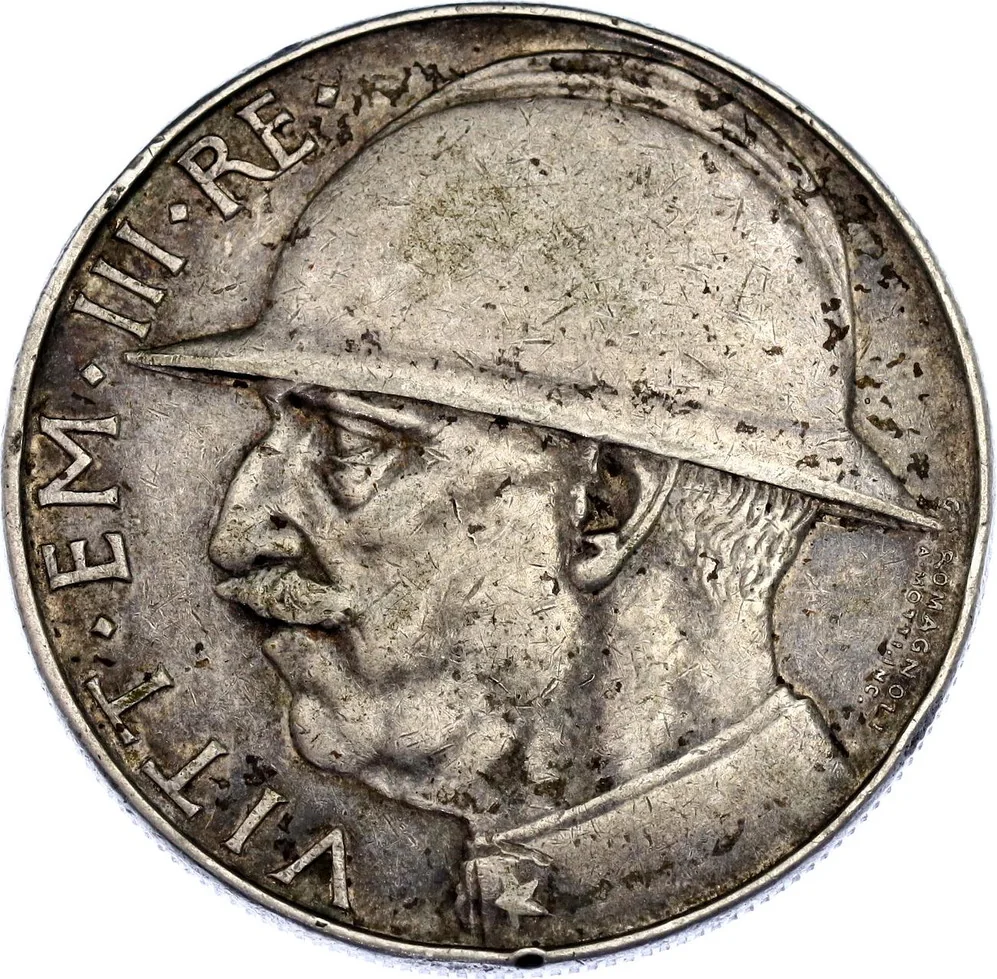
King Vittorio Emanuele III in military uniform, facing left. The engraver's name is at right.
Inscription:
VITT·EM·III·RE·
G.ROMAGNOLI
A.MOTTI.INC.
G.ROMAGNOLI
A.MOTTI.INC.
Translation:
Victor Emmanuel III King
G. Romagnoli
A. Motti Incisor
G. Romagnoli
A. Motti Incisor
Script: Latin
Engraver: Giuseppe Romagnoli
Reverse
Description:
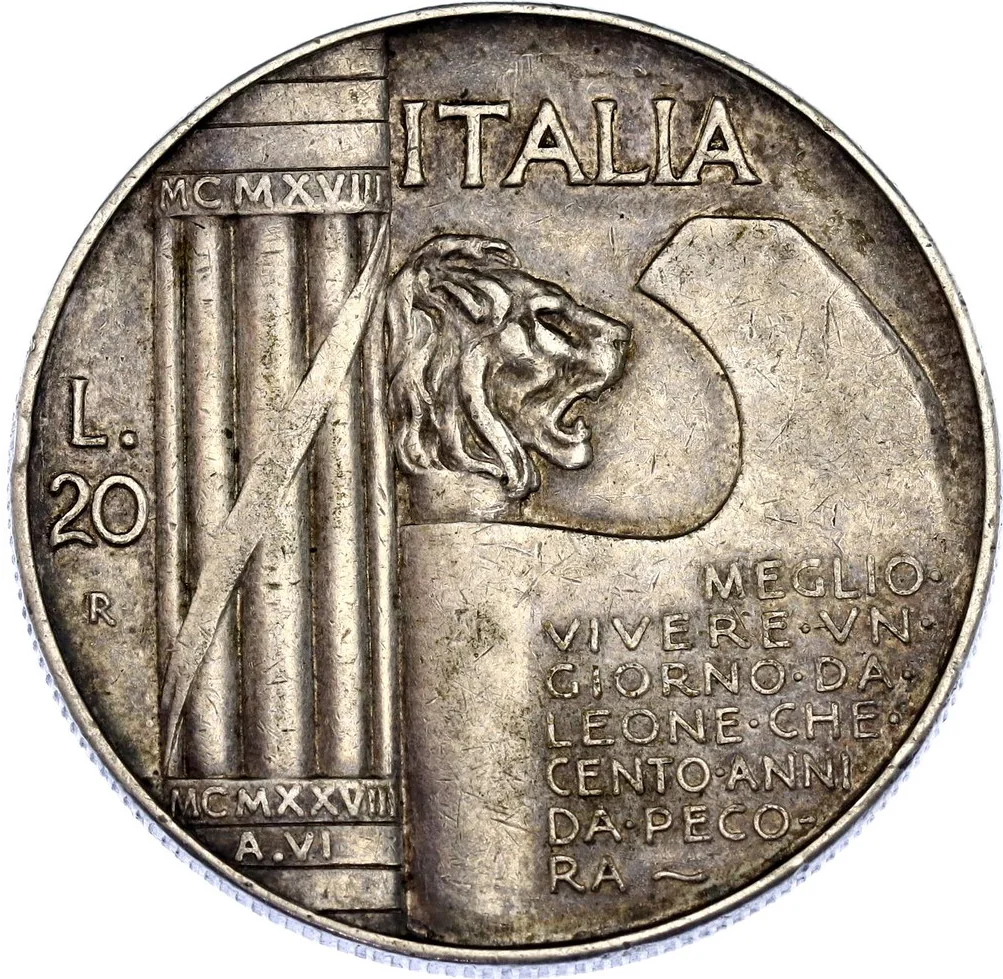
Upper fascio with axe bearing lion head and motto; bindings show war end and current year in Roman numerals. Left: value and mintmark.
Inscription:
MCMXVIII ITALIA
L.
20
R
MCMXXVIII
A.VI
MEGLIO·
VIVERE·VN·
GIORNO·DA·
LEONE·CHE·
CENTO·ANNI·
DA·PECO-
RA ~
L.
20
R
MCMXXVIII
A.VI
MEGLIO·
VIVERE·VN·
GIORNO·DA·
LEONE·CHE·
CENTO·ANNI·
DA·PECO-
RA ~
Translation:
Italy 1918
L. 20 R
1928
Year 6
Better to live one day as a lion than one hundred years as a sheep.
L. 20 R
1928
Year 6
Better to live one day as a lion than one hundred years as a sheep.
Script: Latin
Engraver: Giuseppe Romagnoli
Edge
Reeded
Mintings
| Year | Mint Mark | Mintage | Quality | Collection |
|---|---|---|---|---|
| 1928 | R | 3,536,250 |
Historical background
By 1928, Italy’s currency situation was firmly under the control of Benito Mussolini’s Fascist regime, which sought to project an image of strength and stability. The decade had begun with economic turmoil, including a sharp depreciation of the lira and high inflation following World War I. Mussolini, viewing a weak currency as a sign of national humiliation, famously pledged to "defend the lira at all costs" in his 1926 Pesaro speech. This led to a painful period of deflationary policy, with high interest rates and wage cuts, successfully revaluing and pegging the lira at an artificially high rate of "Quota 90"—90 lire to the British pound.
This revaluation was a political triumph for Mussolini, symbolizing Fascist discipline and restoring prestige, but it came at a severe economic cost. Italian exports became more expensive and less competitive on the global market, hurting key industries like textiles and agriculture. The resulting pressure on businesses and workers suppressed domestic consumption and contributed to rising unemployment. The regime masked these problems with extensive propaganda, celebrating the "battle for the lira" as a victory for national will over market forces.
Consequently, the lira in 1928 was stable but overvalued and rigidly managed, its value dictated by political dogma rather than economic reality. The currency was supported by strict capital controls and the regime’s authority, insulating it from market pressures but also from necessary adjustments. This situation left the Italian economy structurally weaker and more vulnerable, a fragility that would be fully exposed during the global Great Depression that began the following year.
This revaluation was a political triumph for Mussolini, symbolizing Fascist discipline and restoring prestige, but it came at a severe economic cost. Italian exports became more expensive and less competitive on the global market, hurting key industries like textiles and agriculture. The resulting pressure on businesses and workers suppressed domestic consumption and contributed to rising unemployment. The regime masked these problems with extensive propaganda, celebrating the "battle for the lira" as a victory for national will over market forces.
Consequently, the lira in 1928 was stable but overvalued and rigidly managed, its value dictated by political dogma rather than economic reality. The currency was supported by strict capital controls and the regime’s authority, insulating it from market pressures but also from necessary adjustments. This situation left the Italian economy structurally weaker and more vulnerable, a fragility that would be fully exposed during the global Great Depression that began the following year.
🌱 Fairly Common