

10 rials – Iran
Add to wishlist
Circulating commemorative coins
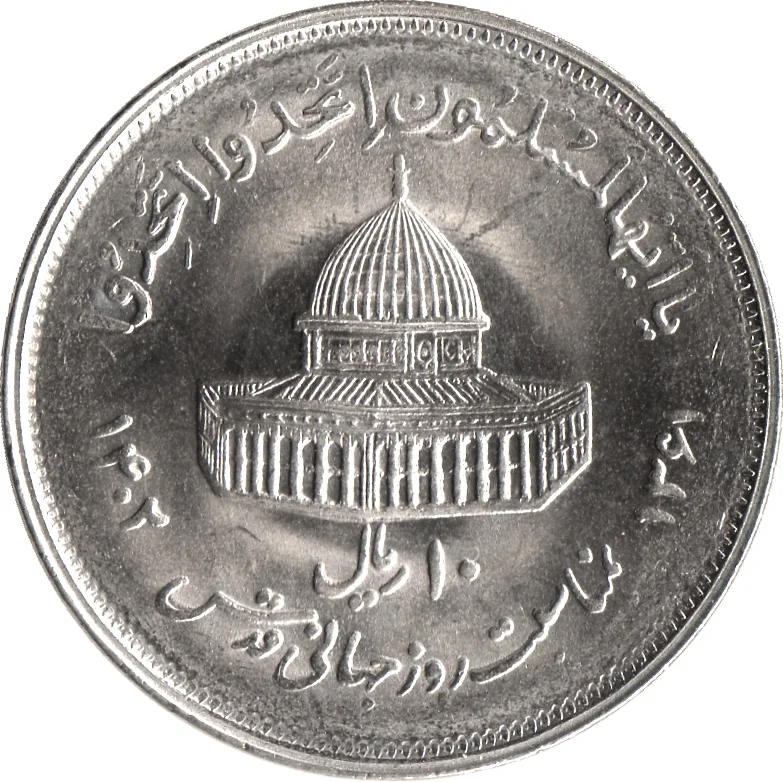
Commemoration: World Jerusalem Day
Iran
Context
Material
Diameter: 27.75 mm
Weight: 6.97 g
Thickness: 1.72 mm
Shape: Round
Composition: Copper-nickel
Technique: Milled
Alignment: Coin alignment
flip
References
KM: #
Numista: #1685
Value
Exchange value: 10 IRR
Obverse
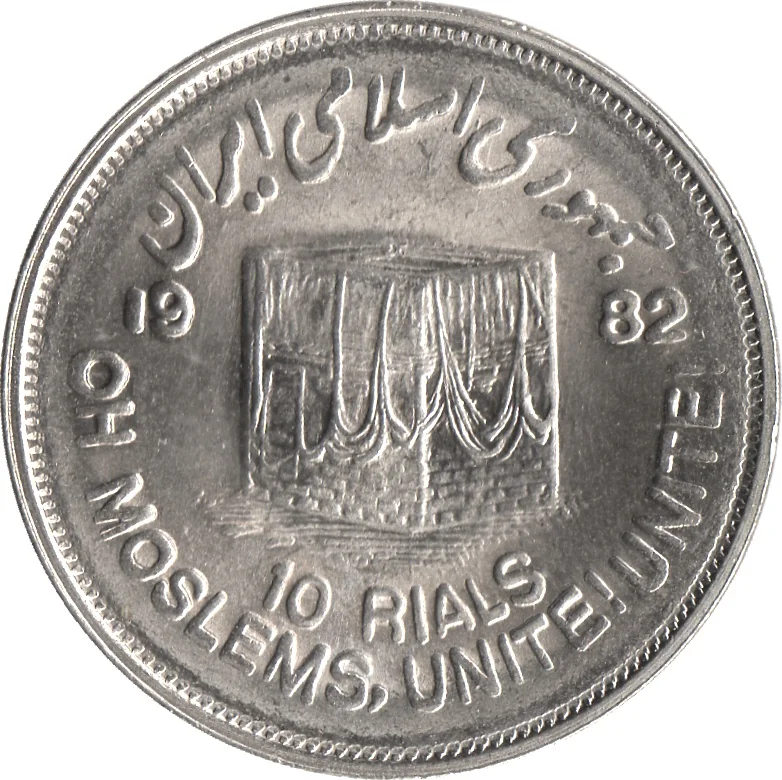
Description:
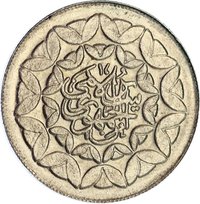
Kaaba design
Inscription:
جمهوری اسلامی ايران
1982
10 RIALS
OH MOSLEMS, UNITE! UNITE!
1982
10 RIALS
OH MOSLEMS, UNITE! UNITE!
Translation:
ISLAMIC REPUBLIC OF IRAN
1982
10 RIALS
OH MOSLEMS, UNITE! UNITE!
1982
10 RIALS
OH MOSLEMS, UNITE! UNITE!
Language: Persian
Reverse
Edge
Reeded
Categories
| Building> Religious building |
Mintings
| Year | Mint Mark | Mintage | Quality | Collection |
|---|---|---|---|---|
| 1982 | — | — |
Historical background
In 1982, Iran's currency situation was dominated by the profound economic strains of the ongoing Iran-Iraq War, which had begun in 1980. The conflict diverted vast resources to the military, crippling oil exports—the country's primary source of foreign exchange—and devastating infrastructure. This led to severe budget deficits, which the government financed primarily by expanding the money supply, laying the groundwork for persistent and rising inflation. While the official exchange rate for the Iranian rial was fixed by the government, a thriving black market for foreign currency emerged, with rates diverging sharply from the official peg to reflect the true scarcity of hard currency and declining confidence.
The government maintained a complex multi-tiered exchange rate system, a policy that would become more formalized in subsequent years. An official rate was used for essential imports like food and medicine, while other rates applied to different transactions. This system was intended to conserve foreign reserves and shield the population from the full shock of devaluation, but it created major distortions. It encouraged corruption and rent-seeking, as access to cheaper foreign currency at the preferential rates became a lucrative privilege. The economic reality was one of growing scarcity, with war-related shortages affecting basic goods and inflationary pressures eroding purchasing power.
Despite the pressures, a full-blown hyperinflation or currency collapse was avoided in 1982, largely due to strict state controls on the economy and the population's wartime resilience. However, the fundamental imbalances set during this period established a troubling trajectory. The policies of monetary expansion, currency overvaluation, and a multi-layered exchange regime, initially framed as wartime necessities, became entrenched features of Iran's economy. The currency distortions and inflationary habits of 1982 thus sowed the seeds for the chronic economic challenges that would plague Iran for decades to come.
The government maintained a complex multi-tiered exchange rate system, a policy that would become more formalized in subsequent years. An official rate was used for essential imports like food and medicine, while other rates applied to different transactions. This system was intended to conserve foreign reserves and shield the population from the full shock of devaluation, but it created major distortions. It encouraged corruption and rent-seeking, as access to cheaper foreign currency at the preferential rates became a lucrative privilege. The economic reality was one of growing scarcity, with war-related shortages affecting basic goods and inflationary pressures eroding purchasing power.
Despite the pressures, a full-blown hyperinflation or currency collapse was avoided in 1982, largely due to strict state controls on the economy and the population's wartime resilience. However, the fundamental imbalances set during this period established a troubling trajectory. The policies of monetary expansion, currency overvaluation, and a multi-layered exchange regime, initially framed as wartime necessities, became entrenched features of Iran's economy. The currency distortions and inflationary habits of 1982 thus sowed the seeds for the chronic economic challenges that would plague Iran for decades to come.
🌱 Common