


Obverse
Description:
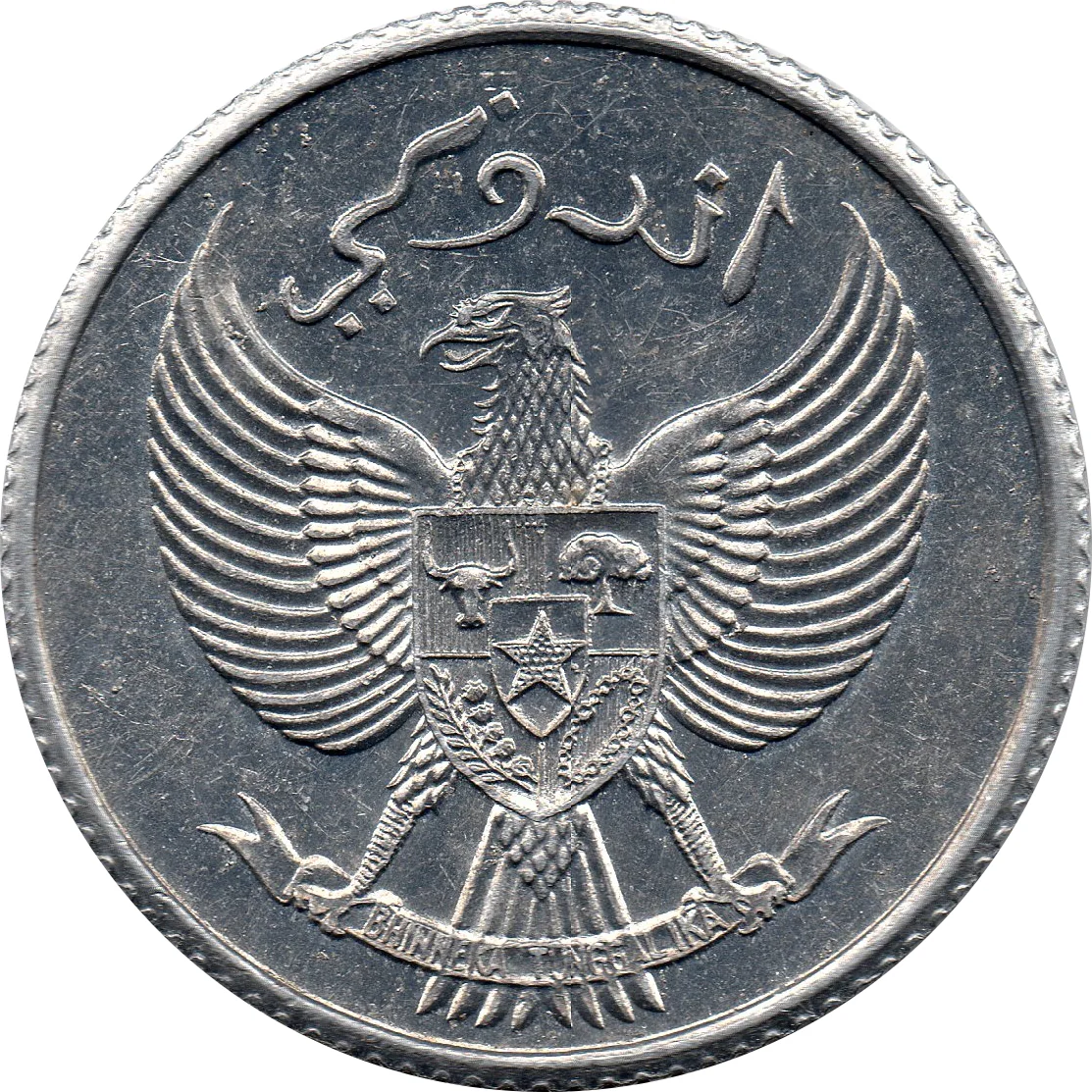
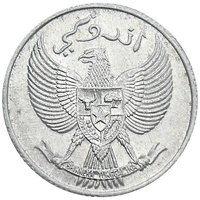
Indonesia's national emblem: Garuda Pancasila.
Inscription:
إندونيسيا
BHINNEKA TUNGGAL IKA
BHINNEKA TUNGGAL IKA
Translation:
Indonesia
Unity in Diversity
Unity in Diversity
Languages: Indonesian, Javanese
Engraver: A. de Bruin
Reverse
Description:
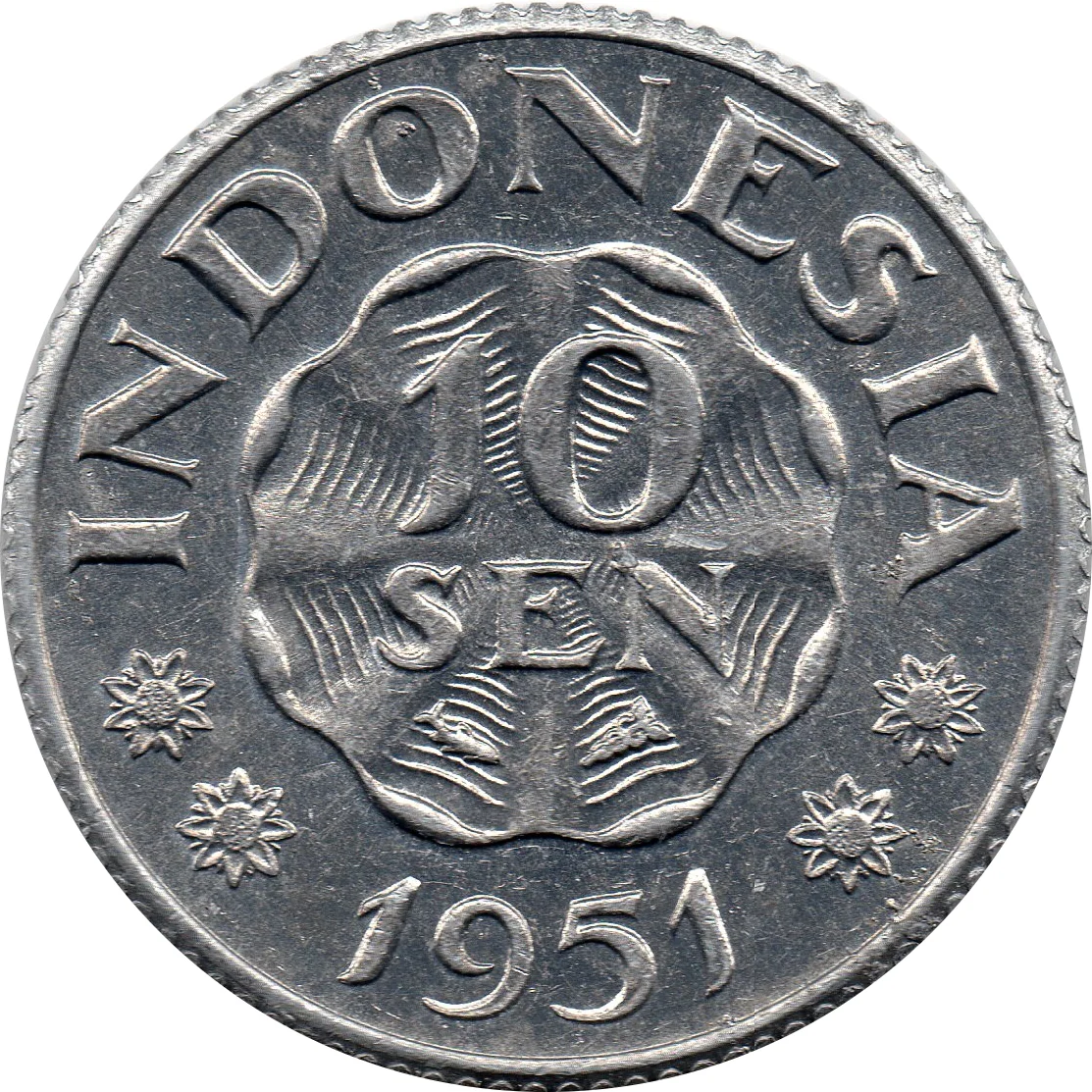
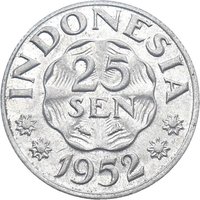
Denomination within scallops, ornaments flank date.
Inscription:
INDONESIA
10
SEN
1951
10
SEN
1951
Script: Latin
Engraver: Ludwig Oswald Wenckebach
Edge
Reeded
Categories
| Symbols> Coat of Arms |
Mints
| Name | Mark |
|---|---|
| Royal Dutch Mint | — |
Mintings
| Year | Mint Mark | Mintage | Quality | Collection |
|---|---|---|---|---|
| 1951 | — | 250,000,000 | ||
| 1954 | — | 50,000,000 |
Historical background
In 1951, Indonesia was grappling with the severe economic and monetary challenges of its early post-independence years. The nation had just secured sovereignty from the Netherlands in December 1949, inheriting a fragmented financial system. Multiple currencies were in circulation: the Indonesian rupiah (ORI), which the Republican government had introduced during the revolution, coexisted with leftover Dutch guilders and even Japanese occupation currency in some areas. This monetary chaos was compounded by the costs of the independence struggle, a weak tax base, and the burden of assuming the debt of the former Dutch East Indies government through the Round Table Conference agreement.
The primary economic policy of the time, the "Rencana Sumitro" or Sumitro Plan (named after Finance Minister Sumitro Djojohadikusumo), aimed to rationalize this system and foster indigenous entrepreneurship. However, 1951 was marked by a sharp turn due to the Korean War boom. A dramatic spike in global prices for Indonesia's key exports—rubber, tin, and petroleum—caused a sudden influx of foreign exchange earnings. This windfall created a surge in the money supply, leading to intense inflationary pressures that eroded the rupiah's value and hurt the majority of the population. The government's attempt to stabilize by importing consumer goods was insufficient to curb the rising cost of living.
Consequently, the currency situation remained precarious and symptomatic of a fledgling state. While the export boom filled state coffers temporarily, it exposed the economy's vulnerability to commodity price swings and highlighted the lack of monetary control. The inflationary spiral of 1951 undermined stability, creating social discontent and setting the stage for the more interventionist "Benteng" program and subsequent debates over nationalization that would characterize the rest of the decade. The year thus represented a turbulent transition from revolutionary currency to a unified national monetary system, a process fraught with external shocks and internal structural weaknesses.
The primary economic policy of the time, the "Rencana Sumitro" or Sumitro Plan (named after Finance Minister Sumitro Djojohadikusumo), aimed to rationalize this system and foster indigenous entrepreneurship. However, 1951 was marked by a sharp turn due to the Korean War boom. A dramatic spike in global prices for Indonesia's key exports—rubber, tin, and petroleum—caused a sudden influx of foreign exchange earnings. This windfall created a surge in the money supply, leading to intense inflationary pressures that eroded the rupiah's value and hurt the majority of the population. The government's attempt to stabilize by importing consumer goods was insufficient to curb the rising cost of living.
Consequently, the currency situation remained precarious and symptomatic of a fledgling state. While the export boom filled state coffers temporarily, it exposed the economy's vulnerability to commodity price swings and highlighted the lack of monetary control. The inflationary spiral of 1951 undermined stability, creating social discontent and setting the stage for the more interventionist "Benteng" program and subsequent debates over nationalization that would characterize the rest of the decade. The year thus represented a turbulent transition from revolutionary currency to a unified national monetary system, a process fraught with external shocks and internal structural weaknesses.

🌱 Very Common