

100 rupiah – Indonesia
Add to wishlist
Indonesia
Context
Material
References
KM: #
Numista: #1678
Value
Exchange value: 100 IDR
Inflation-adjusted value: 492.19 IDR
Obverse
Description:
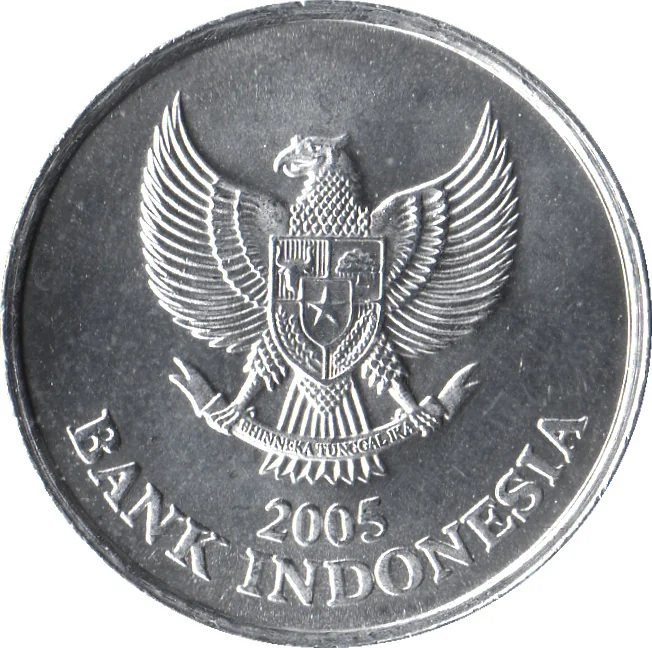
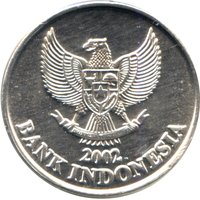
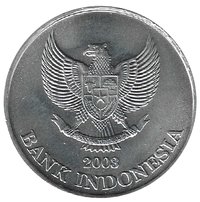
Indonesia's national emblem (Garuda Pancasila) with the date above and issuer name below.
Inscription:
BHINNEKA TUNGGAL IKA
2005
BANK INDONESIA
2005
BANK INDONESIA
Translation:
Unity in Diversity
2005
Bank Indonesia
2005
Bank Indonesia
Script: Latin
Languages: Indonesian, Javanese
Reverse
Description:
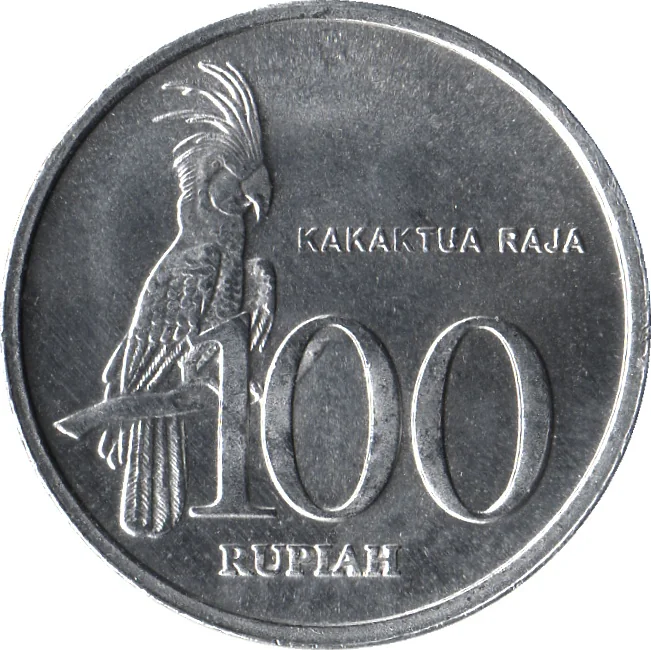
Black Palm Cockatoo (Probosciger aterrimus)
Inscription:
KAKAKTUA RAJA
100
RUPIAH
100
RUPIAH
Translation:
One Hundred Rupiah
Script: Latin
Languages: Malay, Indonesian
Edge
Plain
Categories
| Animal> Bird |
| Symbols> Coat of Arms |
Mints
| Name | Mark |
|---|---|
| Perum Peruri | — |
Mintings
| Year | Mint Mark | Mintage | Quality | Collection |
|---|---|---|---|---|
| 1999 | — | — | ||
| 1999 | — | — | Proof | |
| 2000 | — | — | ||
| 2001 | — | — | ||
| 2002 | — | — | ||
| 2003 | — | — | ||
| 2004 | — | — | ||
| 2005 | — | — |
Historical background
In 1999, Indonesia's currency, the rupiah (IDR), was in a fragile state of recovery following the devastating Asian Financial Crisis that began in mid-1997. The crisis had caused the rupiah to collapse from around 2,400 per US dollar to a low of nearly 17,000 at its worst point in 1998, triggering hyperinflation, a deep economic contraction, and social turmoil. By 1999, the currency had stabilized significantly, trading in a range of approximately 7,000 to 8,000 IDR/USD, but this "stability" was tenuous and remained far weaker than pre-crisis levels.
This relative calm was underpinned by a combination of factors. Domestically, the political transition from President Suharto's 32-year authoritarian rule to the democratic government of President B.J. Habibie (and later Abdurrahman Wahid) brought a measure of political stability. Internationally, a massive $43 billion bailout package from the International Monetary Fund (IMF), tied to strict structural reforms, provided critical external support. The central bank, Bank Indonesia, maintained high interest rates to defend the currency and curb inflation, which had begun to recede from its crisis peak.
However, the situation remained fraught with challenges. The banking sector was crippled by bad debts, requiring a costly and ongoing restructuring. Corporate foreign-currency debt burdens were immense, and investor confidence was still skittish, sensitive to political uncertainties and the pace of reform. Consequently, while the freefall had been arrested, the rupiah in 1999 was a symbol of an economy in a painful and incomplete convalescence, vulnerable to setbacks on the long road to recovery.
This relative calm was underpinned by a combination of factors. Domestically, the political transition from President Suharto's 32-year authoritarian rule to the democratic government of President B.J. Habibie (and later Abdurrahman Wahid) brought a measure of political stability. Internationally, a massive $43 billion bailout package from the International Monetary Fund (IMF), tied to strict structural reforms, provided critical external support. The central bank, Bank Indonesia, maintained high interest rates to defend the currency and curb inflation, which had begun to recede from its crisis peak.
However, the situation remained fraught with challenges. The banking sector was crippled by bad debts, requiring a costly and ongoing restructuring. Corporate foreign-currency debt burdens were immense, and investor confidence was still skittish, sensitive to political uncertainties and the pace of reform. Consequently, while the freefall had been arrested, the rupiah in 1999 was a symbol of an economy in a painful and incomplete convalescence, vulnerable to setbacks on the long road to recovery.
🌱 Very Common