

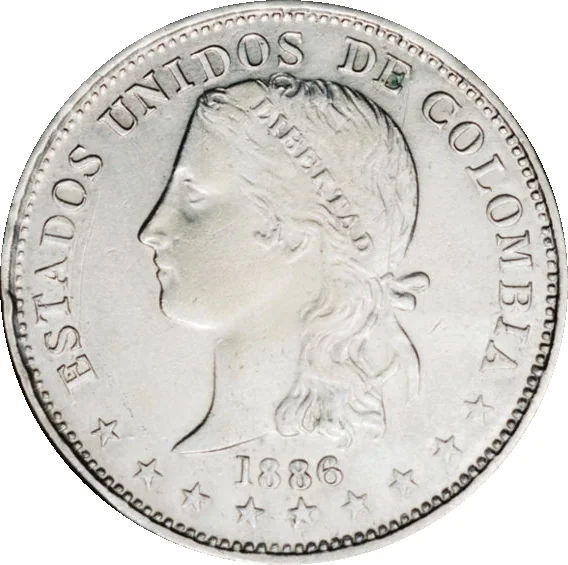

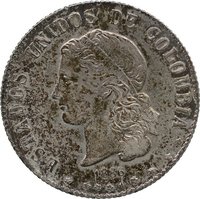
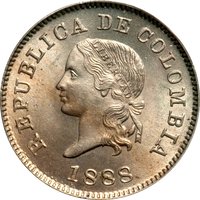
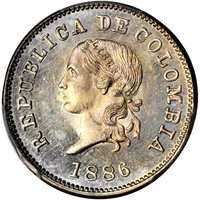
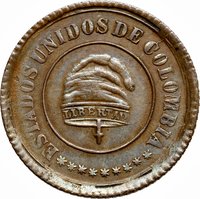
Obverse
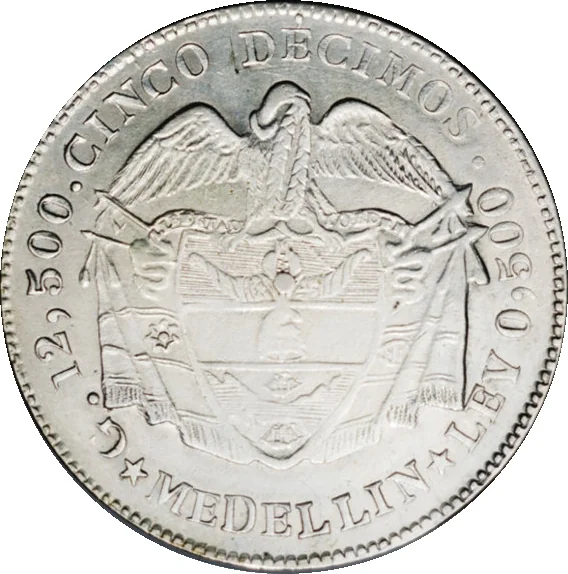
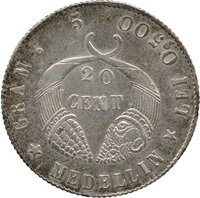
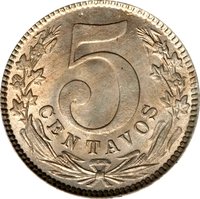
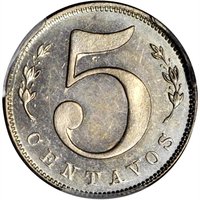
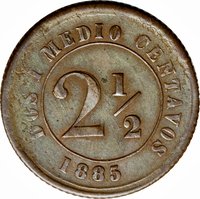
Reverse
Description:
Condor over heraldic flags.
Inscription:
G. 12,500 .CINCO DECIMOS.
*MEDELLIN* LEV 0,500
*MEDELLIN* LEV 0,500
Script: Latin
Edge
Categories
| Symbol> Allegory |
| Symbols> Coat of Arms |
Mintings
| Year | Mint Mark | Mintage | Quality | Collection |
|---|---|---|---|---|
| 1886 | — | — |
Historical background
In 1886, Colombia’s currency situation was characterized by profound disorder and fragmentation, a direct legacy of the political instability following the dissolution of Gran Colombia and decades of civil conflict. The country operated without a unified national currency; instead, a chaotic mix of foreign and domestic coins circulated. These included Spanish colonial doubloons, French francs, British sovereigns, and Peruvian pesos, alongside various privately issued banknotes from numerous, often unstable, commercial banks. This monetary anarchy created severe problems for commerce and taxation, as exchange rates fluctuated wildly and counterfeiting was rampant, undermining economic confidence and integration.
The political context of 1886 was pivotal, as it marked the adoption of a new centralist constitution that established the Republic of Colombia, ending the United States of Colombia era. This political recentralization under President Rafael Núñez created the necessary conditions for monetary reform. The new government recognized that a strong, unified state required control over the currency as a symbol of sovereignty and a tool for economic policy. Consequently, the same year saw the foundational step toward reform with the establishment of the Banco Nacional, granted the exclusive right to issue banknotes, aiming to phase out the multitude of private and foreign currencies in circulation.
However, the reform process was gradual and faced significant hurdles. The Banco Nacional's notes did not immediately supplant the existing monetary jungle, and the state's fiscal weaknesses limited its ability to enforce a uniform currency. The promised gold standard, intended to provide stability, remained an aspiration rather than a reality in 1886. Thus, while the year stands as a critical turning point—laying the legal and institutional groundwork for the future monetary system—the actual circulation remained a complex and unstable patchwork, with true unification and stability only emerging in the subsequent decades through further reforms and the eventual creation of the Banco de la República in 1923.
The political context of 1886 was pivotal, as it marked the adoption of a new centralist constitution that established the Republic of Colombia, ending the United States of Colombia era. This political recentralization under President Rafael Núñez created the necessary conditions for monetary reform. The new government recognized that a strong, unified state required control over the currency as a symbol of sovereignty and a tool for economic policy. Consequently, the same year saw the foundational step toward reform with the establishment of the Banco Nacional, granted the exclusive right to issue banknotes, aiming to phase out the multitude of private and foreign currencies in circulation.
However, the reform process was gradual and faced significant hurdles. The Banco Nacional's notes did not immediately supplant the existing monetary jungle, and the state's fiscal weaknesses limited its ability to enforce a uniform currency. The promised gold standard, intended to provide stability, remained an aspiration rather than a reality in 1886. Thus, while the year stands as a critical turning point—laying the legal and institutional groundwork for the future monetary system—the actual circulation remained a complex and unstable patchwork, with true unification and stability only emerging in the subsequent decades through further reforms and the eventual creation of the Banco de la República in 1923.
Series: 1886 Colombia circulation coins
✨ Legendary