

1 bu – Kubota Domain
Add to wishlist
Japan
Context
Material
Weight: 8.7 g
Silver Weight:: 7.83 g
Shape: Irregular rectangular
Magnetic: No
Technique: Hammered
Alignment: Medal alignment
flip
References
KM: #
Numista: #16667
Value
Bullion value: $19.85
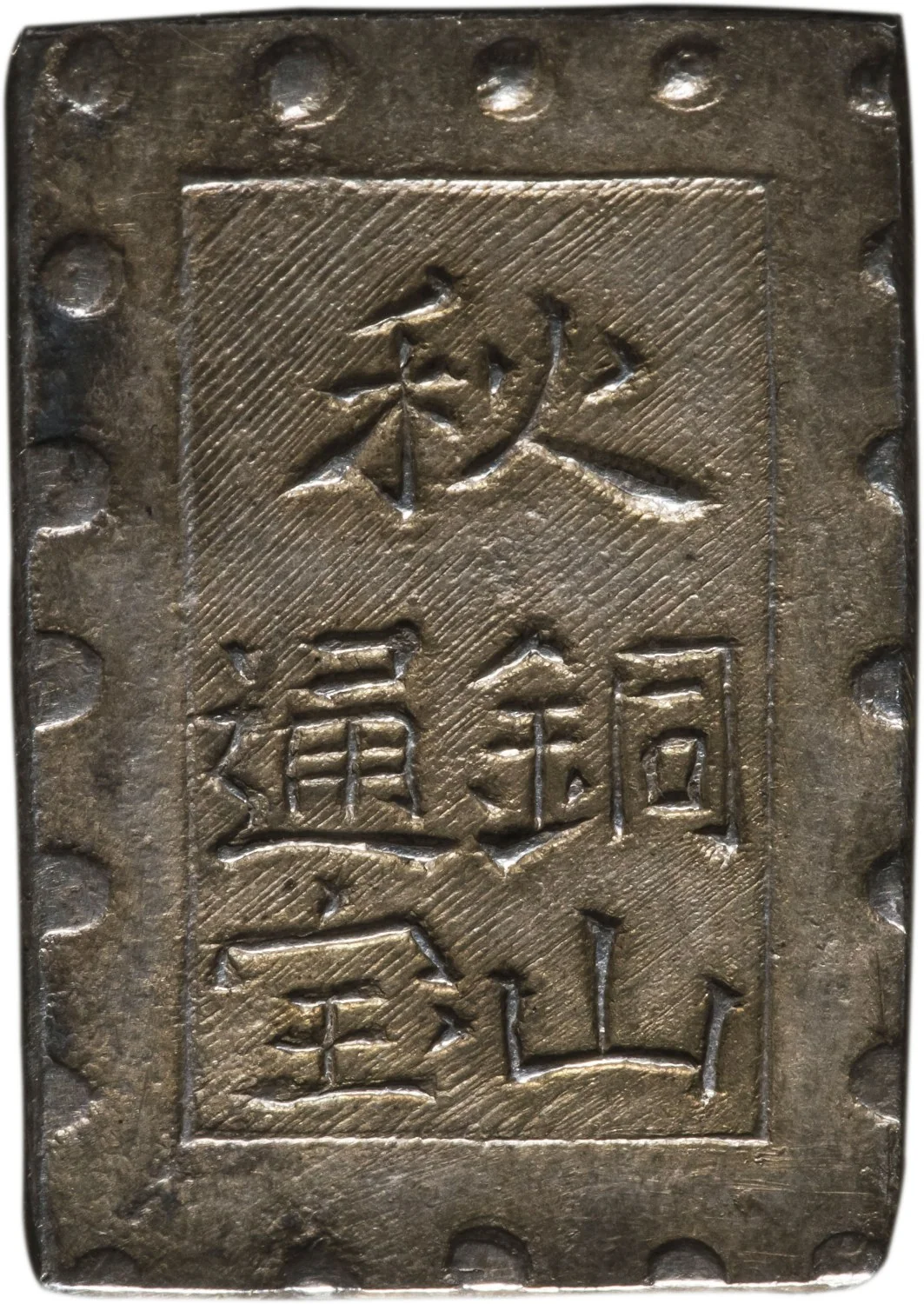
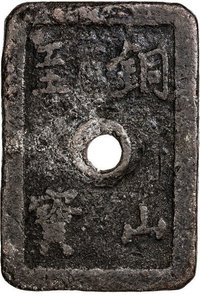
Obverse
Description:
Five figures in a pearl-framed rectangle.
Inscription:
秋
通銅
宝山
通銅
宝山
Translation:
Autumn Coin
Tongbao Mountain
Tongbao Mountain
Language: Chinese
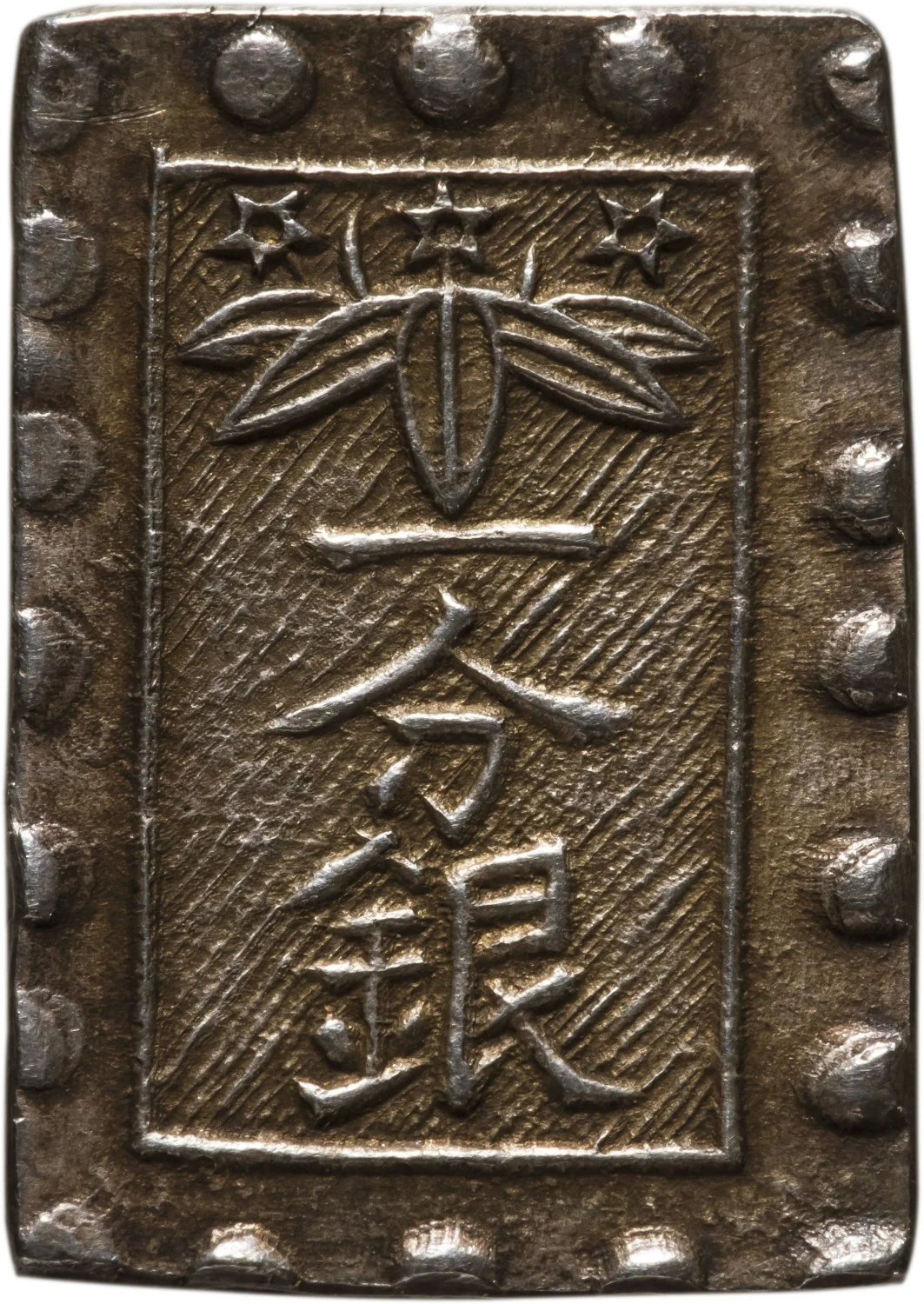
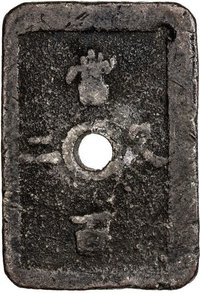
Reverse
Description:
Satake family bamboo crest above "value" characters, within a pearl-bordered rectangle.
Inscription:
一
分
銀
分
銀
Translation:
One Fen Silver
Language: Chinese
Edge
Mintings
| Year | Mint Mark | Mintage | Quality | Collection |
|---|---|---|---|---|
| 1868 | — | — |
Historical background
In 1868, the Kubota Domain (also known as the Akita Domain), under the rule of the Satake clan, faced a complex and precarious currency situation typical of many domains in the final year of the Tokugawa shogunate. Like other han, Kubota issued its own local paper currency, known as hansatsu, which circulated within its borders. This system created a fragmented monetary landscape across Japan, where domain notes were often not accepted elsewhere and their value fluctuated based on the domain's economic strength and silver reserves. For Kubota, a large but relatively remote domain in the northeast, maintaining confidence in its currency was a constant challenge, especially as the national economy strained under foreign trade and internal unrest.
The outbreak of the Boshin War (1868–1869) and the Meiji Restoration critically destabilized this already fragile system. Kubota, as a member of the Northern Alliance (Ōuetsu Reppan Dōmei) that opposed the new imperial forces, found itself on the losing side of the conflict. This political and military defeat had immediate financial consequences: the domain's hansatsu risked becoming worthless as the new Meiji government moved to centralize power and abolish the feudal system. The domain's finances were further exhausted by the costs of war mobilization and the subsequent penalties imposed by the victorious imperial government.
Recognizing the inevitable, the Meiji government began a rapid process of monetary unification in 1868, declaring all hansatsu to be gradually retired and replaced with a new, national currency. For Kubota, this meant its local currency entered a state of terminal decline, to be exchanged at rates determined by the central authorities. This transition, while necessary for modernizing Japan's economy, placed significant hardship on the domain's samurai and merchant classes, whose wealth and transactions were tied to the soon-to-be-obsolete notes. Thus, 1868 marked the abrupt end of Kubota's centuries-old right to issue money, symbolizing the swift dissolution of its autonomous feudal economy into the emerging nation-state of Japan.
The outbreak of the Boshin War (1868–1869) and the Meiji Restoration critically destabilized this already fragile system. Kubota, as a member of the Northern Alliance (Ōuetsu Reppan Dōmei) that opposed the new imperial forces, found itself on the losing side of the conflict. This political and military defeat had immediate financial consequences: the domain's hansatsu risked becoming worthless as the new Meiji government moved to centralize power and abolish the feudal system. The domain's finances were further exhausted by the costs of war mobilization and the subsequent penalties imposed by the victorious imperial government.
Recognizing the inevitable, the Meiji government began a rapid process of monetary unification in 1868, declaring all hansatsu to be gradually retired and replaced with a new, national currency. For Kubota, this meant its local currency entered a state of terminal decline, to be exchanged at rates determined by the central authorities. This transition, while necessary for modernizing Japan's economy, placed significant hardship on the domain's samurai and merchant classes, whose wealth and transactions were tied to the soon-to-be-obsolete notes. Thus, 1868 marked the abrupt end of Kubota's centuries-old right to issue money, symbolizing the swift dissolution of its autonomous feudal economy into the emerging nation-state of Japan.
✨ Legendary